The gray, swirled ball hanging in a barn rafter is made of paper, and the wasps make that paper themselves by chewing wood. Slow-motion clips of a European wasp nest being opened on a farm keep drawing viewers because the inside looks engineered: stacked horizontal combs wrapped in a shell of thin, layered sheets. Here is how the insects build it, using what is documented about the two species most often called the European wasp.
Which wasp is it?
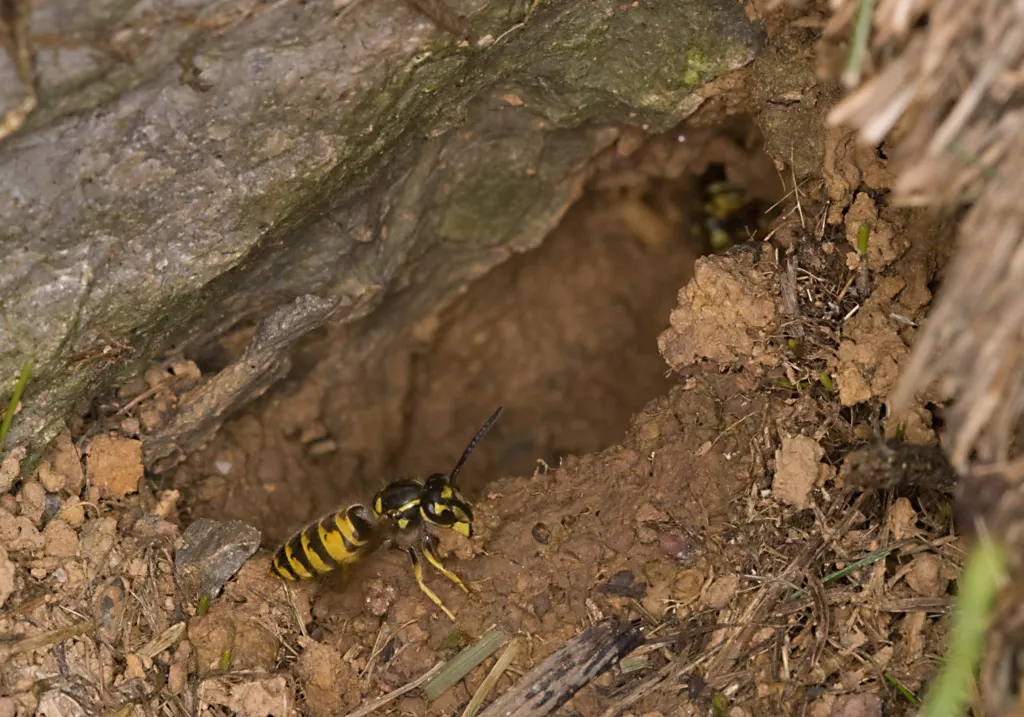
“European wasp” is a loose name. It usually means Vespula germanica, also called the German wasp or German yellowjacket, but it is sometimes used for Vespula vulgaris, the common wasp. Both are black-and-yellow, about half an inch long, and build near-identical paper nests. Neither is a true paper wasp, a separate group, even though their nests are paper too. Up close, a German wasp worker has three tiny black dots on its face, while a common wasp worker usually has a single anchor-shaped mark.
Step one: chewing wood into pulp
Workers rasp fibers from wood with their jaws and mix them with saliva, producing a pulp that dries into brittle paper. In V. germanica, gathering pulp is one of the standard jobs a worker cycles through, after nest work and before foraging for sugar and then for protein.
Step two: the queen’s starter nest
Every nest begins with one queen in spring. A common wasp queen flies in with a load of pulp, presses it onto the site, and flies out for more, clinging with her back two pairs of legs while she shapes the paper with her front legs and mouthparts. She builds a short stalk called a petiole, hangs a single cell from it, then adds six more around it to set the six-sided pattern. She makes 20 to 30 cells before laying her first eggs.
The petiole has a defense built in. The wasps coat its base with a chemical that repels ants.
Step three: the layered envelope
As workers take over, the nest grows downward in tiers of combs, and the whole structure is wrapped in an envelope of paper sheets. That shell is the striped, scalloped surface the slow-motion clips linger on.
Its thickness is not random. Hanging nests and those near the ground surface get much thicker envelopes than nests buried underground, and small nests get thicker walls than large ones. The reason is heat. The colony keeps its core near 32 C (90 F), and a bigger nest holds warmth more easily because the heat it produces scales with its volume. On hot days, workers fan their wings to cool it down.
How big these paper cities get
- A common wasp colony raises 3,000 to 8,000 larvae in a season, with the queen laying about 200 to 300 eggs a day.
- A typical British German wasp nest holds 6,100 to 6,500 small worker cells and about 1,500 large cells across roughly eight combs.
- In Australia’s milder climate, the average nest has more than 9,500 small cells and 3,600 large ones, and many survive the winter.
Late in summer, workers switch to cells 30 to 40% larger to raise new queens and males. In a cold climate the colony then collapses, and the nest is not reused the next year.
A word of caution before filming your own
Common wasps can sting more than once, and workers defend a disturbed nest hard when they sense a serious threat. Opening a live nest is a job for professionals, not a phone camera. For more on how insects shape their homes, read about ant species sorting themselves by heat in Paris parks, or browse more in Pets & Animals.
Even a busy nest can have squatters. Bee moths lay eggs in German wasp nests, and their hatched larvae feed on unguarded wasp brood, sometimes tunneling through and destroying large parts of the paper.
Further reading
Image: pjt56, CC BY 3.0 via Wikimedia Commons
This article was produced with AI assistance and reviewed by our Editorial Desk. How we work.