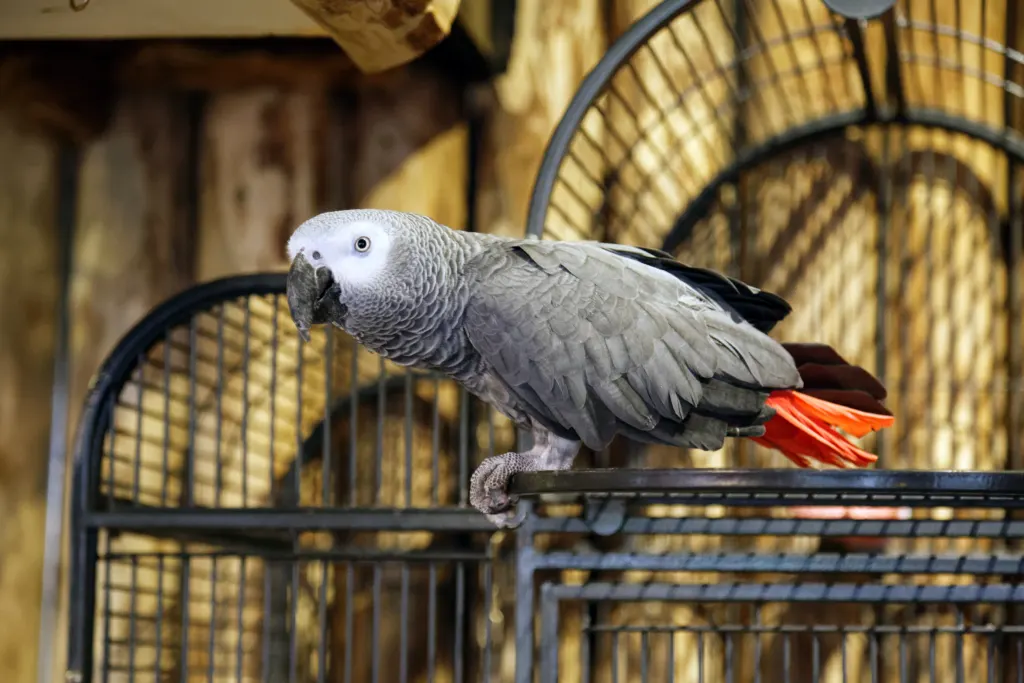
Hold up a cork and ask an African grey parrot what it is made of, and some of these birds will tell you. Clips of Apollo, a grey parrot in Florida, naming objects and the materials they are made from keep circulating online, and they are the latest chapter in a line of research that began with a bird bought at a pet shop in 1977.
Apollo, the toddler-level talker
Apollo hatched in April 2020. Tori and Dalton Mason bought him in December 2020 from a pet shop in St. Petersburg, Florida, for $1,700, after a previous owner surrendered him. Their YouTube channel, Apollo and Frens, had about 1.84 million subscribers and around 1 billion views as of April 2026.
The Masons describe Apollo’s general intelligence as similar to a human toddler. He knows the basic colors, a few materials and many nouns, and answers questions such as “what’s this?”, “what color?” and “what made of?” Researchers at Eckerd College in St. Petersburg have partnered with the couple on a project titled “Assessing Object Identity and Material Recognition in an African Grey Parrot.”
He also has a record. On December 18, 2023, Guinness World Records approved a custom title for the most items identified by a parrot in three minutes after Apollo correctly named 12 objects, among them a bug, a book and socks, and the record entered the book in August 2024.
Alex, the parrot who started it
None of this would look familiar without Alex. Animal psychologist Irene Pepperberg bought him at about one year old and worked with him for three decades at Purdue University, the University of Arizona, Harvard and Brandeis. His name stood for avian language experiment, or avian learning experiment.
By 1999, Pepperberg reported, Alex could identify 50 objects, recognize quantities up to six, tell apart seven colors and five shapes, and handle the ideas of bigger, smaller, same and different. Ask him what a thing was made of, or which color or shape it had, and he could usually say. He described a key as a key regardless of its size or color. In research tests, he answered correctly about 80% of the time.
Some of his moments became famous. Looking in a mirror, he asked “What color?” and learned the word grey after hearing it six times. In 2005, Pepperberg reported he understood a zero-like concept, answering “None” when two objects had no difference. He died on September 6, 2007, at age 31, well short of the 45-year average lifespan for a grey parrot in captivity.
The training method both birds share
Apollo is trained with Pepperberg’s model/rival technique. Two trainers act out the lesson: one asks, the other answers and competes with the bird for attention. A correct answer earns the object itself rather than a snack, which ties the word directly to the thing. Trainers sometimes answer wrong on purpose so the bird sees the object taken away.
The Masons changed one thing. Alex lived in a lab where tests had to be repeated for statistics. Apollo lives at home, and Tori Mason has said, “[Apollo] lets us know what he wants to learn.”
Smart, or well trained?
The skeptics have a point worth weighing. Pepperberg never claimed Alex used language, calling it a two-way communication code instead. Herbert Terrace, who worked with the chimpanzee Nim Chimpsky, argued that Alex performed by rote, calling it “a complex discriminating performance.” A short viral clip cannot settle that debate, because it shows a bird’s best answers rather than its misses.
Still, parrots keep surprising researchers, much as carrion crows deciding in 235 milliseconds did this week. For more on how pets talk to people, read about cats meowing four times as often when a person is nearby. Apollo, meanwhile, earns his treats in pistachios, which he calls “pistache.”
Further reading
Image: Acabashi, CC BY-SA 4.0 via Wikimedia Commons
This article was produced with AI assistance and reviewed by our Editorial Desk. How we work.