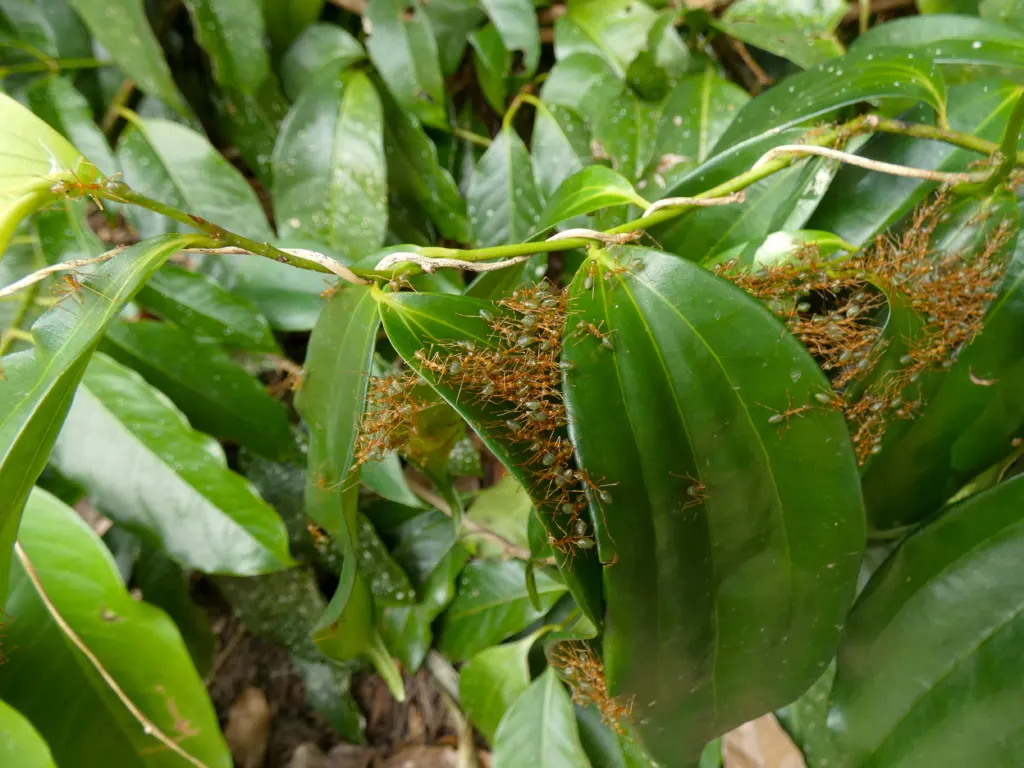
A weaver ant cannot lift a mango leaf on its own, so it borrows its sisters’ bodies. In clips that keep circulating online, rows of orange-brown ants hang off a leaf edge, each one gripping the waist of the ant ahead, and slowly haul the leaf over until it meets its neighbor. The behavior is real, it is well studied, and it ends with the ants using their own larvae as glue guns.
Weaver ants belong to the genus Oecophylla. Two living species do the leaf work: O. longinoda in tropical Africa and O. smaragdina, which ranges from India and Sri Lanka through Southeast Asia to northern Australia, where some workers carry bright green abdomens and are called green ants.
Step by step: how a leaf nest goes up
- Testing. Major workers, about 8 to 10 millimeters long, walk the edges of candidate leaves and tug on them with their mandibles.
- Recruiting. Once a few ants manage to bend a leaf, nearby workers pile in. The bigger the group already pulling, the more likely a passing ant is to join.
- Chaining. When the gap is wider than one ant can span, workers link up by grabbing one another’s narrow waist, and several chains can pull side by side in a ratchet-like rhythm.
- Stitching. Other workers fetch larvae from an older nest, hold them at the seam and tap their heads. The larvae release silk, and the workers weave it back and forth to bind the leaves.
The larvae pay a price. They can only make a limited amount of silk, so those drafted into construction later pupate without a cocoon.
Why the ants start at the tip
A 2014 study from James Cook University in Townsville, Australia, offered colonies a paper “leaf” with one pointed tip and one rounded side, then filmed what happened. Workers did not pick spots at random. In 11 of the 13 trials where biting began, the first ant grabbed the tip side, against only two on the rounded side. Later arrivals clustered next to ants already pulling, in both space and time.
Researchers Thomas Bochynek and Simon Robson described the payoff of that clustering as positive feedback. In one filmed colony, a group gathered at the tip about 350 seconds into the trial and began rolling the paper inward at 460 seconds. A rival group on the rounded edge never managed to bend it at all. The authors call nest weaving “one of the pinnacles of cooperative behaviour in social insects.”
What 18th-century sailors saw
The first written account may come from Joseph Banks, the naturalist on Captain James Cook’s voyage to Australia in 1768. He watched green ants bend leaves broader than a man’s hand and wrote that “many thousands indeed are employed in the joint work.” When he disturbed some of the pullers, the leaf sprang back, which proved to him it had been held down by force.
Big colonies, fast builds
Here is the scale that makes the clips so striking. One colony can spread across many trees, with more than 100 nests and over half a million workers. A large nest can stretch more than half a meter and go up in well under 24 hours. Ant teams that add muscle as they grow also come up in recent robotics research, which describes the ants as a “force ratchet” where some pull while others anchor.
People have put that teamwork to use for centuries. Farmers in China and Southeast Asia have used weaver ants to guard citrus orchards from at least 400 AD, because the ants kill leaf-eating insects. For more on how ant species respond to their surroundings, see our story on heat-loving ants taking over Paris parks, and browse more animal stories in Pets & Animals.
In northeastern Thailand, weaver ant larvae are a delicacy that sells for twice the price of good beef, and one province harvests about $620,000 worth each year.
Further reading
- Wikipedia: Weaver ant
- PLOS One: Pulling chain formation in the nest-weaving ant Oecophylla smaragdina
Image: Steve Fitzgerald, CC BY-SA 4.0 via Wikimedia Commons
This article was produced with AI assistance and reviewed by our Editorial Desk. How we work.