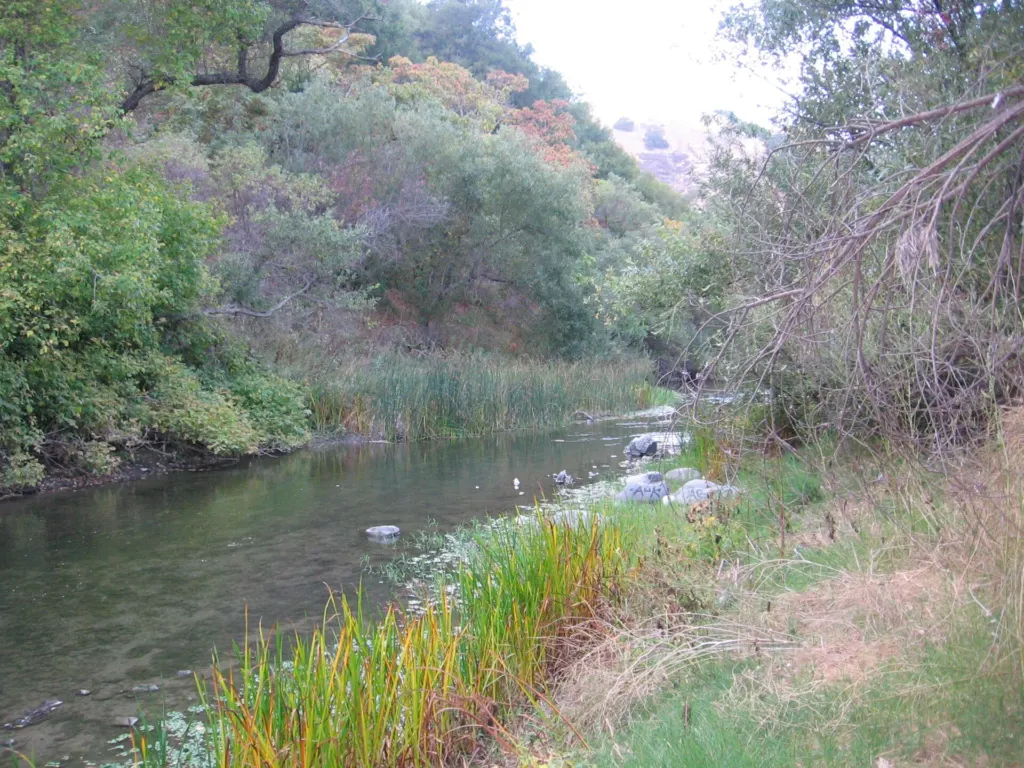
Two Chinook salmon, each somewhere between 12 and 24 inches long, swam past a buried gas pipeline in California’s Sunol Valley on November 19, 2025, roughly 20 miles up Alameda Creek from San Francisco Bay. Biologists working for the conservation group California Trout logged them as the first salmon known to have reached that stretch under their own power since the 1950s. This fall is the first full migration season since the last man-made barrier on the main stem of the creek came out.
That moment took nearly three decades and, by the count of NOAA Fisheries, work at 18 separate barriers. Alameda Creek drains about 700 square miles of the East Bay and is the largest local tributary to the bay, which is why federal biologists describe it as once being the bay’s biggest producer of steelhead and Chinook.
How the creek was closed, and reopened
For readers outside the Bay Area, the short version: dams, rubber flood-control weirs, culverts and a concrete-capped pipeline cut the creek into pieces over the 20th century. Here is the sequence, assembled from the agencies’ own records.
- 1925: Calaveras Dam is built on a tributary; steelhead have had no route above it since.
- 1964 and 1967: the last 20th-century steelhead and coho runs are seen in the lower creek, and 1967 is the final recorded steelhead sighting upstream.
- Early 1970s: the Army Corps of Engineers turns the bottom 12 miles into a riprap-lined flood channel.
- 1997 to 1999: Bay Area steelhead are listed as threatened, Jeff Miller founds the Alameda Creek Alliance, and a workgroup of water agencies, regulators and volunteers forms.
- 2006: the San Francisco Public Utilities Commission (SFPUC) takes out the old Sunol and Niles dams.
- 2018 and 2019: a fish ladder opens at the rebuilt Alameda Creek Diversion Dam, timed releases from Calaveras begin, and the Alameda County Water District finishes a ladder around an inflatable rubber dam in Fremont.
- April 2022: a second ladder lets fish climb the 12-foot concrete drop at the BART weir, the lowest big obstacle.
- Summer to fall 2025: PG&E moves its pipeline about 100 feet downstream, buries it some 20 feet under the bed, and crews regrade roughly 1,800 feet of channel to erase an 8-foot drop.
NOAA’s Office of Habitat Conservation put $4.3 million into that final pipeline job, with PG&E and private donors covering the rest. The two lower ladders were built with close to $10 million in state grants.
What the fish are actually doing
The salmon are the visible part. Miller has said that the Chinook now turning up are probably hatchery strays rather than a native run, but they still carry ocean nutrients into the stream when they spawn and die. The fish the restoration was really designed for is the steelhead, the sea-going form of rainbow trout.
There the numbers are early but striking. In the SFPUC’s annual trapping surveys, biologists caught and released an average of about 40 young steelhead a year from 2015 to 2023, then 2,600 in 2024. Divide one by the other and that is roughly 65 times the earlier yearly figure, in a single season. Those are juveniles heading out to sea, not adults coming back.
Adults remain scarce. In February 2026 a water district employee photographed a male and a female steelhead using a ladder in the lower creek, the first documented adults moving upstream past the old barriers on their own in decades. California Trout’s tag reader, a PIT antenna laid on the creek bed just above the former pipeline, had still not recorded a single adult steelhead as of May 2026. Federal biologists point out that steelhead travel mostly at night and untagged fish slip past unseen, so a silent antenna is not proof of absence.
Where things stand this fall
Partners are now concentrating on monitoring. The workgroup’s next projects include improving survival through the lower flood-control channel, restoring tidal marsh at the mouth and a pilot to bring beavers back, whose ponds hold cool water for young salmonids through dry summers. The SFPUC also plans an Alameda Creek Watershed Center with an exhibit on the fish passage work.
If you walk the 12-mile Alameda Creek Regional Trail between Niles and the bay this season, red, hook-jawed male Chinook are the ones to look for. Watch from the bank and leave spawning gravel alone. Miller has described what he is still waiting for: “I think the first time I actually find a spawning steelhead up there, I’ll probably fall down and start crying.”
Further reading
- Wikipedia: Alameda Creek
- NOAA Fisheries: Decades of Effort Restore Steelhead and Salmon Passage on California’s Alameda Creek
Image: Pedro Xing, CC0 via Wikimedia Commons
This article was produced with AI assistance and reviewed by our Editorial Desk. How we work.