Paris is quietly sorting its ants by heat tolerance. A team from Sorbonne Université and the CNRS collected 36,361 ants from 25 city parks and 24 rural forests around the French capital and found that the park communities lean toward species from warmer, more southern ranges. Their results appear in the Peer Community Journal.
The city did not lose ants overall. Each park held 8.96 species on average against 7.58 in each forest, a surprise the authors flag themselves. What changed was who lived there.
How the ants were counted
The researchers focused on litter ants, the small species that nest and forage in fallen leaves under trees and shrubs. In forests they picked sites with very different amounts of surrounding woodland, from 75 to 95% forest cover within a kilometer down to less than 5%. In Paris they sampled wooded patches in parks of three sizes, from 500 square meters up to 250,000.
The haul was split almost evenly: 18,094 ants from forests and 18,267 from parks, belonging to 29 species in 12 genera. Twenty-three species turned up in forests and 20 in parks. Fourteen lived in both, nine only in forests and six only in parks. Just one non-native species appeared, Lasius neglectus, and dropping it did not change the results.
To score heat preference, the team gave every species a value based on where Paris sits within its geographic range. A species at the northern edge of its range in Paris counts as more heat-loving than one at its southern edge.
What the city selects for
The park and forest communities barely overlapped. About 89% of the difference between them came from species swapping in and out rather than simple loss. Species that favored parks scored higher on the heat index, a statistically significant link. In the authors’ words, “urbanisation selects specific ant traits and favours more thermophilic species.”
Paris gives them reason to look at heat. The paper cites earlier work putting the city’s heat island at 2 to 3°C warmer than the countryside on an average year, with night gaps of up to 6°C.
Park size mattered too. Large parks held 10.1 species on average, medium parks 8.8 and small ones 8.0. By our arithmetic, that is about 26% more species in the biggest parks than in the smallest, and the average park held roughly 18% more species than the average forest. In forests, by contrast, the amount of surrounding woodland made no measurable difference.
Limits
The single-queen result is weaker than the title suggests. Species with one queen per colony, known as monogynous species, showed only a marginal tendency to favor the city when tested alone, and no significant effect in the full model that weighed all traits together. The authors also stress that comparing parks with forests cannot separate habitat loss from the other things cities change at once, such as temperature, pollution and food supply.
The heat score is a proxy built from species’ geographic ranges, not a lab measurement of how much heat each ant can take. And the study covers one city and one kind of habitat, the leaf litter.
Why it matters
The authors describe ants as having strong ecological effects, so a shift in which species fill city parks can ripple outward. If urban heat already favors warm-adapted ants, city parks may preview how insect communities reshuffle as the wider climate warms.
Other recent insect research on Badiyaa includes a study of how luna moth tails were reshaped in a seven-year lab experiment and the search for rare ice crawlers on Yellowstone’s rock glaciers, a cold-loving insect at the other end of the heat scale.
The two ants most common in both habitats were Temnothorax nylanderi and Myrmecina graminicola, both typical forest dwellers that still dominated the park samples.
Further reading
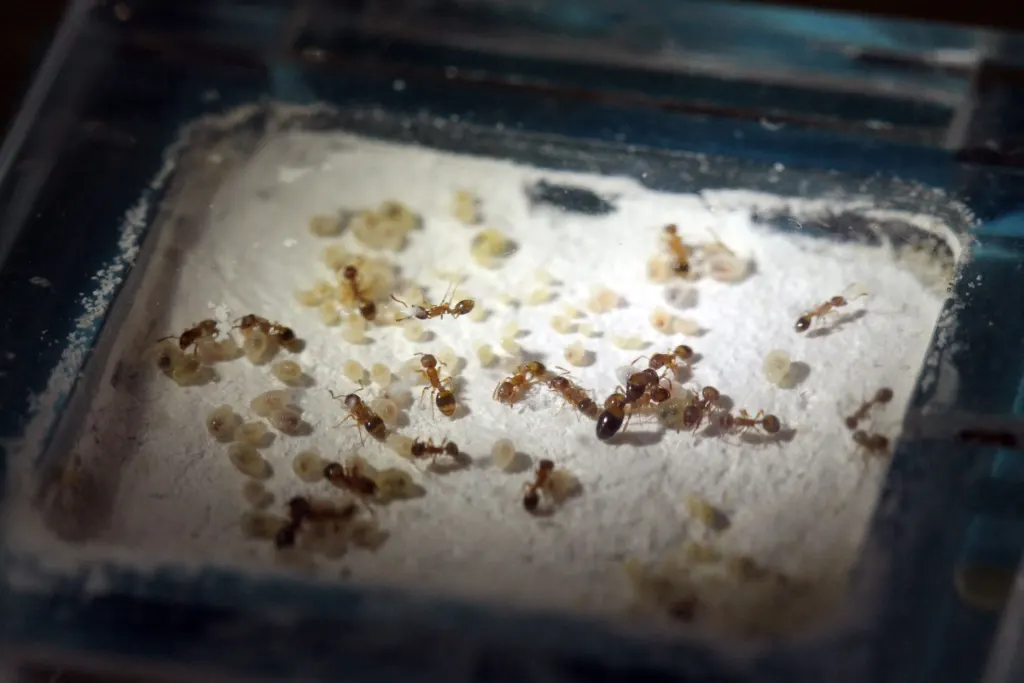
Image: Levent K., CC BY-SA 2.0 via Wikimedia Commons
This article was produced with AI assistance and reviewed by our Editorial Desk. How we work.