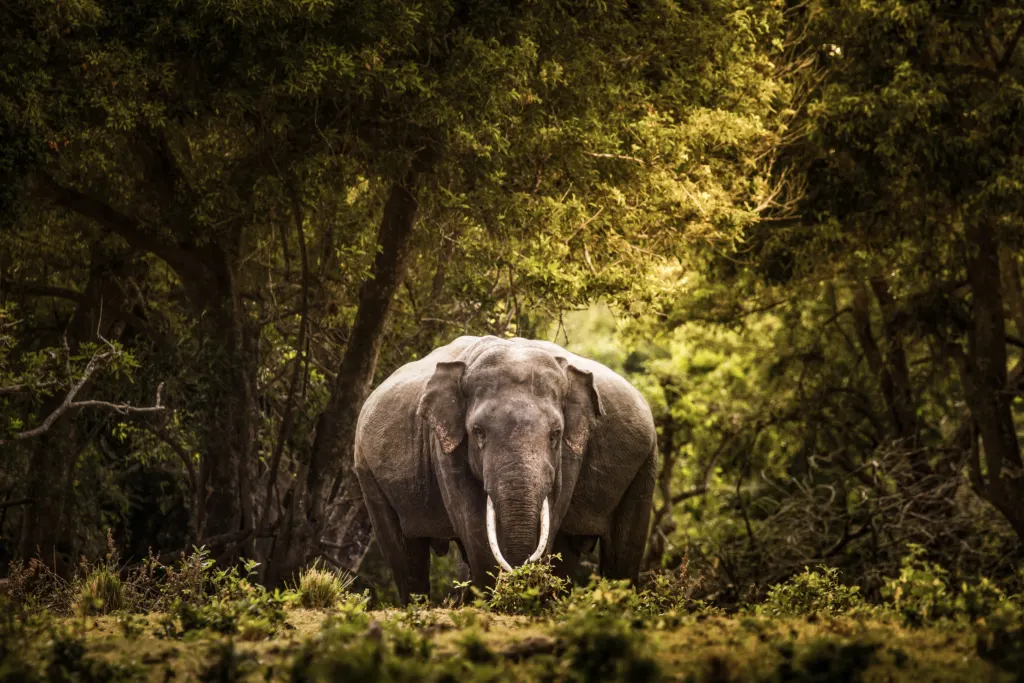
Elephant society can survive losing a few members. Lose enough of them, a little at a time, and it breaks. A study of 443 wild female Asian elephants tracked for 12 years found that after members kept dropping out and being replaced, the population’s social network split into smaller, more isolated communities and stayed that way.
The paper, published in Science on November 12, comes from Anastasia Madsen of UC San Diego and the University of Cincinnati, with Sri Lankan colleagues from the conservation group EFECT and the University of Colombo, and senior author Shermin de Silva.
What the researchers tracked
Asian elephant herds do not look like the tight, matriarch-led families many people picture from African documentaries. Females form wide, fluid networks: small groups on any given day, but with long-term companions they return to over years. That fluidity makes them a good test case for a basic question about any community: can it keep its shape while its members change?
The team followed which elephants spent time with which, and how those ties grouped into larger communities, across 12 years. Their finding, in their words, is that “following accumulated demographic turnover, networks fractured into smaller and more isolated communities.”
Not just fewer elephants
The striking part is why the network split. It was not only that animals disappeared. According to the authors, connections changed “not only owing to loss of members but also modifications in relationships among remaining individuals.” In other words, the elephants left behind reorganized who they associated with, and the result was a more fragmented society.
The authors frame it as a tipping point. Small, steady changes to membership can push a social system past a threshold into a different state, which may then affect how well the group copes with future disturbance. By their account, this is real-world proof that a wild, long-lived land mammal’s society can shift into a new shape and stay there.
How this builds on earlier work
De Silva has studied these networks for well over a decade. Her 2011 study in BMC Ecology followed 286 identified adult females at Uda Walawe National Park in Sri Lanka over 20 months. It found that daily groups were small and association rates low, yet individuals belonged to larger social units that stayed stable across years. The new paper uses a far longer window, 12 years against 20 months, roughly seven times as long, and that stretch of time is what reveals slow erosion that a short study cannot see.
Why it matters for a declining species
The Asian elephant has been listed as Endangered since 1986, after its population fell by at least half over the last three elephant generations, roughly 60 to 75 years. The global wild population was estimated at 48,323 to 51,680 animals in 2019. Habitat loss, fragmentation and poaching are the main threats, and in Sri Lanka elephants now occupy only about two-fifths of their range from the late 19th and early 20th centuries.
The study suggests that conservation counts alone may miss part of the damage. A population can hold steady in numbers while its social fabric quietly frays, because each removal also reshapes relationships among the survivors.
What the study does not show
The abstract does not say whether the split is permanent over an elephant lifetime of about 60 years, or what caused the turnover in the first place. It also covers a single population, and the full paper sits behind a paywall, so details such as the exact drivers of turnover are not in the public summary.
Badiyaa has covered elephants closer to home too, from the Oregon Zoo’s Samudra flattening a 500-pound pumpkin to an AI-generated baby elephant clip shared by Indian police. The new study runs in Science volume 394, pages 792 to 798, with a companion commentary in the same issue.
Further reading
- Science: Increased demographic turnover and isolation precede social fragmentation in Asian elephants
- Wikipedia: Asian elephant
- BMC Ecology (2011): The dynamics of social networks among female Asian elephants
Image: Senthiaathavan, CC BY-SA 4.0 via Wikimedia Commons
This article was produced with AI assistance and reviewed by our Editorial Desk. How we work.