The calf grabs a whole bunch of bananas from a roadside stall. Four seconds later the bunch has shrunk to a single fat banana, and its mother calmly sets one piece of fruit back on the display. That melting fruit is the giveaway: the 12-second “CCTV” clip that spread across Asia this week was made with AI, and the account that first posted it says so on its own profile.
The video first appeared on TikTok in the early hours of 28 October, Sri Lanka time, on an account called nature.love.ai. Its profile description reads “All the Videos are Ai Generated,” and TikTok attached its own “Contains AI-generated media” label to the post. By 2 November it had roughly 2.4 million views, according to Sri Lankan fact-checkers who traced the clip.
How a fake turned into a “lesson”
Copies stripped of context traveled fast. A Sinhala-language Facebook post on 28 October framed the scene as nature teaching humans how to raise children. English-language pages followed, one drawing close to 139,000 views. By 2 November another version had relocated the story to a fruit stall in India, complete with fresh “security camera” stills that match neither the shop nor the camera angle in the TikTok original. That retelling pulled about 158,000 views and nearly 1,000 shares.
Then a state police force picked it up. On 30 October the Uttar Pradesh Police in India posted the clip on X with the caption “One little banana heist. One big lesson in doing the right,” adding that people who witness a theft should report it rather than stay silent. A Community Note soon flagged the footage as an AI fabrication.
Replies were blunt. “Police sharing AI slop. Can’t detect fakes. Wants to detect crimes,” one user wrote. Another was gentler: “The message is sound. Just mention that you KNOW its AI.”
The numbers behind the spread
Add the two biggest Facebook reposts together and you get roughly 297,000 views (139,000 plus 158,000). Set that against the 2.4 million on TikTok and the copies come to about 12% of the original’s audience, or one view in eight. In other words, most people met this elephant on the account that openly labels its work as AI, and still a sizable crowd saw it later with the label gone.
Why it fooled people
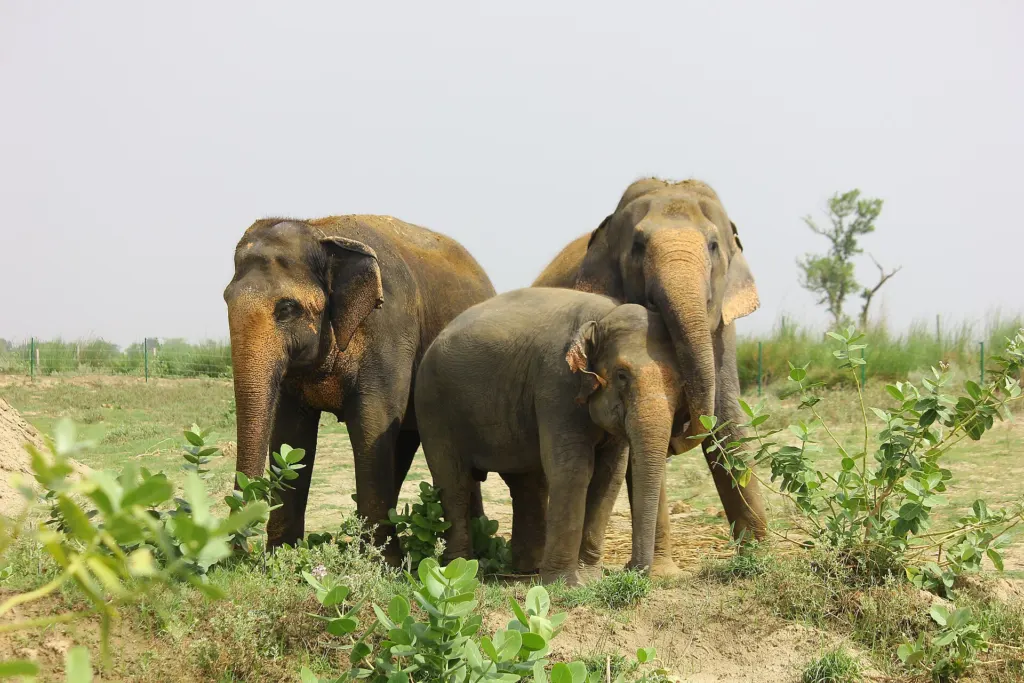
The premise is not absurd. Asian elephants spend somewhere between half and three-quarters of each day feeding and can get through up to 150 kilograms (330 pounds) of plants daily, so a hungry herd near a fruit stand is a believable scene. Real ones do wander into shops: in June 2025 an elephant near Thailand’s Khao Yai National Park walked into a store and ate snacks that included dried bananas, and in Sri Lanka a bull known as Raja has become famous for stopping vehicles on the Buttala-Kataragama Road to beg for fruit. In China’s Xishuangbanna prefecture, officials have even planted bananas and bamboo to give wild herds food away from villages.
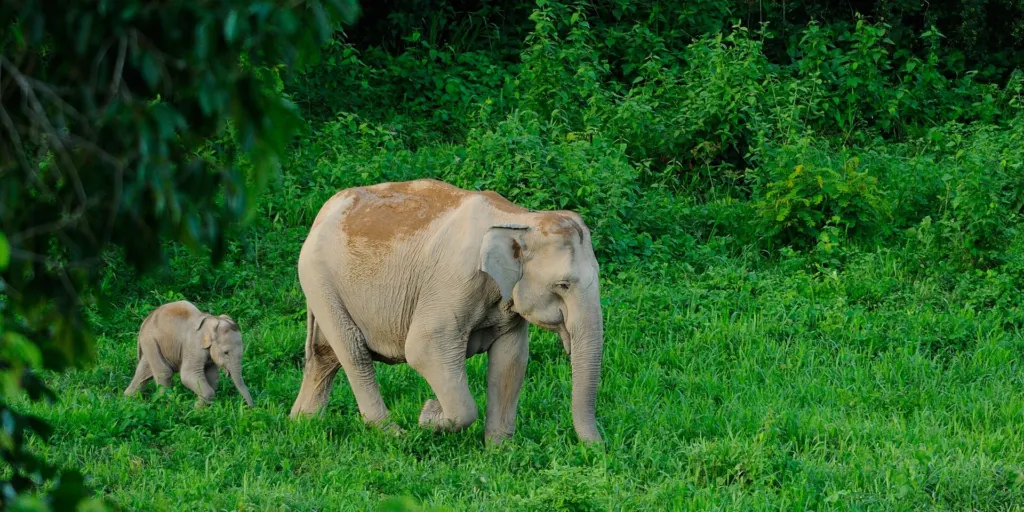
Mothers and calves also stay close. Cows and their young move together in small groups, and a calf may nurse for up to three years, so the image of a mother stepping in feels right to anyone who has watched elephants.
But the physics is off. An Asian elephant’s trunk ends in a single finger-like tip, so it tends to wrap around food and squeeze it toward the mouth. In the clip, the fruit itself keeps changing. Fact-checkers counted a bunch at 1.2 seconds, two bananas at 3 seconds, one oversized banana at 4 seconds and a single banana returned at 7 seconds. Real footage does not rewrite the objects in it.
A quick check before you share an animal clip
- Read the watermark. The Facebook copies still carried a TikTok handle, @nature.love636, in the middle of the frame, which led straight to the AI account.
- Open the creator’s profile and scroll a few posts. An account that churns out one miraculous animal moment after another is a warning sign.
- Scrub frame by frame. Count legs, tusks, fruit or anything the animal is holding.
- Look for the platform’s own AI label on the original post, since reposts rarely keep it.
- Check any CCTV overlay for a date and time that make sense.
A detection tool the fact-checkers ran on one frame put the odds of AI generation at 99%, though they treated that only as supporting evidence. The decisive proof is simpler and sits in plain text on the creator’s profile, where the account has about 1.3 million followers and lists the United Kingdom as its location.
Further reading
Image: tontantravel, CC BY-SA 2.0 via Wikimedia Commons
This article was produced with AI assistance and reviewed by our Editorial Desk. How we work.