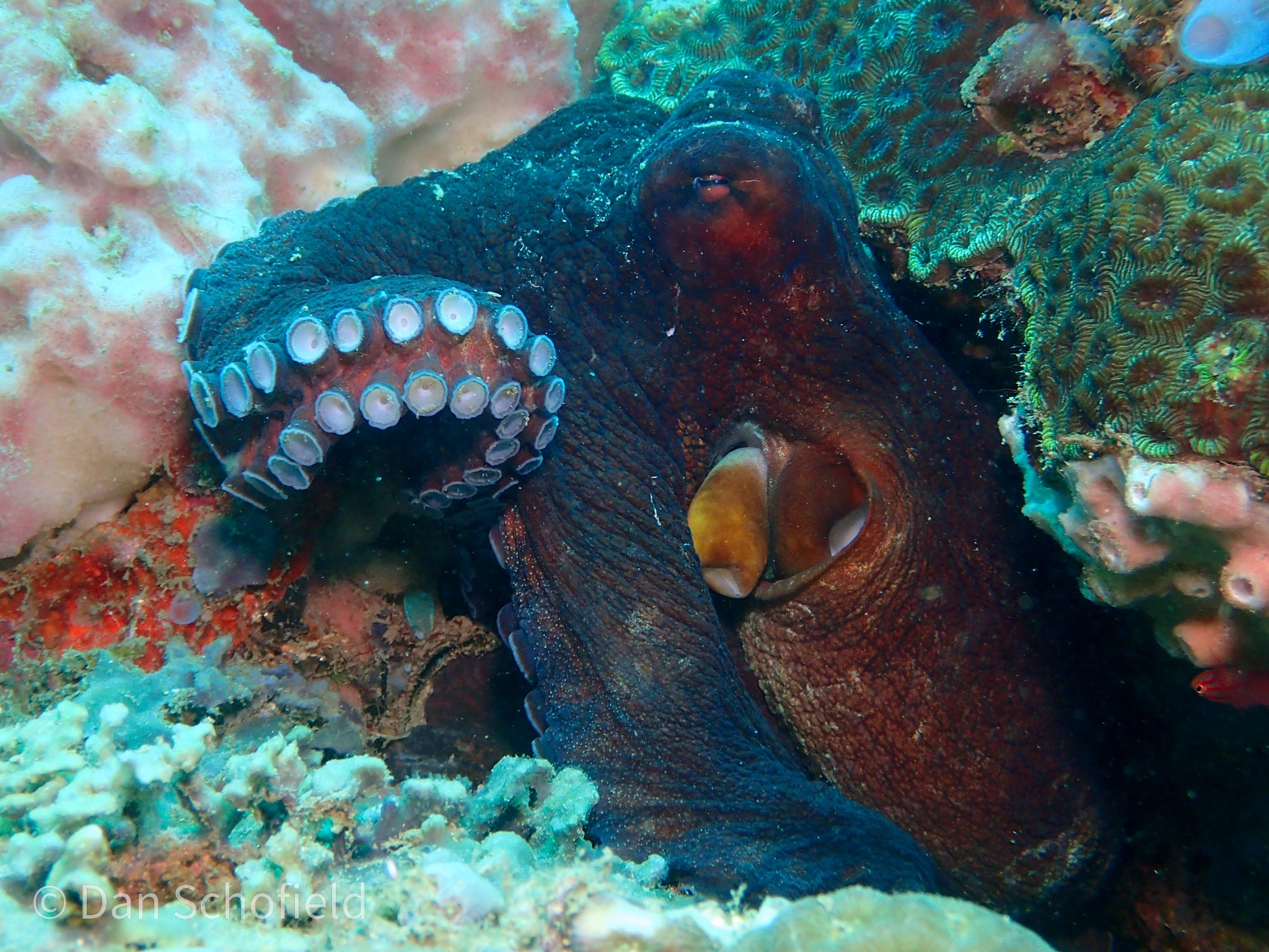
Steal from the hunt, take a punch. In the Red Sea, day octopuses have been seen throwing quick, sharp jabs at the fish they hunt alongside, and scientists think at least some of those blows are a way of keeping freeloaders in line.
The behavior was described in a 2021 paper in the journal Ecology titled "Octopuses punch fishes during collaborative interspecific hunting events." The team, led by Eduardo Sampaio with Martim Costa Seco, Rui Rosa and Simon Gingins, worked out of the University of Lisbon's marine laboratory and the Max Planck Institute of Animal Behavior at the University of Konstanz in Germany.
A hunting party with a bouncer
The octopus in question is Octopus cyanea, the big blue or day octopus. It sometimes hunts cooperatively with the roving coral grouper, and in the Red Sea it has been seen joining mixed hunting parties with blacktip groupers and goatfish. The idea is teamwork: fish chase prey into crevices, and the octopus's arms flush out anything hiding.
But teams have cheats. According to Wikipedia's account of the day octopus, octopuses in these hunts were seen to punch and strike groupers with their arms. The researchers suggested two practical reasons: disciplining fish that profit from the hunt without pulling their weight, and keeping fish from crowding around the octopus.
Then there is the spicier theory. Because some punches happened outside those situations, the octopuses are also speculated to lash out out of spite, a response to normally helpful partners snatching prey from the octopus or from other fish in the group. Revenge, it turns out, may not be a purely human hobby.
Meet the puncher
O. cyanea is built for this kind of daytime drama. Most octopuses are nocturnal, but this one hunts by day, mostly at dawn and dusk. According to its species profile, it lives on reefs from the Red Sea and East Africa to Hawaii, grows to a 16-centimeter mantle with arms of at least 80 centimeters, and can change color, pattern and skin texture at will. One researcher counted 1,000 changes in appearance in seven hours.
It also lives fast. A day octopus survives just 12 to 15 months after settling out of its drifting larval stage, growing from about 67 grams to 6,500 grams. Badiyaa's math: that is a roughly 97-fold weight gain in barely a year, fueled by crabs, shrimp, fish and mollusks it often hauls back to a den and leaves as a midden of empty shells outside the door.
Why a punch matters
Cooperation between species is common in the ocean, but enforcing it is rarer to see. A jab costs the octopus little and can change where a fish positions itself, which makes it a cheap way to steer a partner. The title of Sampaio and colleagues' 2021 study says it plainly: the punching happens during collaborative hunting, not in open warfare.
Octopuses keep surprising researchers. Badiyaa has covered how octopus arms hold two-thirds of the animal's 500 million neurons, and how octopuses change color by squeezing pigment sacs, the same trick the day octopus uses on the reef.
Sources
- "Octopuses punch fishes during collaborative interspecific hunting events" (Sampaio, Seco, Rosa and Gingins), Ecology, 2021
- Octopus cyanea, Wikipedia, 2026
Image: Dan Schofield, CC BY 4.0 via Wikimedia Commons
This article was produced with AI assistance and reviewed by our Editorial Desk. How we work.