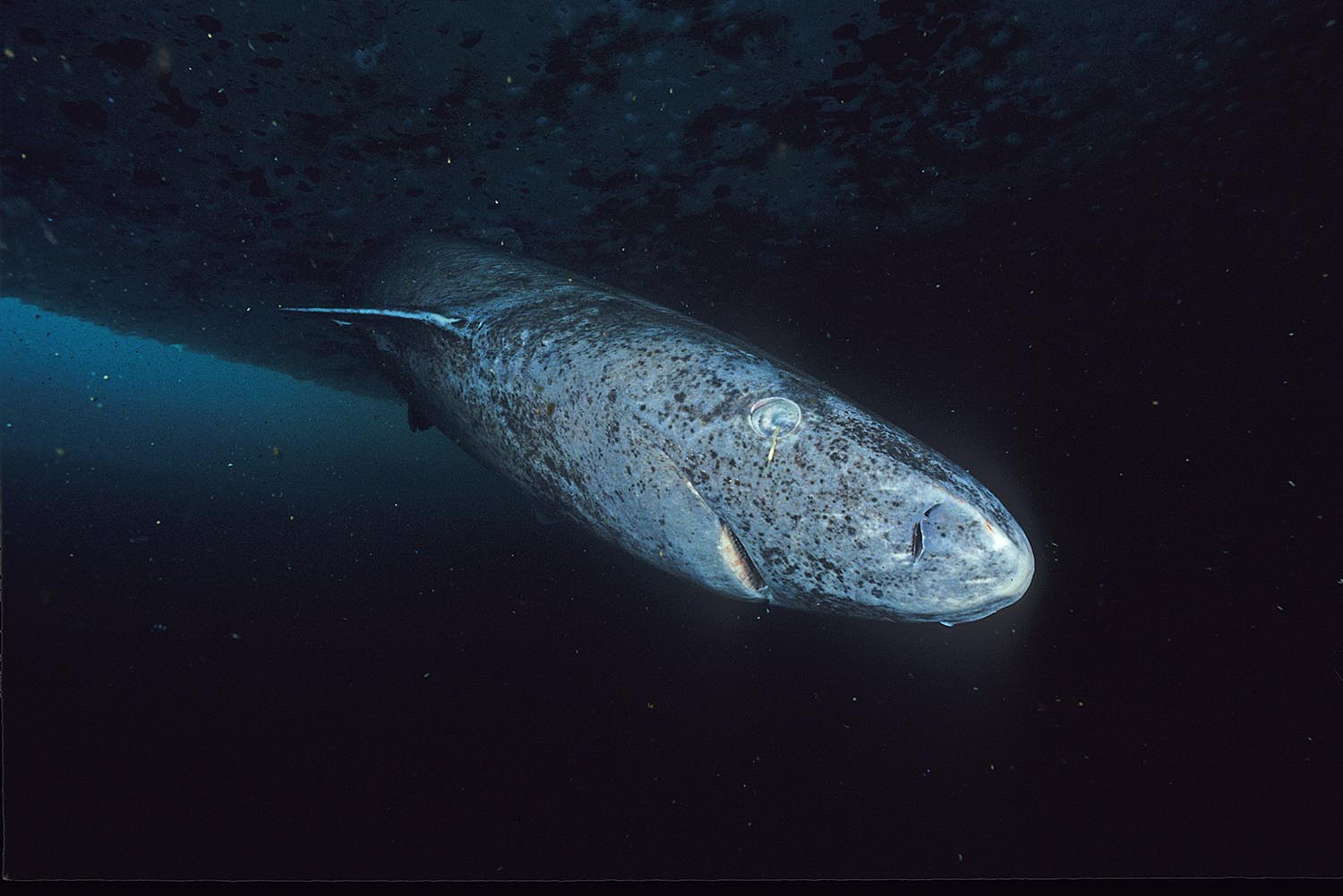
The oldest Greenland shark in a 2016 study may have been born in the 1620s, around the time the Mayflower crossed the Atlantic. A team led by Julius Nielsen of the University of Copenhagen dated that animal at roughly 400 years, making the species the longest-lived vertebrate known.
The trick behind that number came from the Cold War. As the 2016 study in Science explains, the team used the spike of carbon-14 released by 1950s nuclear bomb tests, which got locked into the lenses of sharks' eyes as they formed. Lens tissue laid down before birth never gets replaced, so it works like a time capsule. The biggest shark came out at 392 years, give or take 120, according to Wikipedia's Greenland shark entry.
The slowest love life in the sea
These sharks are in no hurry for anything, romance included. Females reach maturity at around 150 years, when they measure about 4.2 meters long. Males mature smaller, at about 2.8 meters. Then comes the wait: pups are born live after a pregnancy estimated at 8 to 18 years, with up to 10 pups per litter.
To put that in human terms, a female born the year the Declaration of Independence was signed, 1776, would only have been ready to breed around 1926, the year Winnie-the-Pooh was first published. That is Badiyaa's own arithmetic from the 150-year maturity figure, and it is why fisheries scientists worry: a population that takes a century and a half to start replacing itself cannot bounce back from overfishing quickly.
Built like a slow-motion tank
- Size: adults usually reach 4 to 5 meters, and the largest confirmed shark measured 6.4 meters and about 1,023 kg.
- Speed: it averages about 0.34 meters per second, the lowest swim speed for its size of any fish measured.
- Habitat: water from just below freezing to about 7°C, usually 100 to 1,200 meters down, and one was seen at 2,200 meters near a Gulf Stream shipwreck off North Carolina.
- Growth: one shark tagged off Greenland in 1936 and caught again in 1952 grew only about half a centimeter to a centimeter a year.
Even so, it eats seals. Biologists suspect it ambushes them while they sleep, and stomachs have turned up polar bear, moose and, once, an entire reindeer.
Parasites in its eyes, ammonia in its meat
Here comes the gross part. Many Greenland sharks carry a copepod, Ommatokoita elongata, clamped onto their eyes. The parasite can scar the cornea until the shark is nearly blind, though it seems to get by on smell and hearing.
The flesh is no treat either. It is loaded with urea and trimethylamine N-oxide, and fresh meat is toxic to mammals; sled dogs that eat it can be left unable to stand. Iceland's answer is hákarl, the national dish of fermented shark: the meat is pressed to drain its fluids for six to twelve weeks, then hung to dry for months. The result has a strong ammonia smell, and people new to it may gag on the first bite.
Why its age matters now
The IUCN lists the species as vulnerable. About 3,500 Greenland sharks are caught each year as bycatch across the Arctic and Atlantic, compared with about 25 taken by Iceland's small targeted fishery, Wikipedia's entry notes. The shark's genome was published in 2024, and researchers are now probing its DNA repair genes for clues to that marathon lifespan.
For more deep-sea oddities, see how hagfish slime swells 10,000 times in under a second, how sharks sense the electric fields of hidden prey, and the barreleye fish with a see-through head.
A Greenland shark born in 2026 would, on those numbers, hit maturity around the year 2176.
Sources
- Eye lens radiocarbon reveals centuries of longevity in the Greenland shark, Science (AAAS), 2016
- Greenland shark, Wikipedia, 2026
- Hákarl, Wikipedia, 2026
Image: Hemming1952, CC BY-SA 4.0 via Wikimedia Commons
This article was produced with AI assistance and reviewed by our Editorial Desk. How we work.