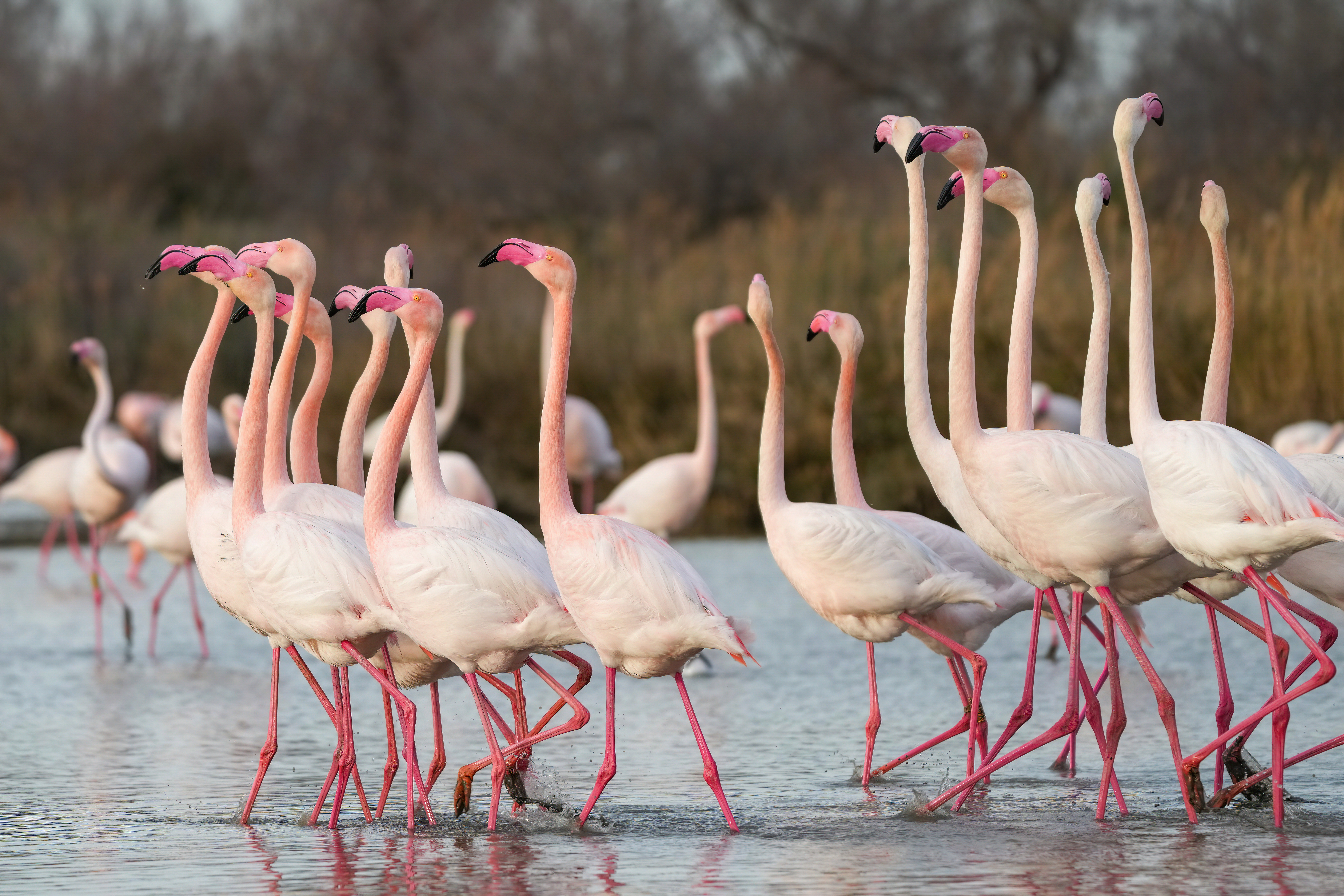
Flamingos are not born pink, and they do not stay pink by accident. The color comes from what they eat, and when mating season arrives, greater flamingos go a step further: they smear pigment from a gland near the tail onto their feathers to look brighter for potential partners. Scientists who studied the habit called it what it looks like, make-up.
You are what you filter
Chicks hatch in pale, fluffy down. The Smithsonian's National Zoo says young American flamingos take several years and several molts to turn pink, and that a pigment in their food is what gives adults their flamboyant color.
That pigment family is the carotenoids, the same group of compounds that colors carrots. Flamingos filter-feed upside down, straining brine shrimp, algae, larvae and other small fare through comb-like plates in their bills. Wikipedia's flamingo entry explains that enzymes in the liver break the carotenoids down into the pigments that end up in the feathers.
The menu sets the shade. American flamingos are a brighter red because their food carries more beta carotene, while lesser flamingos are paler. Birds that eat blue-green algae directly come out darker than those getting the pigment second-hand by eating animals that ate the algae. In zoos, flamingos can fade to pale pink if their diet does not match the carotene levels of the wild.
Pink as a dating profile
Color is also a signal. A well-fed, healthy flamingo is more vividly colored and so a more desirable mate, while a white or washed-out bird is usually unhealthy or underfed. In other words, the brightest bird in the lagoon is advertising that it eats well.
Greater flamingos boost that advert. Their preen gland, the uropygial gland at the base of the tail, produces an oily secretion that also contains carotenoids. The greater flamingo's Wikipedia entry says the birds spread it over their feathers more often in the breeding season, enhancing their color. The finding comes from a 2011 study in Behavioral Ecology and Sociobiology by Juan A. Amat and colleagues, titled "Greater flamingos Phoenicopterus roseus use uropygial secretions as make-up." Bird makeovers, it turns out, are a real field of research.
The group dance
Courtship happens in crowds. Before breeding, colonies split into groups of roughly 15 to 50 birds that stretch their necks, call while flagging their heads from side to side, and flap their wings in sync. In greater flamingos, display complexity rises until a bird is about 20 years old and then declines, and both sexes seem to prefer older, more experienced partners.
The National Zoo notes that American flamingo colonies may display by the thousands in one vast synchronized movement, which seems to bring the whole colony to readiness at once. Some zoos have even put up mirrors to make a small flock feel big enough to breed.
Flamingo facts by the numbers
- Height: an adult American flamingo averages 5 feet and weighs 4 to 8 pounds, according to the zoo.
- Lifespan: about 40 to 60 years for American flamingos.
- Wild population: about 80,000 to 90,000 American flamingos, concentrated in four major breeding colonies.
- Name: from Portuguese or Spanish flamengo, "flame-colored." A group is a flamboyance.
For more on these birds, read why flamingos stand on one leg, how 30 flamingos rode out a hurricane in a zoo restroom, and how other animals practice mate choice copying.
Sources
- “American flamingo”, Smithsonian's National Zoo and Conservation Biology Institute, 2026
- “Flamingo”, Wikipedia, 2026
- “Greater flamingo”, Wikipedia, 2026
- “Greater flamingos Phoenicopterus roseus use uropygial secretions as make-up”, Behavioral Ecology and Sociobiology (Amat et al.), 2011
Image: Giles Laurent, CC BY-SA 4.0 via Wikimedia Commons
This article was produced with AI assistance and reviewed by our Editorial Desk. How we work.