Male bowerbirds do not try to win a mate with looks alone. They build her a stage, decorate it like an obsessive interior designer, and then put on a show in front of it. If she is not impressed, she simply walks off to inspect the next bachelor pad.
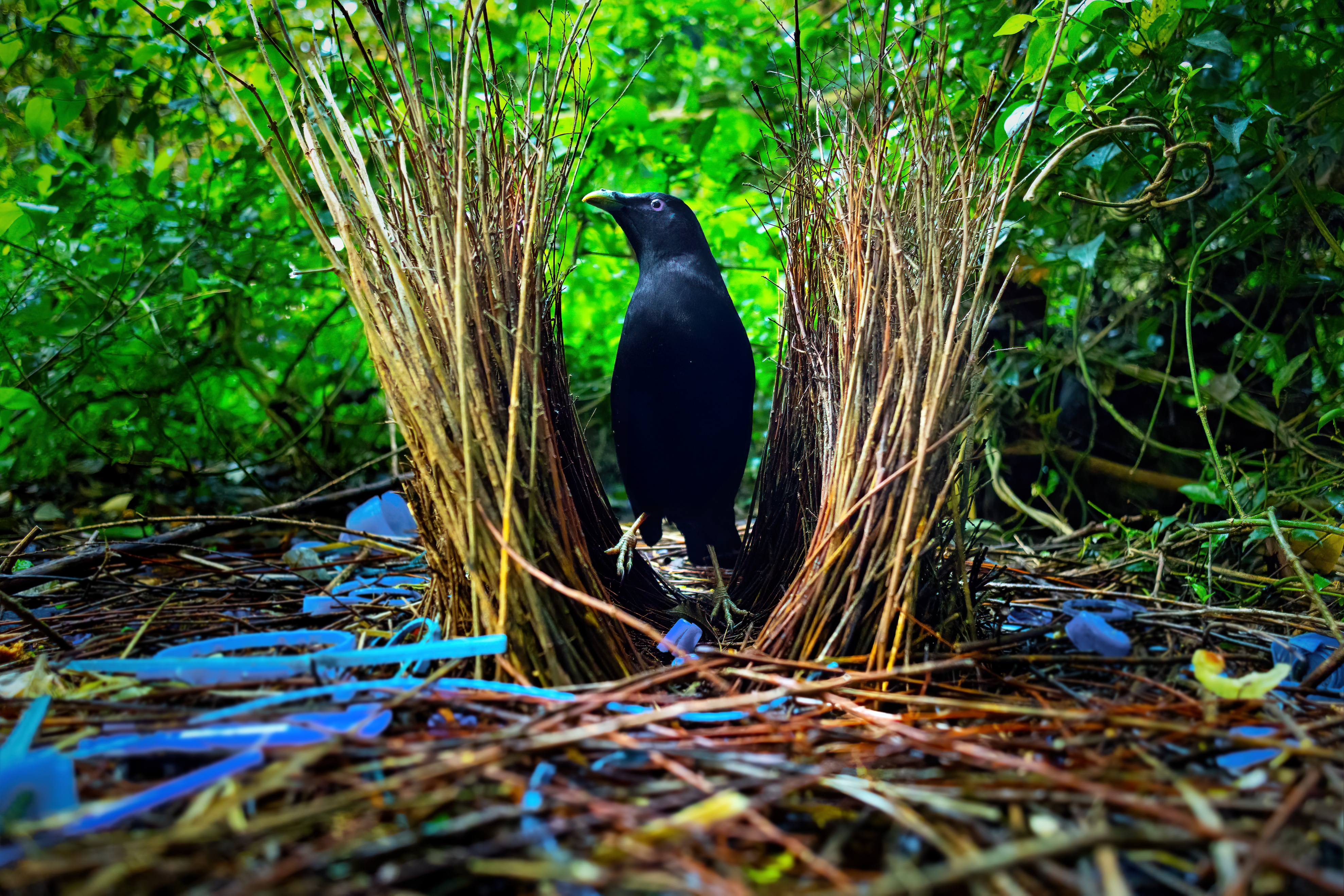
The bowerbird family, found across Australia and New Guinea, has 23 species, and in all but the catbirds the males build a structure called a bower purely for courtship. The bowerbird family's Wikipedia entry describes two main designs: "maypole" bowers, with sticks stacked around a sapling and sometimes a hut-like roof, and "avenue" bowers, two parallel walls of upright sticks.
The blue obsession
The satin bowerbird of eastern Australia is the best known of the builders. The male lays down his avenue of sticks on the ground and decorates it almost entirely in blue. Near people, that means blue clothes pegs, drinking straws and bottle tops, which the Australian Museum's satin bowerbird profile lists among the birds' favourite stolen items. In the bush he settles for blue parrot feathers, flowers and snail shells.
He even paints. The museum notes that males mash chewed plant matter with saliva and smear it on the bower walls, and they maintain the whole thing year round. Across the family, the haul can run to hundreds of shells, leaves, flowers, berries, coins, nails and bits of glass, and rival males are known to steal decorations from each other's bowers.
The courtship show
When a female arrives, the male launches into a performance of strutting and bowing, wings out and quivering, with buzzing, rattling calls and snatches of mimicry, often holding one of his treasures in his bill. If she likes what she sees, she steps into the avenue to mate, then leaves to build a nest and raise the chicks entirely on her own.
Females are picky shoppers. They visit several bowers, come back to favourites more than once and narrow down their choices. Many end up choosing the same few males, while plenty of lesser builders are left with no mates at all. In satin bowerbirds, young males do not even get their glossy blue-black plumage until about age seven.
A seduction built on an optical illusion
The great bowerbird takes it one step further. Researchers at Deakin University in Australia found that males arrange objects on the court in front of the bower from smallest to largest, creating a forced-perspective illusion for the female looking out from the avenue. In their 2012 study in Science, Laura Kelley and John Endler reported that mating success was tied to the quality of that illusion rather than the bower's physical features.
That is one reason scientists rank bowerbirds among the most behaviourally complex birds anywhere. Charles Darwin wrote about them when developing his ideas on sexual selection, and researchers still debate why the bower evolved. One idea is that it protects females by giving them space to choose; another is that the quality of the build signals a healthy male.
For more on how animals pick partners, read about mate choice copying in guppies, grouse and humans, the superb fairywren's blue breeding plumage, and the deep-sea anglerfish males that fuse to their mates for life.
Sources
- Bowerbird, Wikipedia, 2026
- Satin Bowerbird, Australian Museum, 2026
- Illusions Promote Mating Success in Great Bowerbirds, Science (Kelley and Endler, Deakin University), 2012
Image: JJ Harrison, CC BY-SA 4.0 via Wikimedia Commons
This article was produced with AI assistance and reviewed by our Editorial Desk. How we work.