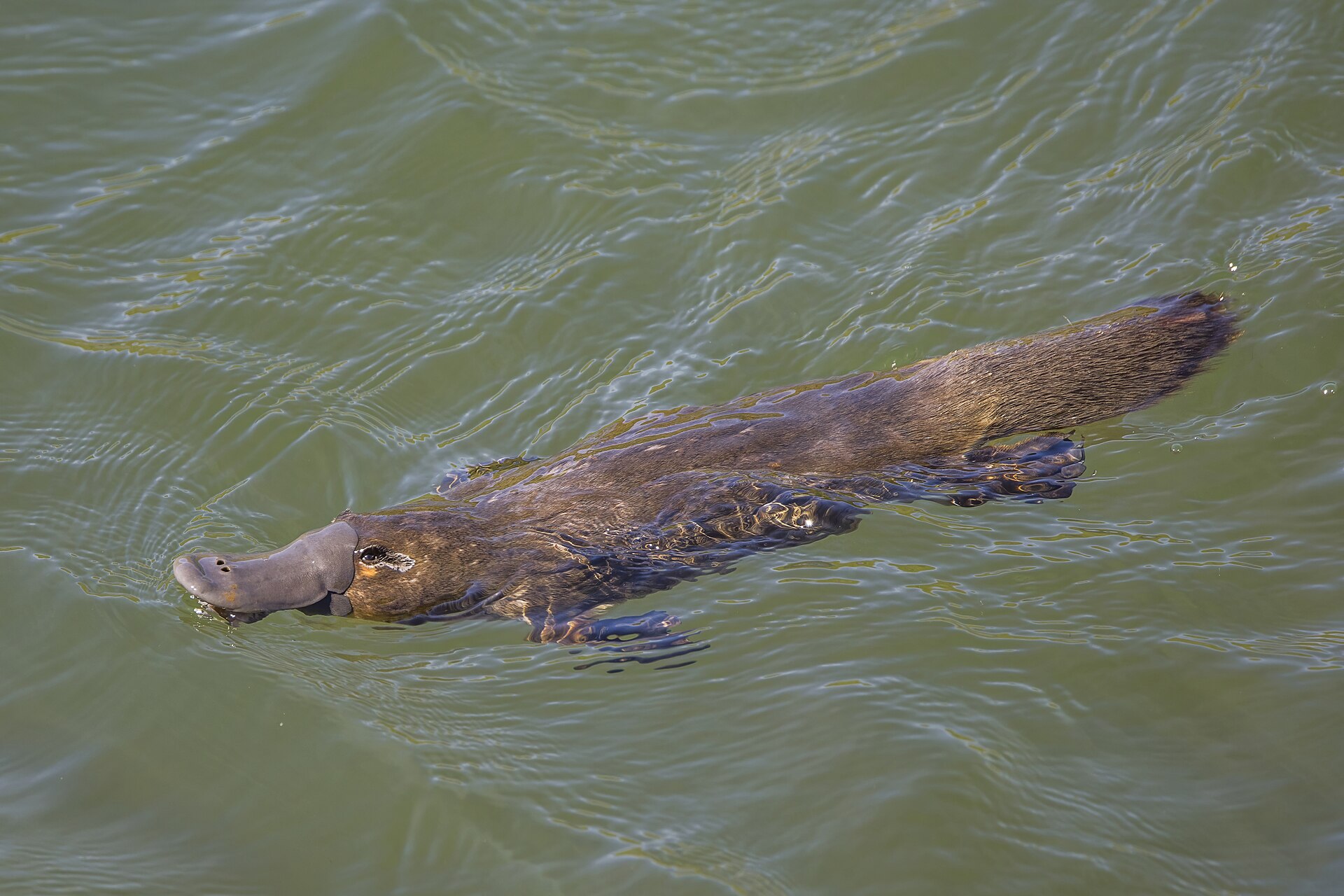
Under ordinary light, a platypus is a plain brown mammal with a duck's bill. Shine an ultraviolet lamp on it and the fur lights up green and cyan. That was the finding of a 2020 study in the journal Mammalia, the first report of biofluorescence in any monotreme, the tiny group of egg-laying mammals.
The glow was not spotted in the wild. A team led by Paula Spaeth Anich at Northland College in Ashland, Wisconsin, examined three museum specimens from Tasmania and New South Wales, held at the Field Museum of Natural History in Chicago and the University of Nebraska State Museum in Lincoln. The fur looked evenly brown under visible light and green or cyan under UV, with the emitted light peaking at around 500 nanometers.
A discovery that started with flying squirrels
The same Northland College group had already caught another mammal glowing. Their 2019 paper in the Journal of Mammalogy reported ultraviolet fluorescence in New World flying squirrels of the genus Glaucomys. The platypus paper itself cites work on fluorescent opossum fur going back to 1983. With the platypus added, the trait now turns up in a placental mammal, a marsupial and a monotreme, the three deepest branches of the mammal family tree.
That spread is the real surprise. Either the ability is very old and has been lost in most living mammals, or it evolved several times over. The 2020 paper does not settle which.
Why would a platypus glow
Nobody knows for sure. One leading idea, noted in Wikipedia's platypus entry, is that the glow may help it hide in dim light from predators that can see ultraviolet. Platypuses are mostly nocturnal and also active at dusk, exactly when UV-sensitive eyes might matter. It could just as easily be a side effect of fur chemistry with no job at all; the study's abstract does not say what the glow is for.
It is far from the platypus's only oddity. It is one of just five living egg-laying mammal species, along with four echidnas. Males carry a venomous spur on each hind foot that can cause pain lasting months. It hunts with its eyes, ears and nostrils shut, using about 40,000 electroreceptors in its bill to sense the tiny electric fields made by the muscles of shrimp and insect larvae. Its fur is among the densest of any mammal, beaten only by otters.
A glowing animal once called a hoax
The platypus has been fooling scientists for more than two centuries. When a preserved specimen reached Britain in 1799, naturalists suspected someone had sewn a duck's beak onto a beaver-like body, and zoologist George Shaw reportedly took scissors to it to look for stitches. Some 221 years later, the same animal surprised researchers again under a UV lamp.
The species is listed as near threatened by the International Union for Conservation of Nature, and Victoria in Australia classed it as vulnerable in January 2021.
Animal color can come from strange places. Badiyaa has explained how the bald uakari gets its bright red face from blood vessels, not pigment, and how the peacock mantis shrimp punches at 51 mph.
Sources
- Biofluorescence in the platypus (Ornithorhynchus anatinus), Mammalia, Northland College / Colorado State University, 2020
- Ultraviolet fluorescence discovered in New World flying squirrels (Glaucomys), Journal of Mammalogy, Northland College, 2019
- Platypus, Wikipedia, 2026
Image: Charles J. Sharp, CC BY-SA 4.0 via Wikimedia Commons
This article was produced with AI assistance and reviewed by our Editorial Desk. How we work.