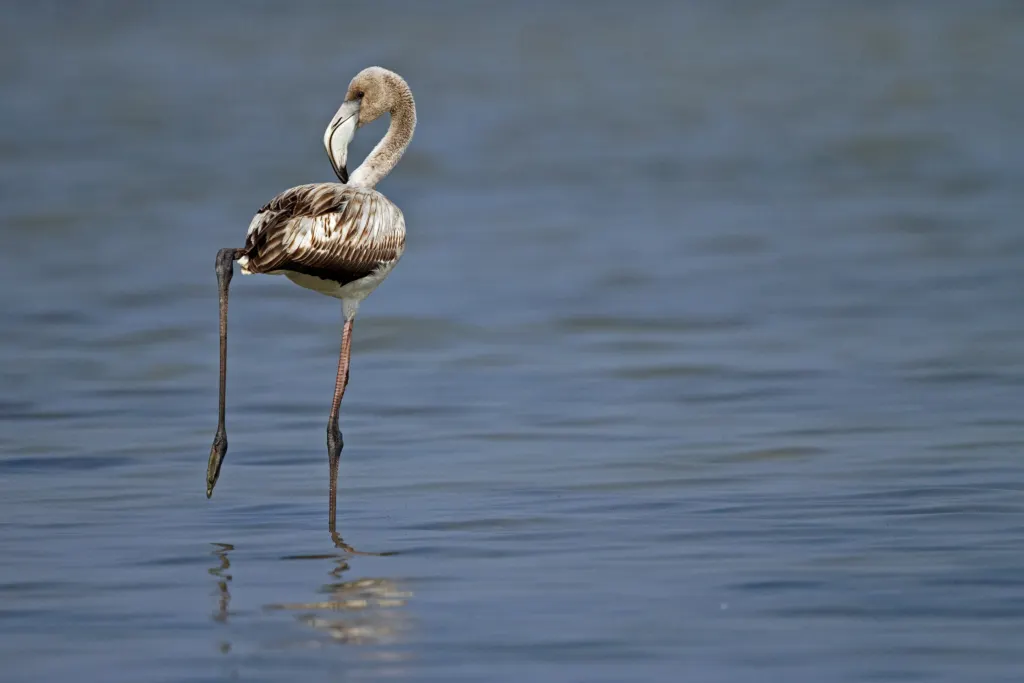
A dead flamingo can stand on one leg. That odd discovery, made with two donated zoo birds in Atlanta, is the best evidence yet for why living flamingos spend so much time balanced on a single pink stilt: in that pose, their body weight locks the leg in place and their muscles barely have to work.
The finding comes from a 2017 study in Biology Letters by Young-Hui Chang of Georgia Tech and Lena Ting of Emory University. It replaced the two explanations most people had heard, that the birds were fighting muscle fatigue or saving body heat, with a simpler one: standing on one leg costs a flamingo very little energy.
The cadaver that stayed upright
The pair worked with two frozen adult Caribbean flamingos from the Birmingham Zoo in Alabama. Clamped by one leg in the one-legged pose, a thawed bird held its posture with no muscle activity at all. The researchers could tilt the body forward and back through 119 degrees and the hip and knee joints barely moved. When they arranged the same bird in a two-legged stance, the joints buckled and it could not hold its own weight.
Chang described the moment in Emory University’s announcement of the study: “I don’t know what made me do it, but I just kind of grabbed the leg and picked it up.” The bird kept its shape. “Here we have a non-living animal able to stand on one leg. Obviously, if it’s not alive, then the muscles are not activated.”
How the leg locks
The trick depends on anatomy most people never see. The bend halfway down a flamingo’s leg is its ankle, not its knee. The real knee and hip sit up against the body, and the thigh bone runs almost horizontally. The full paper lists three conditions for what the authors call a passively engaged gravitational stay. The body’s center of mass must sit in front of the knee, the joints’ natural range limits must hold against gravity, and the foot must be placed under the middle of the body. Miss any one of those and the leg goes floppy again. Chang compared the effect to a hammock or sling rather than a bony lock.
Ting put it this way: “The biomechanics are such that when they stand on one leg, they become very stable and are able to maintain that posture without activating muscle.”
Sleepy birds sway less
For the living half of the study, keepers at Zoo Atlanta set eight juvenile Chilean flamingos, weighing between about half a pound and three pounds, on a force plate after feeding, when they tended to doze. With eyes closed, the point where each bird pressed on the plate wandered within a radius of just 3.2 millimeters, staying directly under the foot joint. When the birds were awake and grooming, that radius grew to 5.1 millimeters and the peak speed of the sway rose about sevenfold.
Old ideas and open questions
Earlier work, such as a 2010 study in Zoo Biology, had tied the pose to heat loss, and that may still matter for birds standing in cold water. Chang and Ting argue it cannot explain why tropical and land birds stand the same way. The team did not record muscle activity directly, and the paper says it cannot rule out steady low-level muscle use during balance. Horses offer a comparison: passive mechanisms cut their muscle forces by about 98% when they doze on their feet.
For more flamingo behavior, see how 30 flamingos rode out a hurricane in a Florida zoo restroom, or browse more Pets & Animals stories.
The study at a glance
Published May 24, 2017. Subjects: two Caribbean flamingo cadavers and eight live juvenile Chilean flamingos. Key number: a 119-degree tilt range with no joint collapse in the one-legged pose, against total collapse in the two-legged one.
Sources
- Chang and Ting, mechanical evidence for one-legged standing in flamingos, Biology Letters, Royal Society, 2017
- Full text of Chang and Ting’s flamingo study, PubMed Central, US National Library of Medicine, 2017
- Flamingo research shows birds use one-legged stance to relax, Emory University, 2017
- Why do flamingos stand on one leg?, Zoo Biology, 2010
Image: Aranyaparva, CC BY-SA 4.0 via Wikimedia Commons
This article was produced with AI assistance and reviewed by our Editorial Desk. How we work.