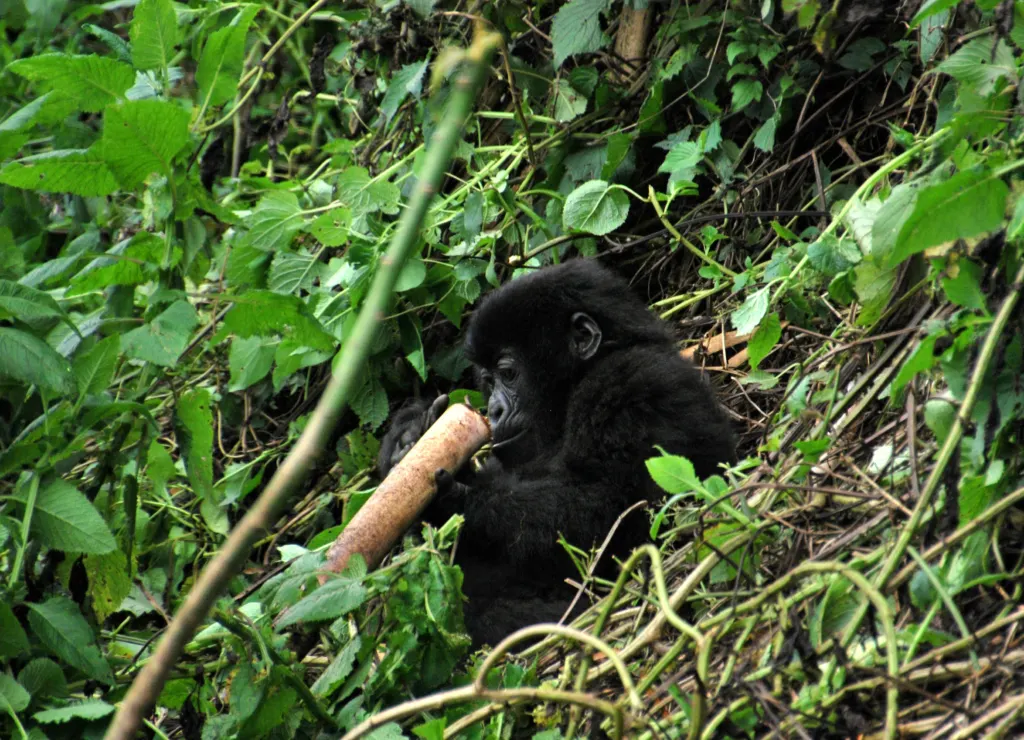
Three young gorillas saw a trap, ran at it and ripped it apart. Then they found a second one and did it again, even faster.
That is what field staff of the Dian Fossey Gorilla Fund reported seeing in Rwanda’s Virunga mountains in July 2012. The animals were juveniles Dukore and Rwema and a blackback, a young adult male, named Tetero, all members of Kuryama’s group. Between them they dismantled two poachers’ snares in quick succession.
Adult gorillas, mostly silverbacks, had been known to break snares before. Youngsters had not. “We knew that gorillas do this but all of the reported cases in the past were carried out by adult gorillas, mostly silverbacks,” Veronica Vecellio, gorilla program coordinator at the Fund’s Karisoke Research Center, said in the Fund’s announcement. She called the way they did it “an impressive cognitive skill.”
How the trap was taken apart
The snares in this case were rope traps held in place by a branch, and the branch was exactly what the young gorillas went for.
According to the Fund, tracker John Ndayambaje spotted one snare close to the group and, with the gorillas heading that way, decided to disable it himself. Silverback Vuba pig-grunted at him, a warning call. At that moment the three young gorillas raced toward the snare, grabbed the branch holding the rope and hauled on it together. Spotting a second trap nearby, they broke its branch and tugged the rope out of the soil just as fast.
Trackers pulled four more snares from the same patch of forest that day.
Why it mattered that week
The timing was grim. Two days earlier a juvenile called Ngwino had died after being caught in a snare. The rope cut deep into her leg, which turned gangrenous, and she dislocated a shoulder struggling to get free. Fund staff and vets from the Mountain Gorilla Veterinary Project tried to save her, but she was too far gone. It was the second gorilla death from a snare that year.
“Today we can proudly confirm that gorillas are doing their part too!” said Felix Ndagijimana, then director of the Karisoke Center.
The bigger picture for mountain gorillas
Mountain gorillas are not usually the target. The snares are set for antelope and other bushmeat, but a gorilla hand or foot is easily caught. Karisoke’s guards are often said to find and remove around 1,000 snares a year, though that figure is an unsourced estimate, so treat it as a rough scale.
The population has been recovering. A 1981 census found only about 254 gorillas in the Virungas; by 2010 the estimate there had climbed to 480, and the world total for the subspecies was put at 1,063 in 2019. Divide 480 by 254 and the Virunga count rose by a factor of about 1.9 in 29 years, close to a doubling, built on patrols, veterinary care and tourism money.
The 2012 sighting did not prove that young gorillas understand what a snare is for. Nobody can read their minds, and a single event is an anecdote, not a study. What it did show is coordinated action by three animals aimed at the exact part of the trap that makes it dangerous.
Badiyaa has also covered Lulingu, a rescued orphan gorilla now raising her own baby in Virunga, and the long debate over how much sign language Koko the gorilla really used. More stories like this live in our Pets & Animals section.
The Fossey Fund still runs the Karisoke Research Center inside Volcanoes National Park, where Dian Fossey began her study of these gorillas in 1967.
Further reading
Image: Carine06 from UK, CC BY-SA 2.0 via Wikimedia Commons
This article was produced with AI assistance and reviewed by our Editorial Desk. How we work.