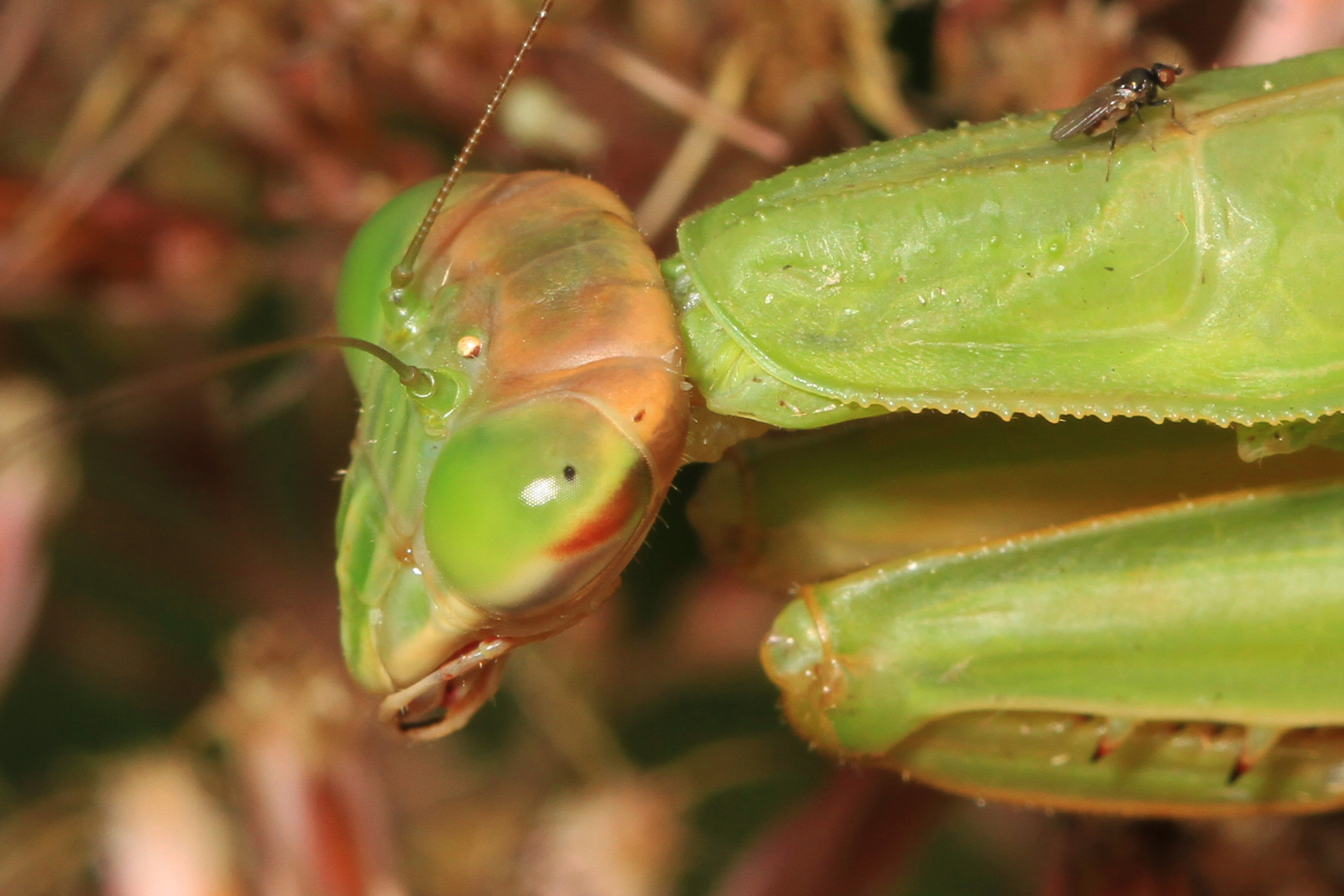
For a male praying mantis, a date can be the last meal he ever attends, as the main course. Female mantises are famous for eating their mates, and the science behind the habit is stranger than the cartoon version: some males fight their way through courtship, and the ones that get eaten may still come out ahead.
How often it really happens
According to Wikipedia's mantis entry, around 90% of predatory mantis species show sexual cannibalism. In captivity it is common. In the wild, roughly a quarter of male-female encounters end with the male being eaten.
The odds depend on the species and the female's appetite. In the Chinese mantis, Tenodera sinensis, 83% of males escape a given encounter, but because males mate more than once, the risk stacks up over a season. Wikipedia's sexual cannibalism entry cites a study of the same species in which cannibalism happened in up to 50% of matings. Hungry females on poor diets are more likely to attack, and the most dangerous moment for the male is climbing off afterward.
The classic image of a female starting with her partner's head comes from laboratory observations, and some researchers think bright lights and hovering scientists made it worse. Chinese mantises that were well fed and left undisturbed put on elaborate courtship displays instead, with the male dancing to switch the female's interest from food to mating.
Wrestling for a date
Some males take a more physical approach. Nathan Burke and Gregory Holwell of the University of Auckland studied the springbok mantis, Miomantis caffra, a highly cannibalistic species. In their 2021 study in Biology Letters, they reported that most first contacts turned into a violent struggle, with each sex trying to grab the other first using its spiked front legs. When the female won, she always ate the male. When the male grabbed first, his chances of mating rose dramatically.
The wrestling left marks. The researchers found that males sometimes wounded females with the claws on their front legs, causing loss of haemolymph, the insect equivalent of blood, and leaving scar tissue.
A nutritious sacrifice
Being eaten is not a total loss for the male's genes. William Brown of the State University of New York at Fredonia and Katherine Barry of Macquarie University fed male and female Chinese mantises crickets carrying different radioactive labels, then let them mate. Half the pairs went on to cannibalism. Their 2016 paper in Proceedings of the Royal Society B found that eggs from females who ate their mates contained significantly more male-derived amino acids, and those females produced more eggs afterward. Even without cannibalism, males passed about 25% of their labelled amino acids to the female through mating alone.
Survival tactics males use
- Sneak up in the wind: male Tenodera aridifolia approach when breezes mask their movement.
- Go slow: Pseudomantis albofimbriata males creep in from the rear or the front to avoid being noticed.
- Grab first: springbok mantis males wrestle the female before she can strike.
Mantises number more than 2,400 species worldwide, and the femme fatale trope has followed them into cartoons and film. The real story is less about villainy than about appetite, timing and a lot of nervous males.
Badiyaa has also covered two newly named Australian mantis species, a 98-million-year-old mantis in amber, and the anglerfish males that fuse to their mates for life.
Sources
- “Mantis”, Wikipedia, 2026
- “Sexual cannibalism”, Wikipedia, 2026
- “Male coercion and female injury in a sexually cannibalistic mantis”, Biology Letters (Burke and Holwell, University of Auckland), 2021
- “Sexual cannibalism increases male material investment in offspring”, Proceedings of the Royal Society B (Brown and Barry), 2016
Image: Judy Gallagher, CC BY 2.0 via Wikimedia Commons
This article was produced with AI assistance and reviewed by our Editorial Desk. How we work.