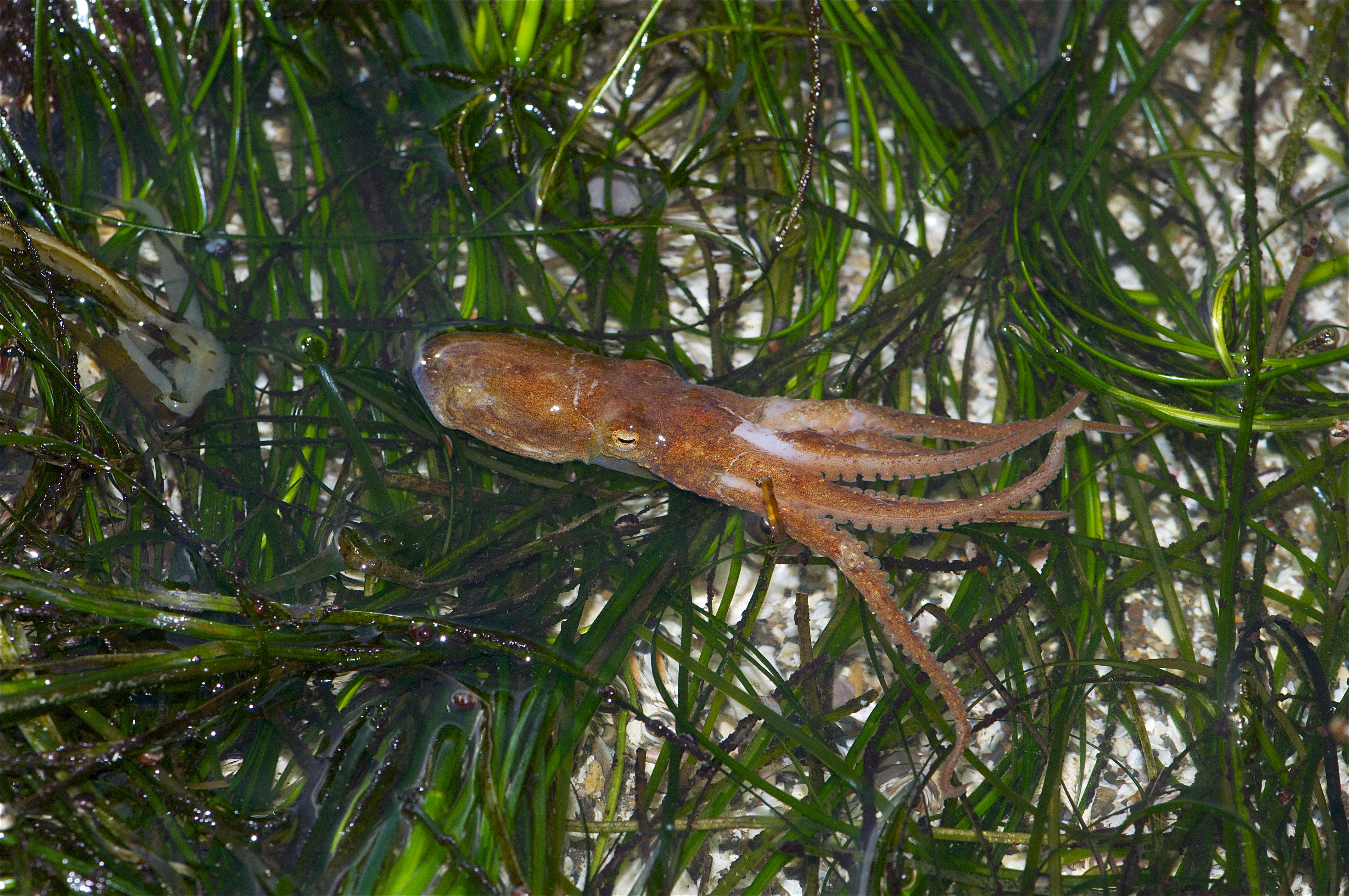
Male octopuses do not need to see a partner, or even touch her with their bodies, to court her. In lab tanks split by a black wall, California two-spot octopuses reached one special arm through small holes, found a female by taste and mated without ever laying eyes on each other.
"They mated through the divider," lead author Pablo Villar of Harvard said in the Okinawa Institute of Science and Technology's release on the study. The scientists described the couples freezing in place: "Both the male and female paused all movement, sometimes for over an hour during spermatophore transfer."
An arm that tastes for love
Every male octopus has one arm, the hectocotylus, set aside for reproduction. It carries a groove that passes a sperm packet to its tip, and in mating it slips into the female's mantle to deliver it. The new work, published on April 2, 2026, in the journal Science, shows that same arm is also a sensory organ.
"The specialized arm for mating had been documented long ago, but it wasn't known that it's also a sensory organ," said senior author Nicholas Bellono, a Harvard professor of molecular and cellular biology.
The tip of the arm turned out to be studded with small suckers dense with nerves and sensory cells. Females, who could retreat to an unreachable corner, often welcomed the approach. Males found them even in total darkness. Two males put together never tried to mate.
The hormone trick
The team traced the signal to progesterone, a female sex hormone. Tissue from female reproductive organs was rich in its precursors. When scientists swapped the female for tubes coated in progesterone, males probed those tubes just as they would a female's mantle and ignored tubes smeared with other chemicals.
Then came the truly strange part. A severed hectocotylus, exposed to progesterone, still moved vigorously on its own. The receptor doing the work, called CRT1, was already known for sensing microbes on prey.
The behavior is not limited to one species. A lab at OIST found the Okinawan octopus Abdopus aculeatus could also mate with no visual cues at all.
A long history of confusion
The arm has fooled scientists before. Aristotle knew of it but doubted a tentacle could deliver sperm. In 1829 the French naturalist Georges Cuvier found one lodged in a female argonaut, mistook it for a parasitic worm and gave it a name of its own, Hectocotyle, from Greek words for "hundred" and "cup," as Wikipedia's entry on the hectocotylus recounts. In argonauts the arm actually breaks off and stays with the female.
The octopus that breaks the rules
Keeping an arm's length is the norm. Researchers led by Roy Caldwell of the University of California, Berkeley, reported in a 2015 PLOS ONE study of the Larger Pacific Striped Octopus that all other known octopuses mate in a "distance" or "mount" posture. This one goes face to face, beak to beak, often with grappling, and pairs sometimes even share a den and a meal. Males came away with the female's sucker marks on them.
There may be a good reason most species keep their distance: the same paper notes that some octopuses can be cannibalistic, in captivity and in the wild.
For more on these eight-armed animals, read how octopus arms hold two-thirds of their 500 million neurons and how octopuses change color with pigment sacs.
Bellono's team sees a bigger payoff: because these receptors evolve fast, they may help keep closely related octopus species apart.
Sources
- These arms are made for loving, Okinawa Institute of Science and Technology, 2026
- A sensory system for mating in octopus (Villar et al.), Science, 2026
- Hectocotylus, Wikipedia, 2026
- Behavior and Body Patterns of the Larger Pacific Striped Octopus (Caldwell et al.), PLOS ONE / PubMed Central, 2015
Image: Jerry Kirkhart, CC BY 2.0 via Wikimedia Commons
This article was produced with AI assistance and reviewed by our Editorial Desk. How we work.