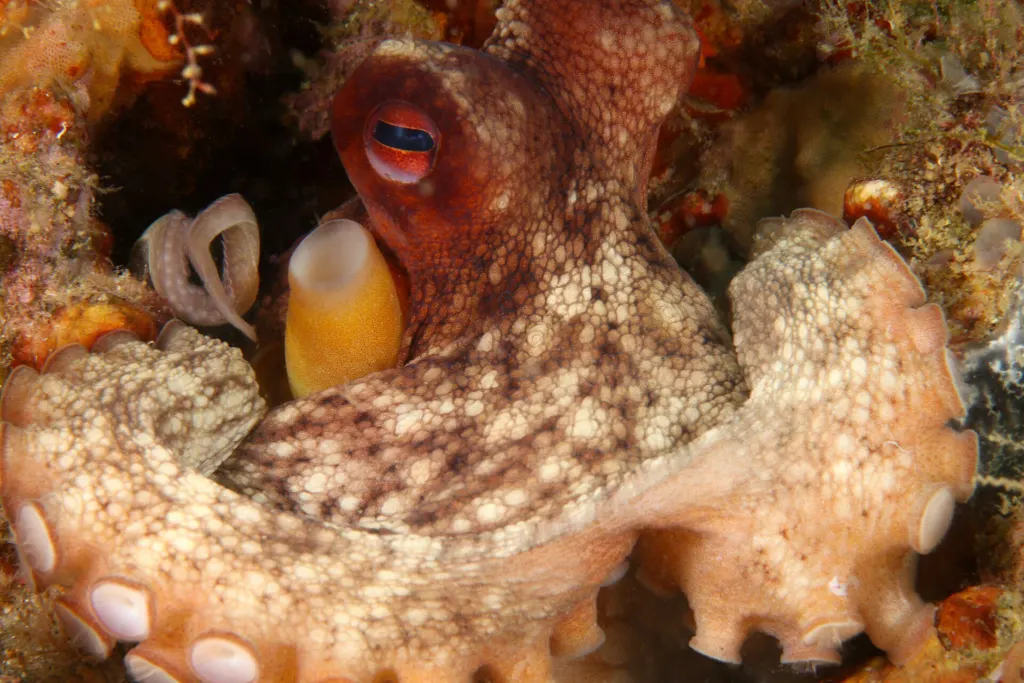
Most of an octopus’s brainpower is not in its head. Of the more than 500 million neurons in an octopus, about the same count as a dog, roughly two-thirds sit in the nerve cords that run down its eight arms. That is why an octopus arm can make some decisions on its own, and why a severed arm can still move and react to touch.
University of Chicago researchers have now shown how that arm wiring is laid out: in segments, stacked like the ridges of a corrugated pipe.
A nerve cord built in sections
Each arm carries a thick axial nerve cord that zigzags down its length, bulging over every sucker. Cassady Olson, a graduate student in computational neuroscience, led the study on the California two-spot octopus, Octopus bimaculoides, with co-author Grace Schulz and senior author Clifton Ragsdale, professor of neurobiology. Their paper, “Neuronal segmentation in cephalopod arms,” appeared in Nature Communications on January 15, 2025.
The discovery started with a lab annoyance. Thin round slices of arm kept sliding off the microscope slides, so the team switched to long strips cut along the arm. In those strips, the nerve cell bodies showed up packed into columns forming distinct segments, separated by gaps called septa. Nerves and blood vessels leave through those gaps to reach nearby muscles, and nerves from several segments feed the same muscle regions, which suggests the segments cooperate.
“Thinking about this from a modeling perspective, the best way to set up a control system for this very long, flexible arm would be to divide it into segments,” Olson said in the university’s announcement.
A map of every sucker
The sucker nerves follow the same plan. They leave through the septa and wire to the outer rim of each sucker in an orderly pattern, giving the octopus a spatial map of its suckers that the team nicknamed “suckeroptopy.” That matters because octopus suckers are more than grippers. They carry chemical receptors that let the animal taste what it touches, and each sucker can move and change shape independently.
Squid tell the same story
To test whether this was an octopus quirk, Olson also examined the longfin inshore squid, Doryteuthis pealeii. The squid’s tentacle stalks, which have no suckers, showed no segmentation. The sucker-tipped clubs at the ends did. Octopuses and squid split more than 270 million years ago, so finding the same pattern only where suckers are suggests the design evolved for dexterous, sucker-covered limbs.
“Organisms with these sucker-laden appendages that have worm-like movements need the right kind of nervous system,” Ragsdale said.
The neuron math
Here is a rough sense of scale, using the round numbers above. Two-thirds of 500 million is about 333 million neurons in the arms. Spread across eight arms, that comes to around 40 million per arm, on average. Counts vary by species and by study, so treat that as an order-of-magnitude figure rather than a measured one, but it shows why each arm behaves almost like a small partner brain.
Smart arms, odd limits
The setup has trade-offs. Learning happens mainly in the central brain, while the arms act on the information they are given. Octopuses also appear to have a poor sense of where their limbs are, and rely on sight to keep track of them. Their skin has a chemical signal that stops suckers from grabbing their own arms, which would otherwise be a real risk with eight independently busy limbs.
Engineers are paying attention. Soft robots that crawl and swim with minimal computing, and silicone grippers with rows of suckers, have both borrowed from the octopus arm.
For another look at cephalopods, see Badiyaa’s story on Humboldt squid, which grow 5-foot bodies and swarm in shoals of 1,200, or find more ocean animals in the Pets & Animals section.
Further reading
Image: National Marine Sanctuaries, Public domain via Wikimedia Commons
This article was produced with AI assistance and reviewed by our Editorial Desk. How we work.