Eighteen years of seafloor recordings from 35 sites off northwest Australia have given researchers their clearest picture yet of where Omura’s whales spend their time: in water warmer than about 27.5°C (81.5°F), and roughly a month after a bloom of plankton. The study, led by PhD student Ciara Browne at Curtin University’s Centre for Marine Science and Technology in Western Australia, was published on October 19 in the journal Marine Mammal Science.
A whale known mostly by its voice
Omura’s whale was only formally named in 2003, when three Japanese scientists described it from nine specimens, including a female that stranded on Tsunoshima island in the Sea of Japan in 1998. For decades before that, it had been lumped in with a small form of Bryde’s whale. Adults run to roughly 10 to 11.5 meters (33 to 38 feet), which makes it one of the smallest rorquals, the family that includes the blue whale. It is the only baleen whale the IUCN still lists as Data Deficient, meaning there is too little information to judge its extinction risk.
Sightings off Australia are rare. Its song is not: a two-part call between 17 and 50 hertz, lasting about 15 seconds, and loud enough to pick up tens of kilometers away. “Omura’s whales are notoriously difficult to study because visual sightings are rare, so listening for their calls provides an important way of understanding where they occur,” Browne said in the university’s announcement.
What the recorders showed
The team did not deploy new equipment. It reused 72 recorder deployments made between 2005 and 2023 for other projects, spread over about 1,800 kilometers (1,100 miles) of coast and reaching up to 500 kilometers offshore. Software flagged candidate calls, and analysts checked them by hand.
The whales were heard in every month, but far more often from September to May, the southern warm season. Statistical models tied their presence to sea surface temperatures above 27.5°C, stronger winds, and chlorophyll levels recorded 30 days earlier. Same-day chlorophyll did not predict anything. The authors read that delay as the time it takes for a plant-plankton bloom to feed the krill-like prey the whales actually eat. The best-performing model explained 65.6 percent of the variation in daily call presence. Calls were most likely about 200 kilometers from the coast, over the shelf and its outer edge.
That pattern matters because it sets Omura’s whales apart from humpbacks and blue whales, which fatten up in cold feeding grounds and then live off their reserves while breeding in warm water. The Australian data fit what biologists call an income breeder: an animal that has to keep eating where it lives, all year, to fund reproduction. A resident population studied off Madagascar points the same way; four whales tagged there in 2016 each stayed within a coastal range of 230 to 405 kilometers.
How much shipping noise costs the listeners
The paper also modeled how far each recorder could hear a calling whale. In deep water away from shipping lanes, the median range reached 62 kilometers. In deep water near shipping lanes it fell below 29 kilometers. Because the area a recorder covers grows with the square of its range, that drop is larger than it looks: (29 ÷ 62)² is about 0.22, so a recorder near busy lanes listens over roughly a fifth of the ocean it could cover in quiet water. In shallow water under 200 meters deep, ranges were 16 to 43 kilometers.
“This knowledge can help inform marine planning and improve our understanding of potential impacts from activities such as shipping, offshore industry and other sources of underwater noise,” co-author Christine Erbe, the centre’s director, said.
Limits of listening
The authors are candid about gaps. Recorders hear only whales that are calling, so silence is not proof of absence. Song is the only call yet linked to the species, and in other baleen whales singing is done by males, so females and calves may be undercounted. Because the recorders were placed for other studies, some stretches of coast were never sampled at all.
The paper is the fourth recent Omura’s whale study led by Browne. If the pattern holds, the odds of hearing one off northwest Australia are climbing right now: the September-to-May peak season began last month.
Further reading
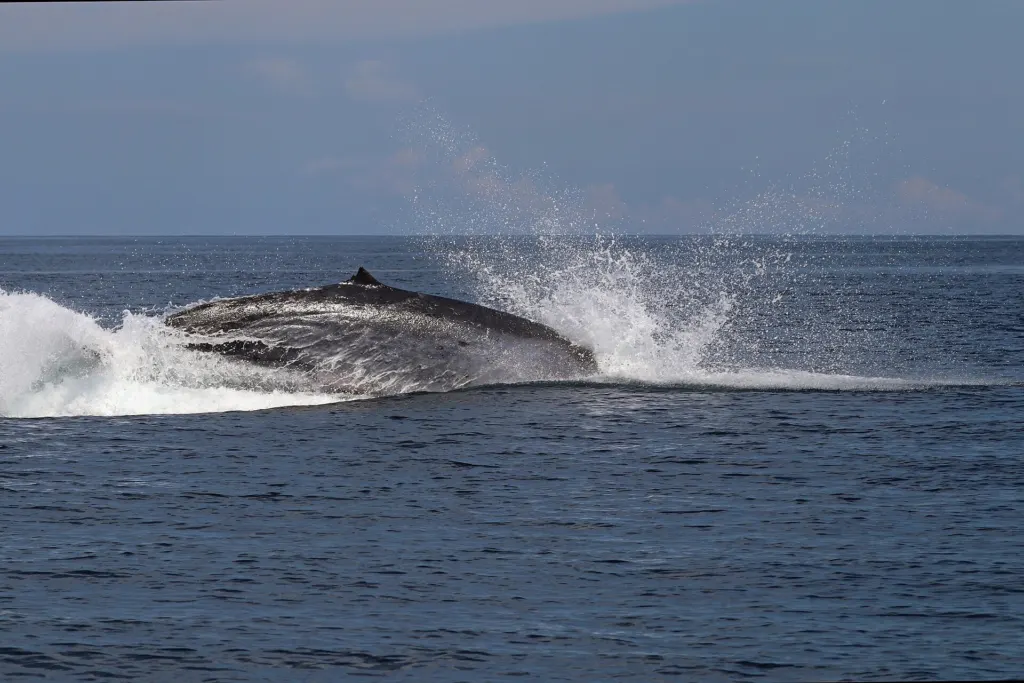
Image: Charles J. Sharp, CC BY-SA 4.0 via Wikimedia Commons
This article was produced with AI assistance and reviewed by our Editorial Desk. How we work.