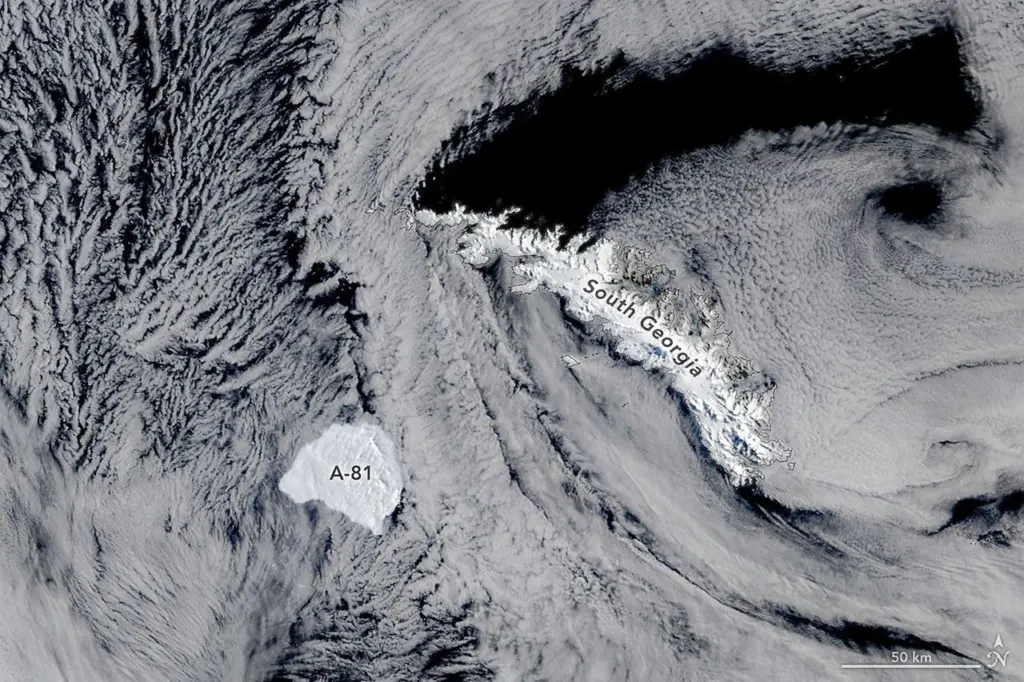
Iceberg A-81, a slab of Antarctic ice covering about 600 square miles (1,550 square kilometers), has slowed to a crawl at the edge of South Georgia’s undersea shelf after a voyage of roughly 1,400 miles (2,300 kilometers) that began in January 2023. A satellite image released by NASA Earth Observatory as its Image of the Day on October 27 shows the berg on October 20, sitting just off the remote British island in the South Atlantic.
That makes A-81 the third giant iceberg in six years to come knocking at South Georgia, an island whose waters feed penguins and seals. Ice analysts Jan Lieser of Australia’s Bureau of Meteorology and Christopher Shuman, a retired University of Maryland researcher, noted that its progress dropped off sharply in the days before the image was taken, as if it were scraping along the shelf edge.
How a 600-square-mile berg left the Brunt Ice Shelf in 2023
A-81 broke away from the Brunt Ice Shelf, a floating sheet of ice about 490 feet (150 meters) thick, on Sunday, January 22, 2023, in the hour after 19:00 UTC, as a spring tide ran. The British Antarctic Survey announced the calving the next day, describing a block almost as large as Greater London.
The split followed a crack called Chasm-1. It had sat dormant for at least 35 years before satellites caught it growing again in 2012; by December 2022 it ran across the whole shelf. That slow fuse matters because the shelf hosts the survey’s Halley VI Research Station, which was hauled 14 miles (23 kilometers) inland of the chasm in 2016 as a precaution.
“This calving event has been expected and is part of the natural behaviour of the Brunt Ice Shelf. It is not linked to climate change,” said Dominic Hodgson, a glaciologist with the survey, at the time. The shelf is watched by a network of 16 GPS instruments that report how the ice deforms.
Three years in the Weddell Sea, then a sprint north
Once free, A-81 rode the Weddell Gyre, a clockwise ocean current that sweeps along the Antarctic coast, for more than three years. It reached the tip of the Antarctic Peninsula by May 2026, crossed into the Scotia Sea and by late October was nearing South Georgia.
Here is the arithmetic on that pace. From January 22, 2023, to October 20, 2026, is 1,367 days. Dividing the 1,400-mile straight-line distance by 1,367 days gives an average of about 1 mile (1.7 kilometers) a day. The real track hugged the coast and was far longer, so that figure is a floor.
Three giant visitors to South Georgia’s shelf since 2020
The island’s underwater shelf, where water depths fall below about 650 feet (200 meters), has a record of catching drifting ice. A comparison of the three recent visitors:
- A-68A (2020): broke from the Larsen C Ice Shelf in July 2017 and was less than 62 miles (100 kilometers) offshore by December 14, 2020, when part of it was reported in water just 249 feet (76 meters) deep.
- A23a (2025): calved from the Filchner-Ronne Ice Shelf in 1986, measured about 1,400 square miles (3,500 square kilometers) in January 2025 and ran aground about 45 miles (73 kilometers) from South Georgia in March 2025. It was moving again by July, broke apart from September, and had shrunk to 69 square miles (180 square kilometers) by March 2026.
- A-81 (2026): roughly 600 square miles, less than half the size A23a was when it neared the island, and now bumping the shelf edge.
Why that shelf matters: a berg wedged in shallow water can sit for months. In 2020, biologists worried that a grounded A-68A could make it harder for penguins to reach their feeding grounds. Another berg, A-43B, stalled in a similar spot for several months in 2004 before currents carried it around the island.
What one satellite image cannot tell us
The evidence for A-81’s stall rests on a single natural-color image from the MODIS instrument on NASA’s Terra satellite plus the drift observations of two ice analysts. Nobody has published a measurement of how deep the berg’s keel reaches, so it is not yet clear whether A-81 is grounded or only slowed. A-68A showed how quickly that can change: during its drift it switched rotation direction, sped up, halted and circled.
There is also a question the image does not settle about cause. The survey has said the Brunt Ice Shelf’s cracking is a natural process, with no evidence that climate change played a significant role, and it set that apart from the rapid, meltwater-linked calving on the Larsen C Ice Shelf. No study yet ties A-81’s route or speed to warming.
The bigger pattern is a clear-out. Brunt also shed iceberg A-74 from its North Rift in February 2021, a 490-square-mile (1,270-square-kilometer) block that has since broken up, and A-83 from the Halloween Crack in 2024. A-83 is still intact and following A-81 north, along with a handful of other bergs leaving the Weddell Sea.
NASA’s account drew on the U.S. National Ice Center’s Antarctic Iceberg Files dated October 22, 2026. The next updates to those files will show whether A-81 stays pinned, as A23a did after grounding in early March 2025, until it was drifting again by July.
Further reading
- NASA Earth Observatory: A-81 Reaches South Georgia
- British Antarctic Survey: Brunt Ice Shelf in Antarctica calves giant iceberg
- Wikipedia: A23a
Image: NASA Earth Observatory/Michala Garrison, Public domain via Wikimedia Commons
This article was produced with AI assistance and reviewed by our Editorial Desk. How we work.