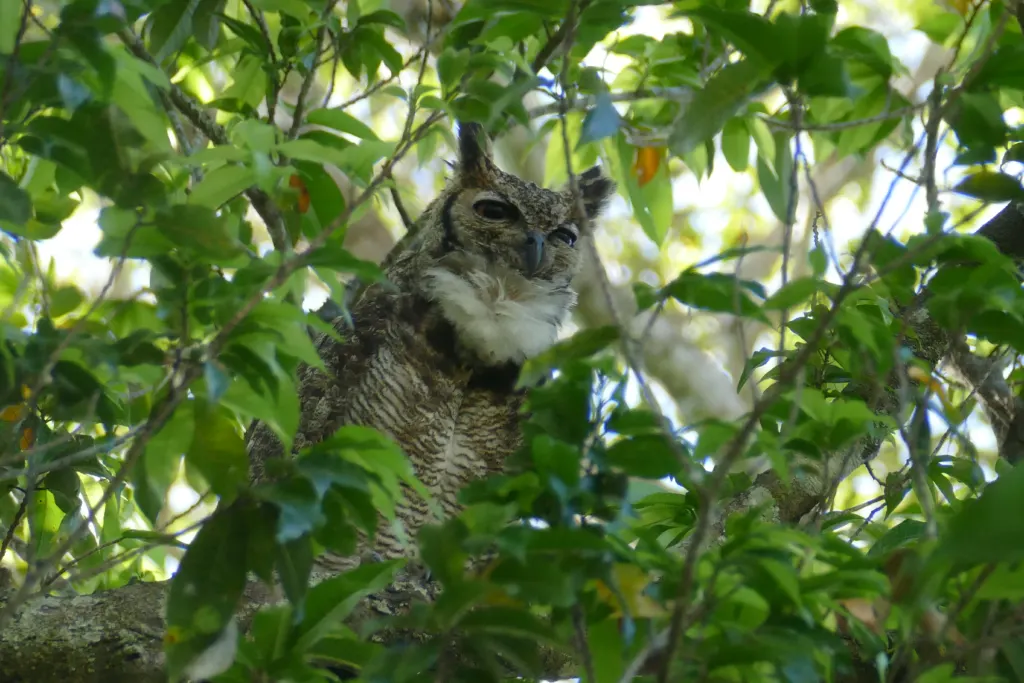
An owl can swivel its head as far as 270 degrees in either direction, enough to look straight over its own back with room to spare, and it does so without choking off blood to its brain. A team at Johns Hopkins worked out how, by injecting dye into the arteries of owls and turning their heads by hand.
Why owls need the twist
The trick starts with the eyes. Owl eyes are so large for the skull that they have become tube-shaped, and they sit fixed in bony sockets. An owl cannot roll its eyes to the side the way a person can, so it turns its whole head instead.
That has an upside for a hunter. Swiveling only the head keeps the body still, which means less noise while the owl waits for a mouse to move. Its forward-facing eyes also give owls some of the widest binocular vision of any bird group, useful for judging distance in low light.
What Johns Hopkins found
The study was led by medical illustrator Fabian de Kok-Mercado, then a graduate student in the Department of Art as Applied to Medicine, with interventional neuroradiologist Philippe Gailloud as senior investigator. The team examined snowy, barred and great horned owls that had died of natural causes, using contrast dye, X-ray angiography, CT scans and careful dissection. Their illustrations won first place for posters and graphics in the National Science Foundation’s 2012 International Science & Engineering Visualization Challenge, announced in Science on February 1, 2013.
Gailloud explained the puzzle bluntly. Specialists in human artery injuries, he said, “have always been puzzled as to why rapid, twisting head movements did not leave thousands of owls lying dead on the forest floor from stroke.”
The answer turned out to be four adaptations working together:
- Roomy bone tunnels. In the neck, the vertebral artery runs through holes in the vertebrae. In owls those holes are about 10 times wider than the artery, leaving slack for it to shift when the neck twists. Twelve of the owl’s 14 neck vertebrae have this feature. Humans have seven neck vertebrae, and in us the artery fits snugly.
- A higher entry point. The owl’s vertebral artery enters the neck at the 12th vertebra rather than the 14th, giving the vessel extra length to play with.
- Blood reservoirs. When the researchers turned the heads of dye-filled specimens, vessels at the base of the head, just under the jaw, kept swelling and pooling the dye. In humans, arteries tend to narrow as they branch. The owl’s reservoirs appear to bank blood for its large brain and eyes during a turn.
- Backup connections. Small links between the carotid and vertebral arteries let blood switch routes if one path is pinched during a rotation.
“In humans, the vertebral artery really hugs the hollow cavities in the neck. But this is not the case in owls,” de Kok-Mercado said in the Johns Hopkins announcement.
The math of 270 degrees
Turning 270 degrees to the left lands an owl’s face at the same bearing as a 90-degree turn to the right. Looking straight behind needs only 180 degrees, so an owl reaches directly backward with 90 degrees of turn still in reserve, from either side. Add both directions together and the head can sweep through 540 degrees of travel without the body moving at all.
Hearing does the rest
The head turns are also how owls aim their ears. In barn owls and some other species the ear openings sit at different heights on the skull, so sound reaches one ear a tiny fraction of a second before the other, about 30 microseconds. The owl turns its head until the sound arrives at both ears at once, and at that point it is facing its prey.
Badiyaa has looked at that hearing system before, in the story of young barn owls fitted with prism goggles that rewired their hearing, and at one of North America’s smallest owls in the eastern screech owl, which whinnies like a tiny horse.
The Johns Hopkins team said its next step was to examine hawks, to see whether other birds share the same head-turning anatomy.
Further reading
Image: Bernard DUPONT, CC BY-SA 2.0 via Wikimedia Commons
This article was produced with AI assistance and reviewed by our Editorial Desk. How we work.