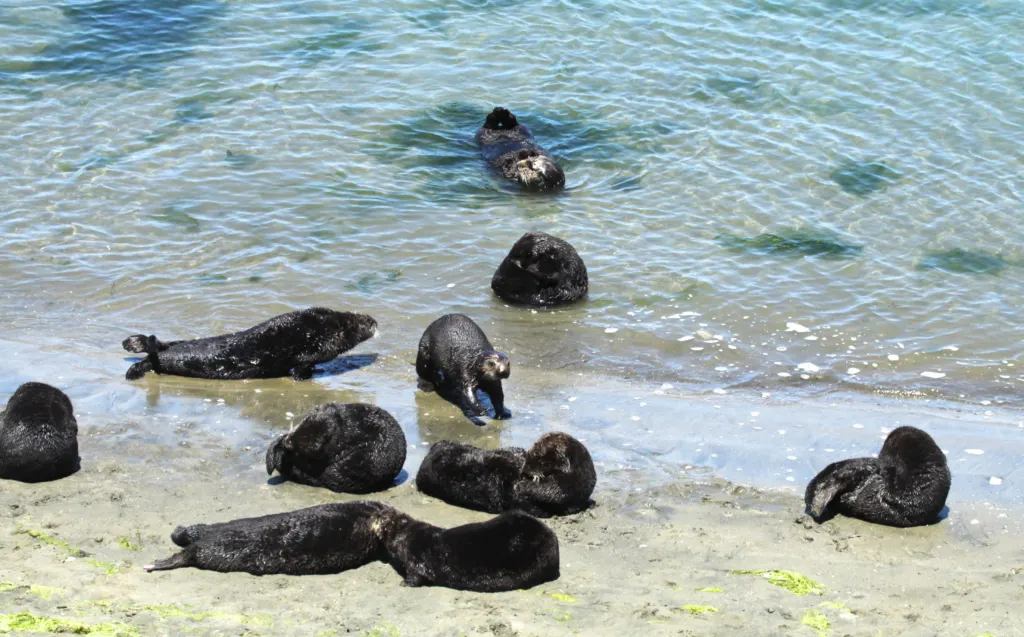
A sea otter floating on its back off California is often running a small workshop on its belly. It tucks a rock into a loose pouch of skin under its foreleg, dives for a clam or mussel, surfaces, sets the rock on its chest and pounds the shell against it until it cracks. That habit makes the sea otter one of the few mammals known to use tools.
When it comes to abalone, the effort is extreme. Otters hammer the shell with a large stone at observed rates of 45 blows in 15 seconds, and because an abalone can cling to rock with a force of 4,000 times its own body weight, prying one loose can take several dives.
The toolkit
- The pouch: a fold of skin under each foreleg that stretches across the chest. Otters prefer the left one, and use it to carry food, and sometimes a favorite rock, up from the seafloor.
- The anvil: a rock balanced on the chest, used to smash hard shells with both paws.
- The hammer: a heavier stone swung against an abalone still stuck to the reef.
- The paws: sea otters are the only marine animal able to lift and flip rocks while hunting, and the only marine mammal that catches fish with its forepaws instead of its teeth.
Not every otter learns every trick. Research summarized on Wikipedia notes that sea otters show social learning, with skills passed from mother to pup and spread within groups, though whether that adds up to a true culture is still unresearched.
Why they eat so much
Unlike seals and whales, sea otters have no blubber. They stay warm with the densest fur of any animal, up to 150,000 hairs per square centimeter, plus a high metabolism, two to three times that of a land mammal their size. To keep it running, an otter must eat an estimated 25% to 38% of its body weight every day.
Put that into numbers. A 30-kilogram (66-pound) adult, mid-range for the species, needs roughly 7.5 to 11.4 kilograms (17 to 25 pounds) of shellfish, urchins and crabs a day. A large share of that comes in hard shells, which explains why the rock is worth carrying.
The hand-holding photos
Otters also hold on to things while they rest. They gather in single-sex groups called rafts, usually 10 to 100 animals strong; the largest raft on record held more than 2,000. To avoid drifting out to sea while resting or eating, they wrap themselves in kelp, and mothers sometimes wrap a pup in kelp before diving to forage.
Pictures of sleeping otters floating paw in paw are some of the most shared animal images online, and Wikipedia carries one such photo of sleeping sea otters holding paws. How often wild otters do this, and whether it serves the same anchoring job as kelp, is less well documented than the tool use, so treat it as an observed behavior rather than a settled rule.
From near extinction to keystone
The fur that keeps otters alive nearly wiped them out. Hunters took them in huge numbers from 1741 until 1911, when an international treaty banned the harvest; by then the world population had dropped from an estimated 150,000 to 300,000 to just 1,000 to 2,000. California’s otters recovered from a remnant of about 50 animals at Big Sur and now number around 3,000 in the wild.
The rebound matters beyond the otters. By eating sea urchins, they act as a keystone species: without them, urchins can strip kelp forests bare.
Captive otters show off the same busy paws. Badiyaa has written about the Oregon Zoo’s rescued sea otters slam-dunking mini pumpkins, a game that began as arthritis care, and about the Monterey Bay Aquarium, which sits on the coast where California’s otters made their comeback.
Further reading
Image: USFWS Pacific Southwest Region, Public domain via Wikimedia Commons
This article was produced with AI assistance and reviewed by our Editorial Desk. How we work.