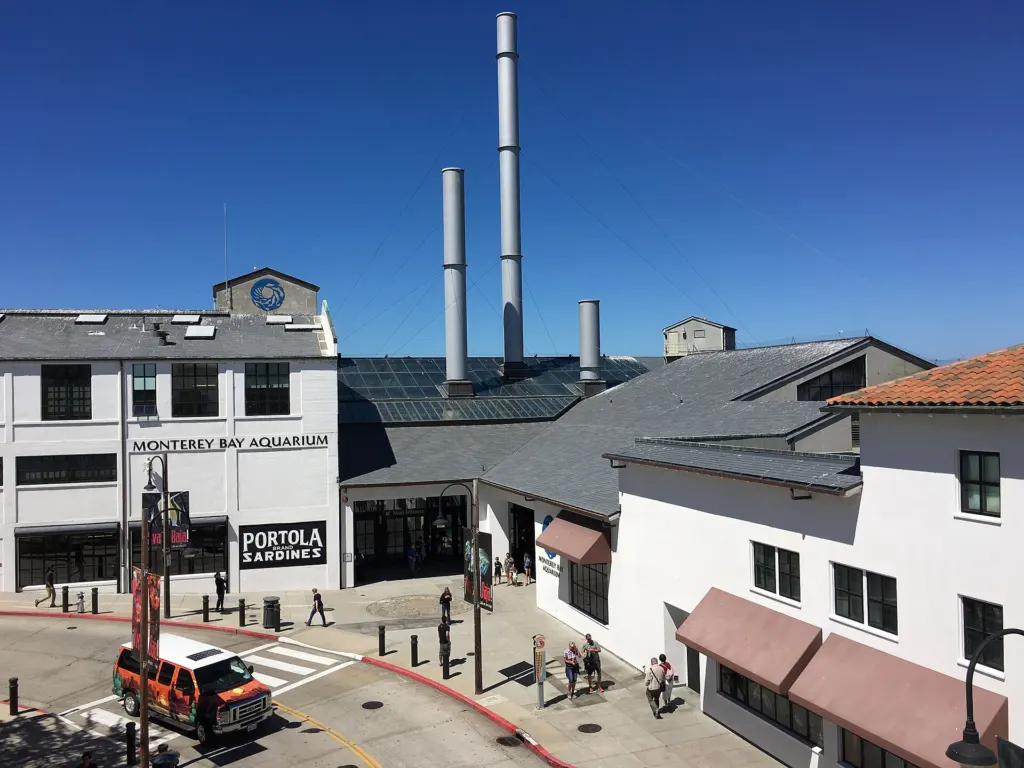
The Monterey Bay Aquarium marked 42 years on Tuesday, October 20, and its origin story is circulating widely again this week: a California sardine cannery that went silent in 1973 was rebuilt, with one family’s money, into one of the most visited aquariums in the United States. The version being shared online puts the founding gift at $57 million. The aquarium’s own published history gives a different number, and the gap is worth a closer look.
From sardines to squid to silence
Knut Hovden opened his plant on Cannery Row on July 7, 1916, and it grew into the biggest sardine operation on that famous Monterey street. The good years did not last. Pacific sardine catches collapsed in the early 1950s, and the plant tried to survive by packing squid instead. Sales never recovered, and the doors closed in 1973.
The location turned out to matter more than the machinery. The empty building sat beside Hopkins Marine Station, a Stanford University research site, and Stanford bought it. A few years later, in November 1977, a group began sketching plans for an aquarium devoted to the sea life just offshore.
The gift, checked against the record
In April 1978, marine scientists, local residents and people from the David and Lucile Packard Foundation set up the Monterey Bay Aquarium Foundation. David Packard was the Silicon Valley pioneer behind Hewlett-Packard, and two of his daughters had studied marine biology. He and Lucile made what the aquarium calls a one-time personal gift to pay for construction.
The aquarium’s timeline says that construction ultimately totaled $55 million. A philanthropy almanac profile of the project also puts the Packards’ gift at $55 million, and adds a condition: once open, the aquarium had to pay its own way.
So where does $57 million come from? Our best explanation is a mix-up with a later project. The aquarium’s history lists a second wing, the Open Sea galleries, which opened in March 1996 with a million-gallon tank of tunas, hammerhead sharks, sea turtles and sunfish. The aquarium gives that wing’s price as $56 million, and some secondary accounts round it differently. Two big construction bills a decade apart are easy to blend. Badiyaa is using the aquarium’s own $55 million for the original gift.
A quick timeline
- 1916: Hovden’s cannery opens on Cannery Row.
- Early 1950s: the sardine fishery collapses; the plant switches to squid.
- 1973: the cannery closes; Stanford buys the building.
- April 1978: the aquarium foundation forms, backed by the Packard gift.
- October 20, 1984: opening day draws 10,681 visitors.
- March 1996: the Open Sea wing opens.
- May 2026: Jenny Gray takes over from founding director Julie Packard.
What the money built
Run the dates and a neat symmetry appears: the cannery operated for 57 years, from 1916 to 1973, while the aquarium in its shell has now been open for 42. By the aquarium’s count it had welcomed more than 70 million visitors by the end of 2023, and more than 2.75 million schoolchildren had come through its education programs since they began in March 1985. That works out to roughly one student for every 25 visitors.
The self-funding rule shaped the place. A philanthropy profile credits local loyalty for much of the income, saying 45 percent of Monterey Peninsula residents hold memberships, part of more than 107,000 member households. Visitors come for otters, jellies and kelp, and the aquarium has used that crowd to push for conservation laws, including a 2011 California ban on the shark fin trade that it says it campaigned for.
A new chapter in the old cannery
This anniversary is the first without Julie Packard in charge. She had run the aquarium since it opened in 1984, as its first and only executive director. In March the board named Jenny Gray, who had led Zoos Victoria in Australia since 2007, as chief executive, with a start date in May. Packard stays on the board.
“I can’t imagine a better person to come lead the Aquarium’s next chapter,” Packard said when the appointment was announced. Gray, for her part, called the job “a platform for me to contribute to ocean conservation.” Her first full year in the converted cannery ends in May 2027.
Further reading
Image: Rhinopias, CC BY-SA 4.0 via Wikimedia Commons
This article was produced with AI assistance and reviewed by our Editorial Desk. How we work.
Spot an error? Help verify this story
The story in 5 slides