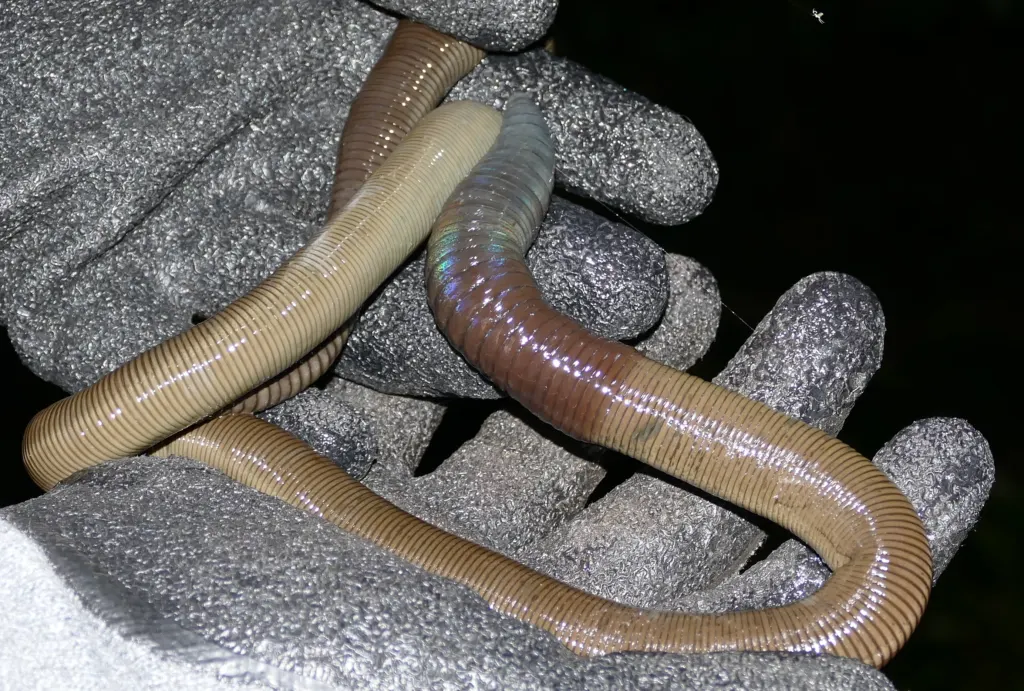
Somewhere under the cow pastures of southeastern Australia lives an earthworm that can stretch to 3 meters, or about 10 feet. The giant Gippsland earthworm (Megascolides australis) usually measures around a meter long and 2 centimeters across, but the biggest specimens are longer than most people are tall.
It is one of roughly 1,000 earthworm species native to Australia, and it lives nowhere but Gippsland, a region in the state of Victoria east of Melbourne.
A worm built like a garden hose
An average adult weighs about 200 grams, or 7 ounces. Its head is dark purple, its body is blue-gray, and it is divided into some 300 to 400 segments. The body can stretch and contract, which makes the worm look even longer than it is when it extends.
To put that in perspective, the familiar nightcrawler of European and North American gardens, Lumbricus terrestris, is the largest native earthworm across much of Europe and typically reaches 20 to 25 centimeters when extended, with around 120 to 170 segments. A 3-meter Gippsland giant is therefore 12 to 15 times longer than a well-stretched nightcrawler and carries more than twice as many segments. Even a newly hatched Gippsland worm, at about 20 centimeters, is as long as a grown nightcrawler.
You can hear it before you see it
Most earthworms leave their castings on the surface. This one does not. It spends nearly its whole life in deep burrows about 52 centimeters (20 inches) down in blue, gray or red clay along stream banks and on some south- or west-facing slopes, and it leaves its waste underground. Heavy rain is usually the only thing that drives it to the surface.
It is normally slow, but it can move quickly through its tunnels, and when it does it makes a gurgling, sucking noise that people above can hear. That sound is one of the ways the worm is detected. It needs water around it to breathe and feeds on organic matter along with bacteria and fungi, a diet that may have helped it cope when the forests above it were cleared for pasture.
A slow life and a fragile future
The species lives long by invertebrate standards and can take five years to mature. Breeding happens mainly from September to December, the southern spring. Adults lay egg capsules 4 to 7 centimeters long in their burrows, and the young take about 12 months to hatch.
That slow pace is a problem. Colonies are small and cut off from one another, so they recover slowly from any loss. The worm is listed as Endangered by the IUCN. It can survive beneath pasture, but plowing, heavy cattle grazing and effluent run-off harm it, and so does dense tree planting, which dries out the moist soil it depends on. Nobody has yet bred the species successfully in captivity.
Local celebrity
Gippsland has embraced its giant. The town of Korumburra holds an annual Karmai Festival named after the worm, and karmai is said to be its name in the Boonwurrung language. A worm-shaped Giant Earthworm Museum near Bass, Victoria, once let visitors crawl through a giant replica burrow before the park that housed it closed in 2012.
Australia’s other slow comeback stories include the northern hairy-nosed wombat, which grew from 35 animals to more than 400, and the Wollemi pine, a living fossil with just 46 adult trees left in the wild. For another small Australian animal with outsized habits, meet the 20-gram willie wagtail that dive-bombs kookaburras.
Further reading
Image: Bernard DUPONT, CC BY-SA 2.0 via Wikimedia Commons
This article was produced with AI assistance and reviewed by our Editorial Desk. How we work.