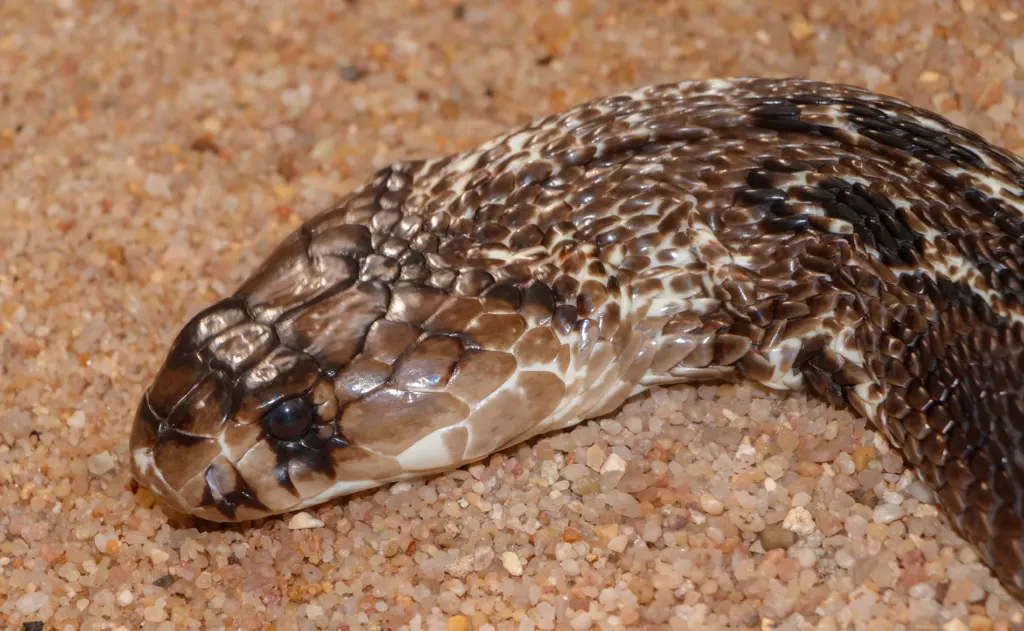
Four snakes do most of the damage on the Indian subcontinent. Russell’s viper, the common krait, the Indian cobra and the saw-scaled viper are known together as the Big Four, and they are blamed for the bulk of medically serious bites across India and Sri Lanka.
The toll is large: the group is linked to an estimated 46,000 to 60,000 human deaths a year. A 2020 nationwide analysis of Indian snakebites put Russell’s viper at the top with 43% of bites, then kraits at 18% and cobras at 12%, while about one bite in five came from a snake nobody identified.
Russell’s viper, the heavy hitter
Russell’s viper (Daboia russelii) is a stout, patterned snake that averages about 120 centimeters (47 inches) on the mainland and tops out near 166 centimeters. Three rows of dark, black-ringed spots run down its yellow, tan or brown back. Its genus name is thought to come from a Hindi word meaning “the lurker.”
It hunts rodents, which is exactly why it turns up around farms and villages. Cornered, it loops into S-curves, lifts the front of its body and hisses, a sound said to be louder than any other snake’s. Big adults can strike so hard they lift off the ground, which fed an old myth that the species chases people.
The common krait, the night biter
The common krait (Bungarus caeruleus) is glossy black or bluish-black with about 40 thin white bands. It usually measures around 0.9 meters, and it eats mostly other snakes, including other kraits and vipers.
By day it hides in burrows and termite mounds and rarely bites. At night it moves around, slips into houses in the monsoon and is notorious for biting people who sleep on the floor. Its fangs are small and the bite can be nearly painless, so a victim may not notice it at all. Its venom attacks the nerves rather than the tissue around the bite.
The Indian cobra and the saw-scaled viper
The Indian cobra (Naja naja), the hooded snake of snake-charmer fame, completes the trio of famous names. Like the krait, it lives close to people, more so than Russell’s viper does.
The fourth member is the smallest. The saw-scaled viper (Echis carinatus) is usually no longer than 60 centimeters, yet it ranks among the worst offenders because it is common in crowded regions, hard to spot and quick to strike. Its trademark pose is a double coil shaped like a figure eight, head in the middle, ready to snap out like a spring. It travels by sidewinding, and after rain up to 80% of adults may climb into bushes; observers once counted about 20 of them piled on a single shrub.
How much venom is in one bite
Comparing each snake’s venom output with the estimated human lethal dose shows why these four are feared. A common krait yields about 10 milligrams of dry venom on average, against a lethal dose of 2 to 3 milligrams, so one average load holds roughly three to five lethal doses. A large Russell’s viper can yield 130 to 250 milligrams, and with a lethal dose of about 40 to 70 milligrams, its biggest loads hold around six. A saw-scaled viper may inject up to 12 milligrams when about 5 milligrams can kill an adult, a little more than double.
India makes a polyvalent antivenom aimed at all four species, and it is widely available there. Venom from two of the snakes has also found its way into medicine: Russell’s viper venom is used in a hospital blood-clotting test, and saw-scaled viper venom gave rise to the anticoagulant echistatin.
Snakes have long split opinion, and research suggests that babies are not born afraid of snakes. For the animal that fights back, read how mongooses take on cobras with a receptor that neurotoxins cannot grip, or meet one of the rare venomous mammals, the slow loris, which makes its toxin from a gland on its arm.
Further reading
- Wikipedia: Big Four (Indian snakes)
- Wikipedia: Russell's viper
- Wikipedia: Common krait
- Wikipedia: Echis carinatus
Image: H. Zell, CC BY-SA 3.0 via Wikimedia Commons
This article was produced with AI assistance and reviewed by our Editorial Desk. How we work.