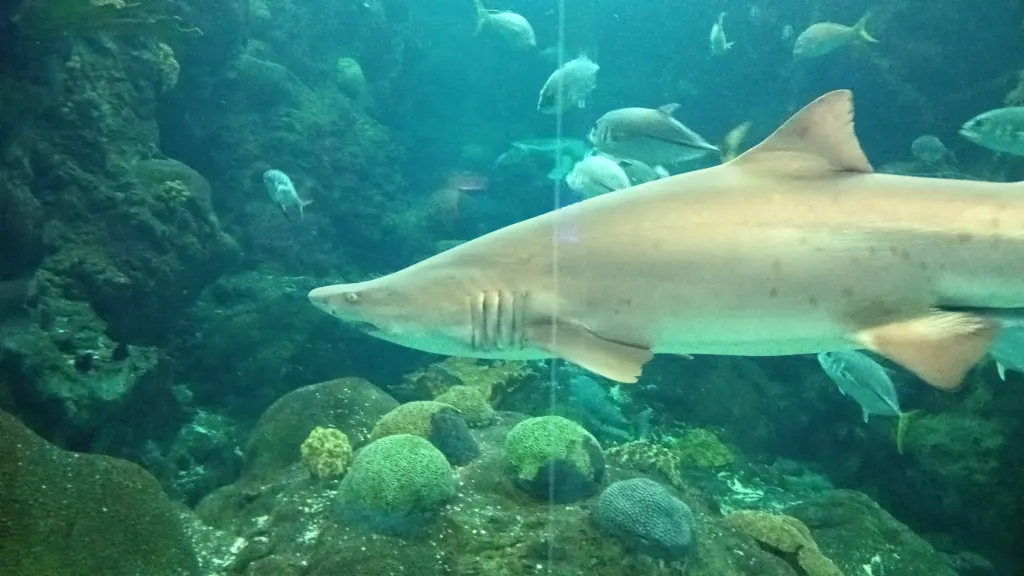
A pregnant sand tiger shark can start out carrying as many as 50 embryos. She gives birth to two. The rest are eaten in the womb by the strongest of their own siblings, one of the strangest survival strategies known in any animal.
Biologists call it intrauterine cannibalism, or embryophagy. The more vivid scientific name is adelphophagy, which translates roughly as “eating one’s brother.” It is the fact that sent the sand tiger to the top of a popular “today I learned” thread this week.
How the womb becomes an arena
Female sand tigers (Carcharias taurus) have two uterine horns, and each one starts with a crowd. Early on, the embryos live off their own yolk sacs and possibly uterine fluid. Then one embryo in each horn pulls ahead.
Once that front-runner reaches about 10 centimeters, roughly 4 inches, it turns on the smaller embryos around it until it is the only one left. With one survivor per horn, the litter is capped at two before the pups are anywhere near ready to be born.
The survivors do not go hungry after that. The mother keeps releasing unfertilized eggs, and the pups feed on that steady supply for the rest of a pregnancy that lasts about eight to twelve months.
Born big and ready to hunt
The payoff is size. Sand tiger pups arrive about 1 meter (3.3 feet) long and able to fend for themselves from day one, already built like small versions of their parents. Adults usually measure 2.2 to 2.5 meters, so a newborn is close to half its mother’s length.
There is a twist in the genetics, too. Females often mate with more than one male, so the embryos in one womb can have different fathers. Because only the biggest embryo in each horn survives, the sibling contest can wipe out every offspring of some of those males.
Why the strategy is a problem now
Run the numbers. Two survivors out of as many as 50 embryos works out to at most 1 in 25 making it to birth. Add in the fact that females breed only every second or third year, and the average sand tiger produces fewer than one pup a year, one of the lowest rates among sharks.
That slow pace has left the species exposed. The sand tiger is listed as Critically Endangered on the IUCN Red List. It is caught for food, fins, hide and liver oil, and shark nets off South Africa once snagged about 200 a year. It was last seen in the Mediterranean in 2003 and is presumed gone from that sea.
A shark that looks scarier than it is
Despite a mouth full of ragged, protruding teeth, the sand tiger is a placid, slow swimmer with no confirmed human fatalities. It is also the only shark known to gulp air at the surface and hold it in its stomach, which lets it hover almost motionless while it stalks prey at night.
That calm temperament is why it is the most widely kept large shark in public aquariums worldwide. Australians know it as the grey nurse shark, and South Africans call it the spotted ragged-tooth shark.
Sharks have more hidden senses than most people realize: read how sharks and rays detect the electric fields of hidden prey, or visit the Monterey Bay Aquarium, built inside an old California sardine cannery. More ocean animals live in our Pets & Animals section.
Further reading
Image: MatthewHoobin, CC0 via Wikimedia Commons
This article was produced with AI assistance and reviewed by our Editorial Desk. How we work.