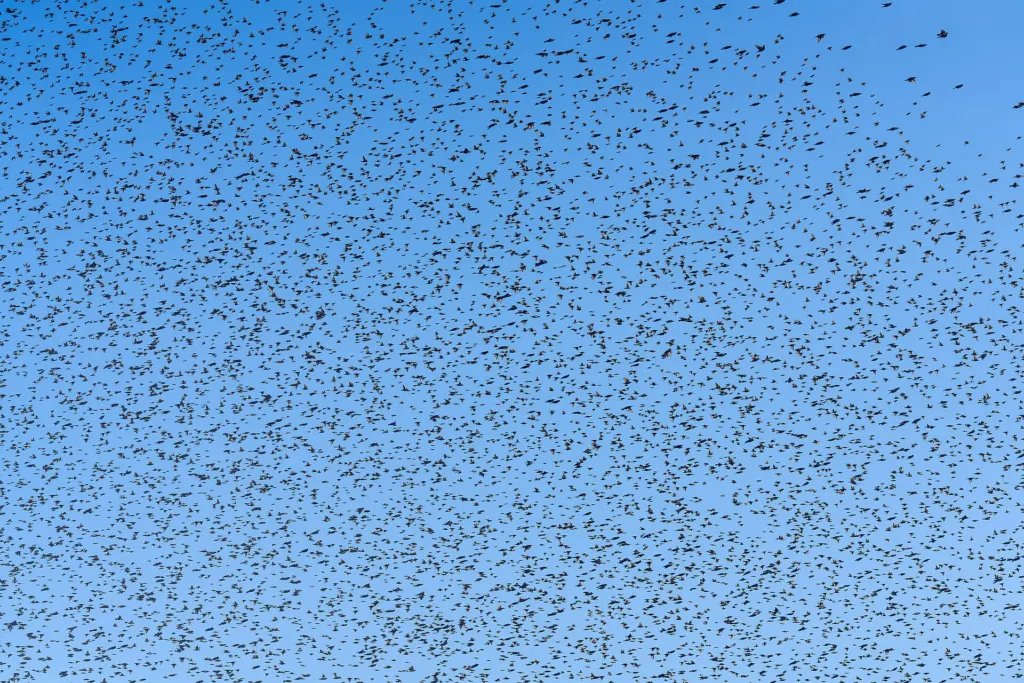
Just before sunset on a winter evening, a dark smudge over a British reedbed starts to twist, thin into a ribbon, balloon into a sphere and fold back on itself. It is made of tens of thousands of starlings, and none of them is in charge.
These shape-shifting clouds are called murmurations. In the UK they typically hold anywhere from 5,000 to 50,000 common starlings (Sturnus vulgaris) and form shortly before sundown in midwinter, near the spot where the birds will roost for the night. The synchronized beating of all those wings makes a whooshing sound you can hear hundreds of meters away.
Why starlings flock this way
The leading explanation is safety. Dense, fast-turning crowds are thought to protect the birds from aerial hunters such as peregrine falcons and Eurasian sparrowhawks. A predator diving into a swirling mass has a hard time singling out one target, and every extra pair of eyes makes a surprise attack less likely.
Flocking does have costs, including more squabbling as numbers rise, which is one reason flocks grow and shrink with the seasons. Starlings are most sociable in autumn and winter, when resident British birds are joined by arrivals from northern and eastern Europe.
How 50,000 birds avoid crashing
Each starling adjusts its own speed and heading in response to the birds right next to it. No one bird steers the flock; the patterns build up from thousands of these tiny local reactions.
A team of physicists based at Sapienza University of Rome measured how this works. After mapping where every bird sat in 3D space within real flocks, each a few thousand strong, they found that each bird interacts with a fixed number of neighbors, six to seven on average, rather than with every bird within a certain distance. Their paper appeared in the Proceedings of the National Academy of Sciences in January 2008.
That difference matters. If birds reacted to everyone within, say, one meter, a flock that suddenly spread out would lose contact and fall apart. By tracking a set count of neighbors however near or far they are, the flock stays together even as its density swings wildly, which is exactly what happens when a falcon strikes. The researchers backed this up with simulations showing the neighbor-count rule kept flocks far more cohesive.
Where to see one
Murmurations gather near roosts, and starlings like to roost in reedbeds, woodlands and even city centers. Very large roosts can hold up to 1.5 million birds.
Wetland reserves with big reedbeds are classic viewing spots. Fairburn Ings in West Yorkshire is one such place: a 266-hectare RSPB-managed reserve beside the River Aire whose lakes formed where old coal-mine workings subsided. It has recorded around 280 bird species, an unusual tally for an inland UK site.
Denmark has the giant version. In spring, flocks of more than a million starlings gather at sunset over the marshes of southwestern Jutland, between Tønder and Ribe, a spectacle Danes call sort sol, or “black sun.”
A rough guide: if a single starling is about 20 cm long, a murmuration of 50,000 birds lined up beak to tail would stretch 10 kilometers, more than six miles.
Other birds gather by the thousands too. Badiyaa has covered crows commuting to winter roosts of up to two million birds and research showing carrion crows make decisions twice as fast as humans, plus the physics of how birds manage to land.
In the UK, the murmuration season peaks in midwinter, so December and January evenings are the time to look up.
Further reading
Image: Skander zarrad, CC BY-SA 4.0 via Wikimedia Commons
This article was produced with AI assistance and reviewed by our Editorial Desk. How we work.