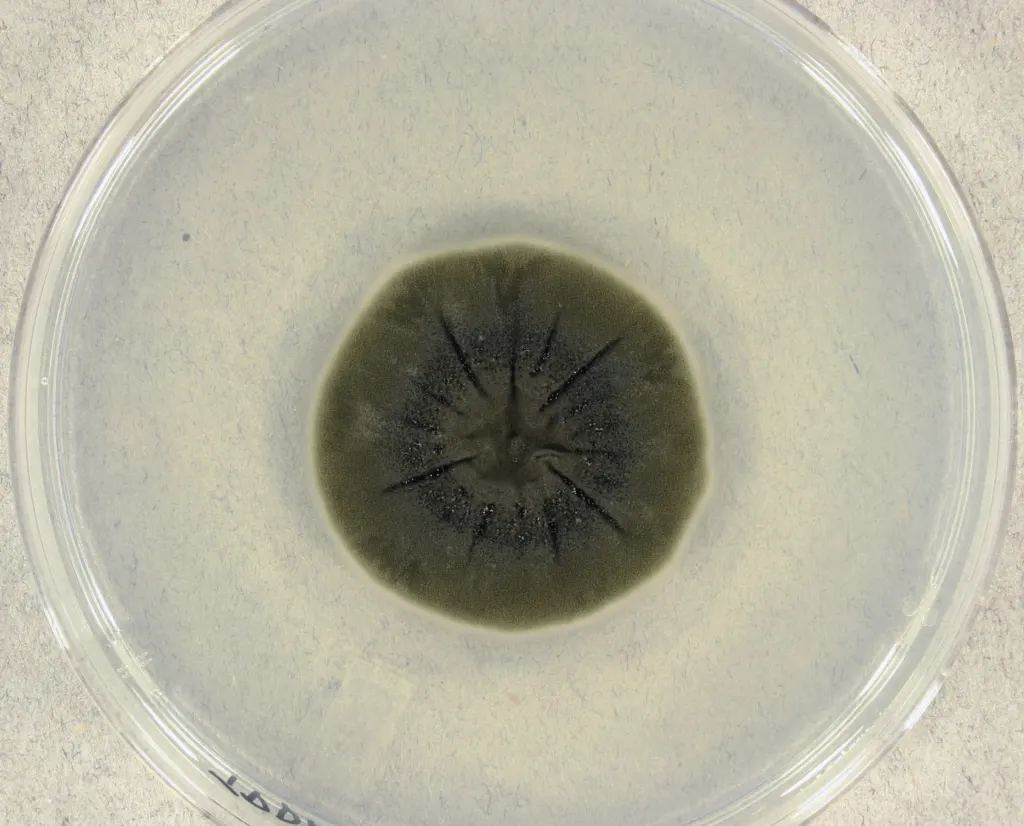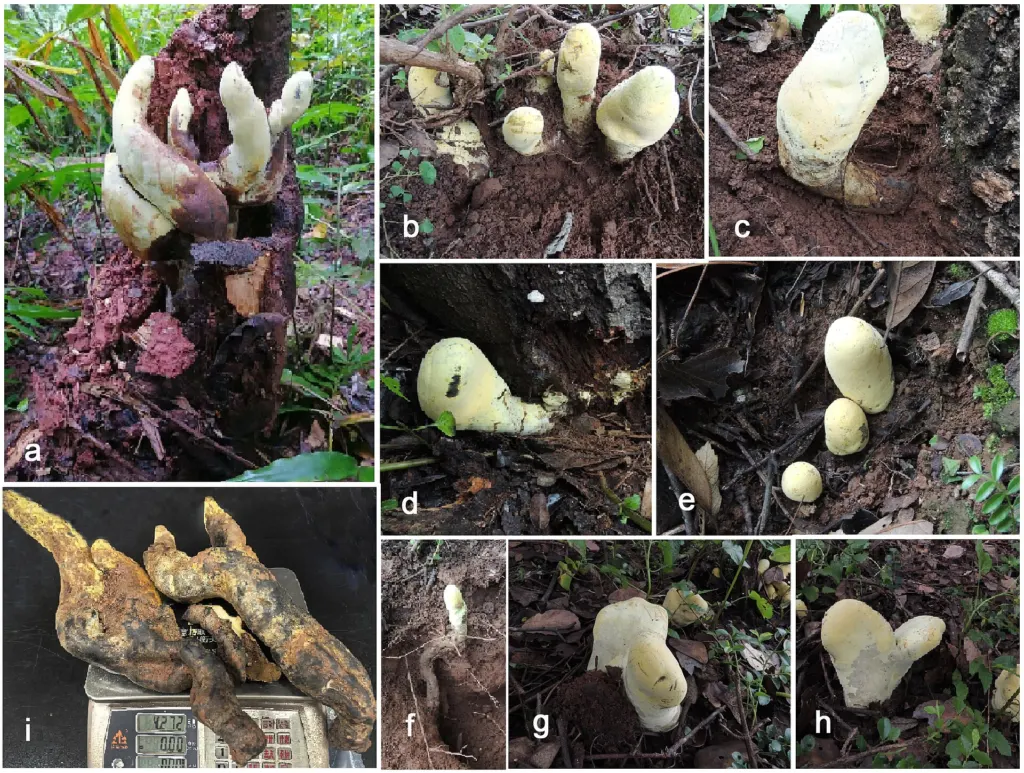
The first people to find it tried a taste. According to mycologist Indunil C. Senanayake, local farmers in China’s Yunnan Province who came across a strange, pale fungus bit into it, then sent photos to researchers because they wanted to know if it was edible. What the team found was a giant: Dianjunus rex, nicknamed D-rex, whose fruiting bodies reach 50 centimeters (about 20 inches) tall and up to 2.2 kilograms (about 4.9 pounds).
That makes it the largest fruiting body yet documented among the Ascomycota, the sac fungi, a group of more than 64,000 known species. And a genetic clock suggests its family first appeared roughly 65 million years ago, about one million years after the asteroid-linked extinction that ended the age of dinosaurs.
A new species, genus and family at once
The formal description, by Jing Song, Senanayake, Fuqiang Yu and colleagues at the Kunming Institute of Botany of the Chinese Academy of Sciences, with co-authors in Thailand and Mexico, appeared at the end of September in Frontiers in Fungal Biology. Its title calls the organism a “fungal giant,” and the team did not stop at naming one species. D-rex was different enough to need its own genus and an entirely new family, Dianjunaceae, inside the order Xylariales.
“This remarkable species represents a new fungal family, Dianjunaceae, and provides a rare window into the evolution of extreme fungal body forms,” Senanayake said in a statement released by the journal.
The name nods to the Latin word for king and to the ancient Dian kingdom of the Yunnan region. Its nearest known relative is Graphostroma platystoma, a fungus of dead hardwood across the Northern Hemisphere. Other cousins include candlesnuff fungus and dead man’s fingers, whose fruiting bodies stand only a few centimeters high.
How the team pinned it down
Specimens came from three Yunnan sites: Damaidi village in Luquan County near Kunming (August to September 2024), and Nanbang village in Mengla County and Yipinglang town in Lufeng (both July 2025). The whitish, upright structures, which mycologists call stromata, grew from the woody roots of Chinese cork oak.
- Shape and cells: the team photographed spores, sacs and fruiting tissue under the microscope and grew cultures from spores on three kinds of agar.
- Four marker genes: sequences from five collections were placed in a family tree of 202 fungal strains, where D-rex formed its own branch, sister to Graphostromataceae, with full statistical support.
- Whole genomes: three wild stromata were sequenced, and 302 single-copy genes shared across 66 fungal genomes were used to rebuild the tree and estimate dates.
The dating step used a molecular clock, calibrated with published divergence ages for other fungal pairs, to land on the early Paleocene for the family’s origin.
Why a dinosaur-era date matters
The Cretaceous-Paleogene extinction about 66 million years ago wiped out around three-quarters of plant and animal species. For a wood-rotting fungus, Senanayake suggests, the wreckage may have been an opening.
“After the mass extinction, forests experienced dramatic changes, including the sudden availability of large amounts of dead plant material,” she said. In an interview published this month, she added that in the dark, cold years after the impact, decomposers could keep working better than plants that depend on light.
The size has its own proposed logic. A tall fruiting body may lift spores into moving air in a crowded forest, but it costs a lot of energy to build. “A fruiting body which towers above surrounding vegetation and debris could have better dispersal of spores by wind in dense forests,” Senanayake said, calling the strategy one that probably paid off only where the benefits outweighed the costs.
The numbers are striking. At 50 cm, D. rex stands roughly 1.7 to 2.5 times as tall as the 20 to 30 cm fruiting bodies that held the sac-fungus record before it (50 divided by 30, and 50 divided by 20).
Limits: what the record does and does not mean
The “largest” title is about the size of a single upright fruiting body, not total weight. The study itself points to Engleromyces goetzei, a bamboo fungus whose Kenyan specimen had two lobes 30 cm across and weighed about 3.2 kg, so one heavy lump of a different species outweighs D-rex’s 2.2 kg by roughly a kilogram.
The 65-million-year figure is also an estimate from genetic data and calibration points, not from fossils of the fungus. The spore-dispersal idea is, in Senanayake’s own word, a hypothesis.
Torda Varga, a mycologist at the Royal Botanic Gardens, Kew, in England, who was not part of the work, noted that some truffles come close in bulk but said D-rex is the largest sac-fungus fruiting body he knows of, adding that his experience is mostly with European fungi. “What I find particularly remarkable is that a fungus with such an enormous fruiting body appears to have remained scientifically undocumented until now,” he said.
Varga suggests scanning databases of DNA shed into the environment for unnamed relatives. The raw sequencing data are already public under NCBI BioProject PRJNA1265937, and the voucher specimens sit in the Kunming Institute of Botany’s fungarium for anyone who wants to check the king’s credentials.
Further reading
- Study: Unearthing a fungal giant (Frontiers in Fungal Biology, 2026)
- Wikipedia: Cretaceous–Paleogene extinction event
Image: Jing Song, Zhuyue Yan, Indunil C. Senanayake, Fuqiang Yu et al., CC BY 4.0 via Wikimedia Commons
This article was produced with AI assistance and reviewed by our Editorial Desk. How we work.