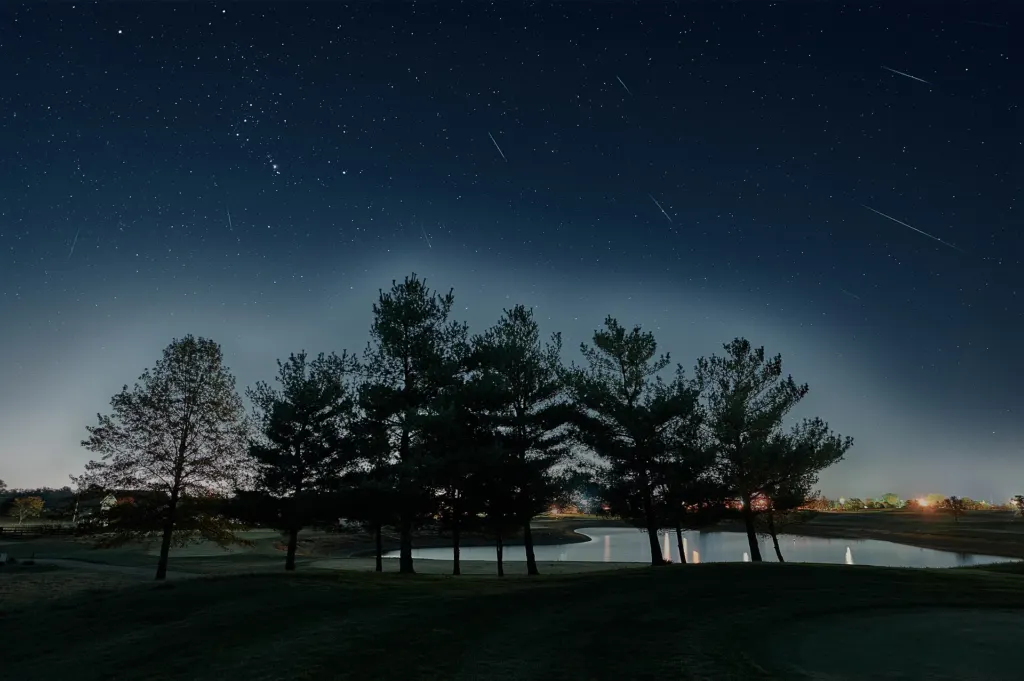
The Orionid meteor shower, made of grit shed by Halley’s Comet, peaks on the night of Wednesday, October 21, into Thursday, October 22, and under a dark sky it brings about 10 to 20 meteors an hour, according to NASA’s Orionids fact sheet. Four days later the Hunter’s Moon turns full at 04:12 GMT on Monday, October 26, a moment that still falls on the evening of Sunday, October 25, for most of the United States and Canada west of the Eastern time zone.
The two events share a calendar week and a practical problem. The moon growing toward full is the main thing standing between you and the meteors, so the real planning question is what time it sets.
Why Halley’s dust hits at 41 miles per second
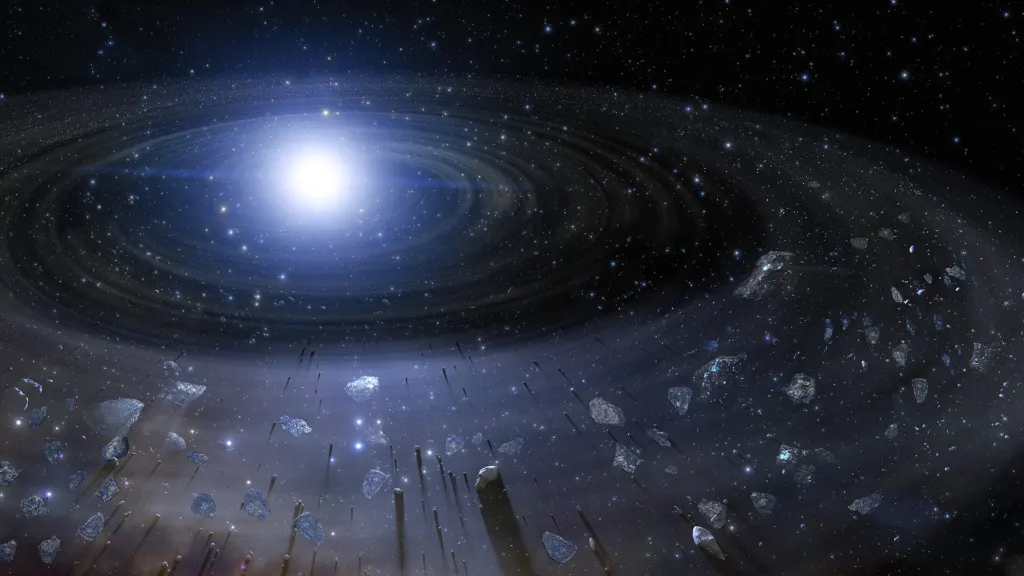
Halley’s Comet, catalogued as 1P/Halley, needs about 76 years to complete one orbit. NASA says casual observers last saw it in 1986 and that it will not come back to the inner solar system until 2061. On every pass its nucleus releases ice and rocky dust, and Earth runs through that debris twice a year: in May it produces the Eta Aquariids, and in October the Orionids.
Speed is what makes this shower distinctive. The grains strike the upper atmosphere at roughly 41 miles (66 kilometers) per second, fast enough to leave trains, meaning glowing trails of hot debris that can hang in the sky for several seconds. The shower takes its name from its radiant, the spot it seems to pour out of, just north of the red star Betelgeuse in Orion. NASA’s advice is counterintuitive: aim your gaze 45 to 90 degrees away from Orion, where meteors look longer, because the ones close to the radiant appear stubby through foreshortening.
How a 73% moon limits the October 21-22 peak
The NASA page credits the American Meteor Society for its shower data, and the society’s 2026 calendar lists the moon as 73% lit, a waxing gibbous, on peak night, with “significant interference” while it is above the horizon. That is the main limit on this year’s display. The society also describes the Orionids as a medium-strength shower: 10 to 20 meteors an hour in a normal year, 50 to 75 an hour in the unusual years from 2006 to 2009, and only low to average numbers in recent displays. Those rates assume a dark rural site; from a lit suburb, expect far fewer.
The workaround is patience. Joe Rao, a guest lecturer at New York’s Hayden Planetarium, calculates that the moon sets shortly after 2 a.m. local daylight time, leaving about three and a half hours of darkness before dawn, when Orion stands high in the south. Rao gives that figure in local daylight time for mid-northern latitudes, so check a local moonset table if you live far north. The shower runs from October 2 to November 7, so a cloudy Wednesday is not the last chance.
Hunter’s Moon at 04:12 GMT: the time on your clock
This year’s Hunter’s Moon is the first full moon after the September 26 Harvest Moon. It is not a supermoon; that title goes to the November 24 full moon. Converting the single instant of 04:12 GMT/UTC on October 26 into local time:
- London: 4:12 a.m. Monday, October 26
- Halifax: 1:12 a.m. Monday (Atlantic Daylight Time, UTC minus 3)
- New York and Toronto: 12:12 a.m. Monday (Eastern Daylight Time, UTC minus 4)
- Chicago and Winnipeg: 11:12 p.m. Sunday, October 25 (UTC minus 5)
- Denver and Calgary: 10:12 p.m. Sunday (UTC minus 6)
- Los Angeles and Vancouver: 9:12 p.m. Sunday (UTC minus 7)
That split is why NASA’s October sky calendar gives the full moon as October 25 while European tables print October 26. For viewing, the exact minute matters little: the disk looks full from October 25 to 27. Published moonrise tables put the rise at 5:26 p.m. on October 25 in New York and 16:21 on October 26 in London, and moonrise is the moment to watch, when a low moon can look orange and oversized. The extra size is the moon illusion, a trick of perception, not a real change.
What NASA’s ‘What’s Up’ video for October gets right
NASA’s Jet Propulsion Laboratory posted its monthly skywatching video on October 1, presented by Raquel Villanueva. It covers three events: Saturn at opposition on October 4, the Orionid peak, and the moon gliding past the Pleiades cluster on the night of October 27-28. On the meteors it is candid rather than hyped, warning that “A bright waxing gibbous Moon will wash out some of the fainter meteors this year” and steering viewers to the hours before dawn after moonset, which matches the society’s moonlight forecast.
Its weaknesses are omissions. The clip gives no hourly rate, no moonset time and no time zone for its October 25 full moon date, and it never uses the name Hunter’s Moon, so a viewer in London or Toronto has to do the conversion above. It also spends nearly as long on a newly spotted ten-sided wave around Saturn’s south pole as on the shower. As a three-event checklist it works; as a planning tool it needs the numbers.
The next fixed date after the full moon is the Pleiades pairing on October 27-28, visible low in the east in the evening with the unaided eye or binoculars. Halley’s Comet itself is due back in 2061.
Further reading
Image: Jim Vajda, CC BY 2.0 via Wikimedia Commons
This article was produced with AI assistance and reviewed by our Editorial Desk. How we work.