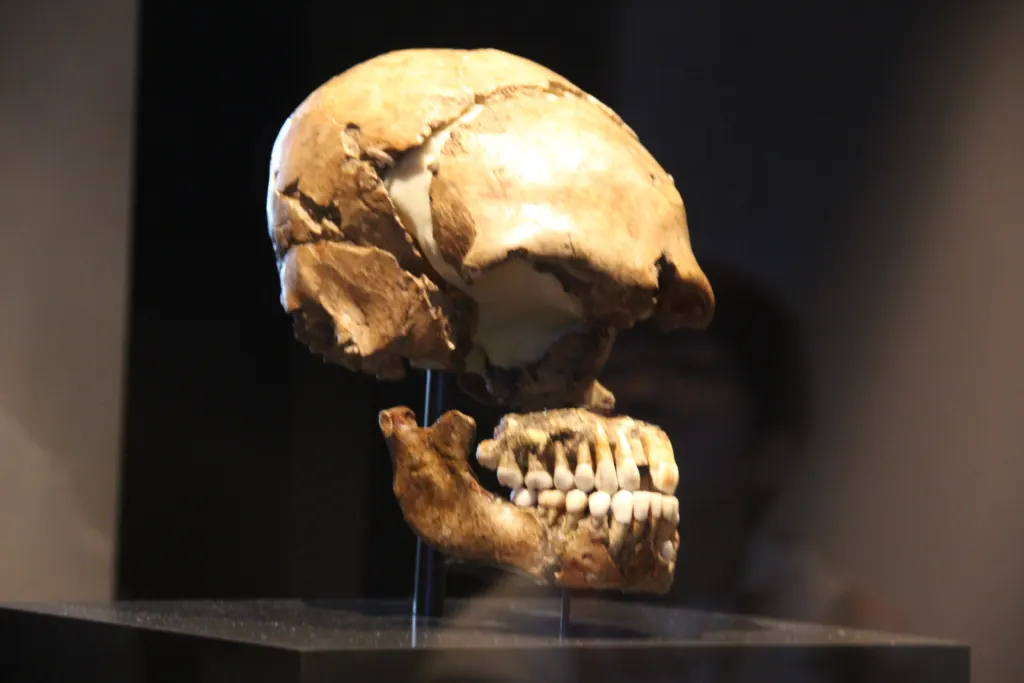
People in southeastern Europe tend to carry a little more Neanderthal DNA than people in the northwest, and a new computer model from the University of Geneva says the pattern needs no help from natural selection to explain it. The gradient, the team reports, grew out of the direction modern humans first spread across the continent and how far north Neanderthals lived.
The study, by Alexandros Tsoupas, Claudio Quilodrán, Jérémy Rio and Mathias Currat, was published on November 11 in the journal Science Advances.
A cline written into European genomes
When modern humans moved out of Africa, they met and had children with Neanderthals. Those encounters left fragments of Neanderthal DNA in the genomes of people today. Estimates put the share at about 1.8 to 2.4% in modern Europeans and 2.3 to 2.6% in modern East Asians.
Within Europe the share is not even. It slopes from southeast to northwest, a gradual change that geneticists call a cline. The Geneva team set out to find what produced that slope and why it has lasted through tens of thousands of years of later migration.
How the model works
The researchers built what they describe as a three-population, layered, spatially explicit simulation. In plain terms, they laid a virtual map of Europe over time and let three groups move across it and interact: Neanderthals, the first modern hunter-gatherers, and the Neolithic farmers who arrived much later.
They then tracked how much Neanderthal ancestry ended up where. The cline appeared from three ingredients working together:
- the direction in which the first hunter-gatherers expanded across Europe;
- the northern edge of the Neanderthal range, beyond which there were no Neanderthals to mix with;
- strong reproductive isolation, meaning the two groups interbred only rarely.
None of this required natural selection for or against Neanderthal genes. The later spread of farming moved in a similar direction, which in the model kept the slope in place and also explains why ancient hunter-gatherers and early farmers differ in their Neanderthal ancestry.
What 2% means in letters of DNA
The human genome holds roughly 3,000 million base pairs, or DNA letters. At 2%, a European genome would carry about 60 million letters traceable to Neanderthals; at 2.6%, an East Asian genome would carry about 78 million. Differences of a few tenths of a percent across Europe therefore amount to millions of letters per person.
Why it matters
Ancient DNA has turned up many puzzling geographic patterns, and a common temptation is to explain them through genes that helped or hurt their carriers. This study shows that simple movement, geography and rare mixing can create a lasting map on their own. The authors write that spatiotemporal patterns in ancient DNA “provide insights into past population dynamics.”
The limits
This is a simulation. It shows that the observed cline can arise without selection; it does not prove selection played no role, and its results depend on the settings chosen for range edges, migration and interbreeding. It also addresses one pattern within Europe, not the full story of Neanderthal ancestry elsewhere in the world.
Badiyaa has covered other new work on our extinct relatives, including Homo naledi teeth that may all come from females and an ancient virus that silences a brain gene in chimpanzees.
The paper appears in volume 12, issue 46 of Science Advances, with funding from the Swiss National Science Foundation.
Further reading
Image: Gary Todd, CC0 via Wikimedia Commons
This article was produced with AI assistance and reviewed by our Editorial Desk. How we work.