Ditches dug into bogs over the past two centuries are now responsible for about 2.7% of all the human-caused warming pressure on Earth's climate, and that share is set to grow even if nobody digs another one.
That is the finding of a study published in Nature on November 25, 2026, led by Jevan B. Yu and César Terrer of the Department of Civil and Environmental Engineering at the Massachusetts Institute of Technology, with colleagues at the Pacific Northwest National Laboratory, the University of Leicester and the UK Centre for Ecology and Hydrology. Its title sums it up: "An enduring climatic burden from past peatland drainage."
Why a wet bog is a carbon vault
Peat is plant matter that never fully rotted. In a waterlogged bog, oxygen is scarce, so dead moss and sedge pile up for thousands of years instead of decomposing. The encyclopedia entry on peat puts the global store at up to 550 billion tonnes of carbon, about 42% of all soil carbon and more than all other vegetation, forests included, even though peatlands cover only about 3% of the land.
There is a catch. The slow, oxygen-free decay in an intact bog releases some carbon as methane, a potent greenhouse gas. Drain the bog and the methane falls, but oxygen floods into the peat and microbes start burning through it, releasing carbon dioxide instead.
The math of a drained bog
The MIT team built a new dataset of measured gas fluxes, modeled how carbon dioxide and methane respond as the water table drops, and reconstructed drainage around the world from 1800 to 2020. They expressed the result as radiative forcing, the change in Earth's energy balance in watts per square meter; the climate panel's own figure for all human-caused forcing in 2019 was 2.72 watts per square meter.
Extra carbon dioxide from drained peat adds about +83 milliwatts per square meter. Avoided methane takes away about 9. The net is roughly +73 milliwatts, with an uncertainty range of 48 to 99, equal to 2.7% (1.8% to 3.6%) of industrial-era forcing.
The striking part is the footprint. That warming comes from just 0.4% to 0.5% of Earth's land area. Put another way, drained peat delivers a share of global warming five to seven times larger than its share of the land surface.
The legacy problem
Draining a bog starts a slow burn that does not stop when the digging does. The authors found that simply keeping today's drained areas as they are could almost double the cumulative warming from drainage by 2100. Rewetting is the main way to slow it, by blocking ditches and letting the water table rise again.
Europe knows this landscape well. Two and a half thousand years ago much of what is now the Netherlands was peat; drainage and digging helped leave about 26% of the country below sea level. Ireland's state peat company, Bord na Móna, stopped harvesting peat in January 2021.
And yes, bogs keep other secrets too. The acidic, airless peat that locks away carbon also preserved Denmark's Tollund Man, a bog body from the 4th century BC so intact that he was first mistaken for a recent murder victim.
For more on where our carbon goes, read Badiyaa's story on the Scripps oxygen record showing the ocean absorbing more carbon, and our report on US data centers emitting about as much CO2 as Denmark.
Sources
- “An enduring climatic burden from past peatland drainage”, Nature (Massachusetts Institute of Technology et al.), 2026
- “Peat”, Wikipedia, 2026
- “Radiative forcing”, Wikipedia, 2026
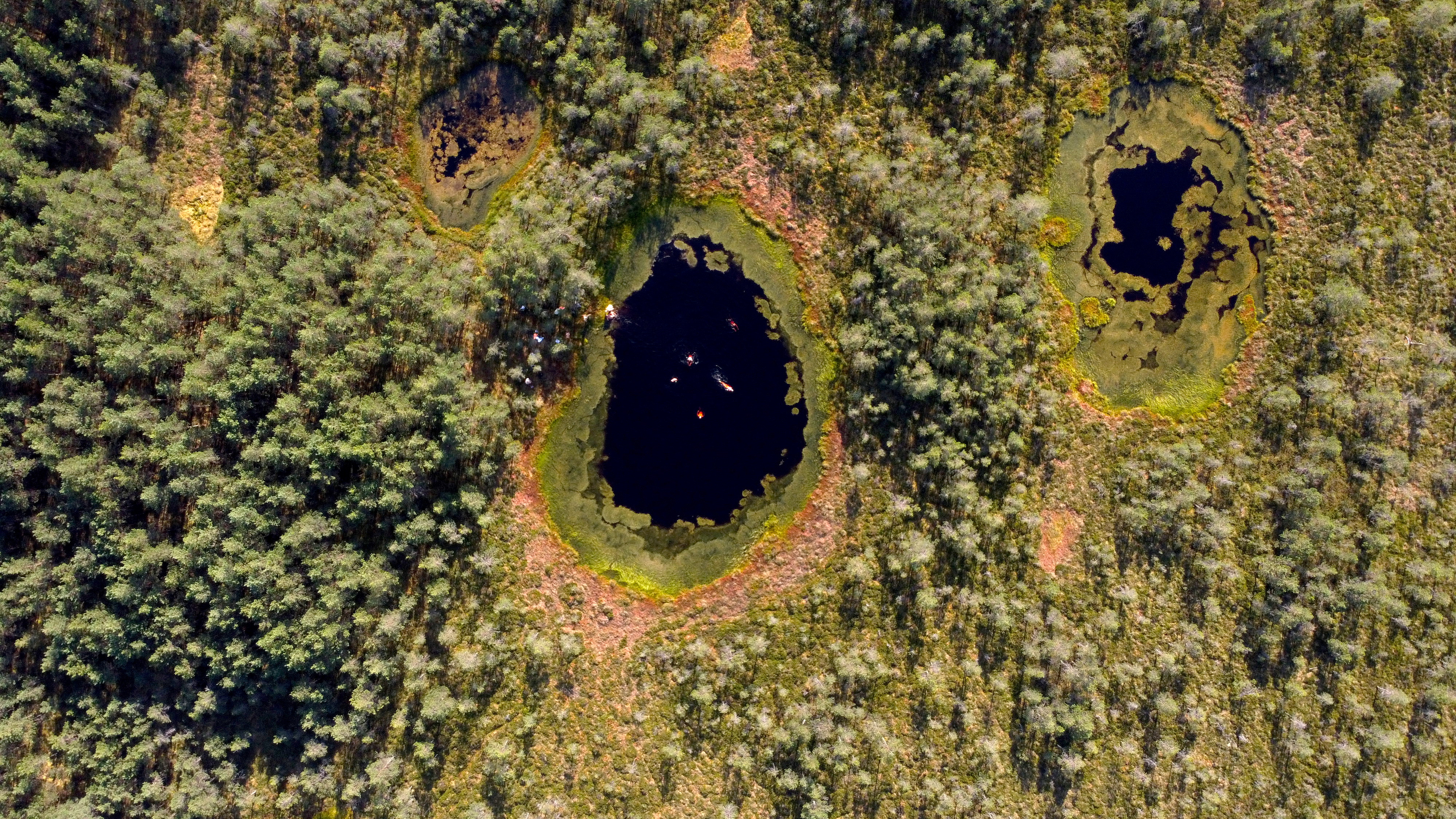
Image: Sillerkiil, CC BY-SA 4.0 via Wikimedia Commons
This article was produced with AI assistance and reviewed by our Editorial Desk. How we work.