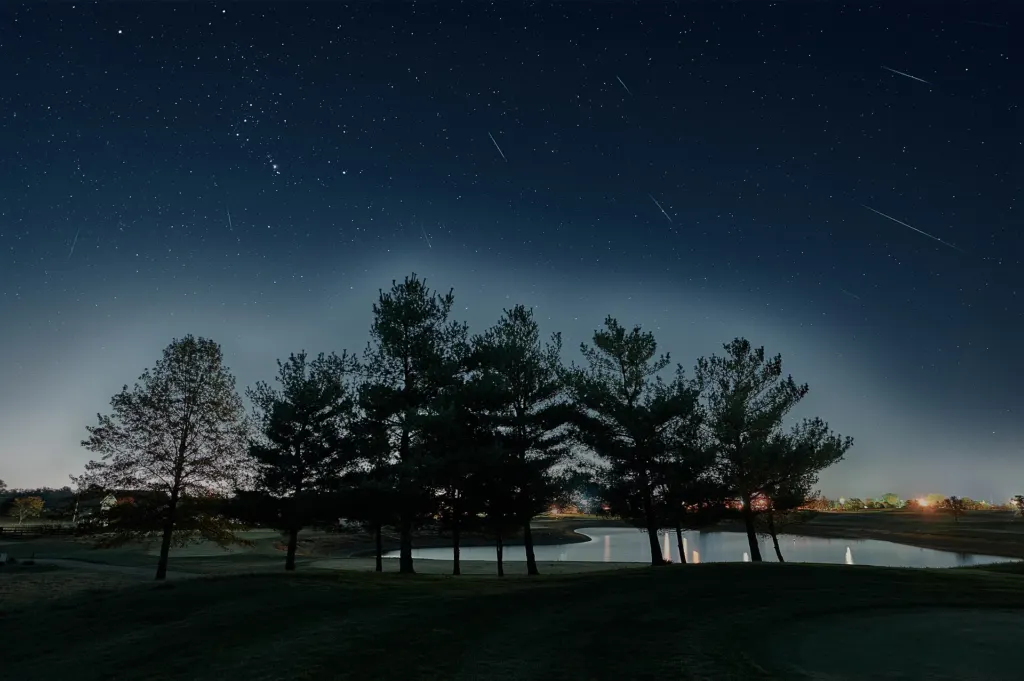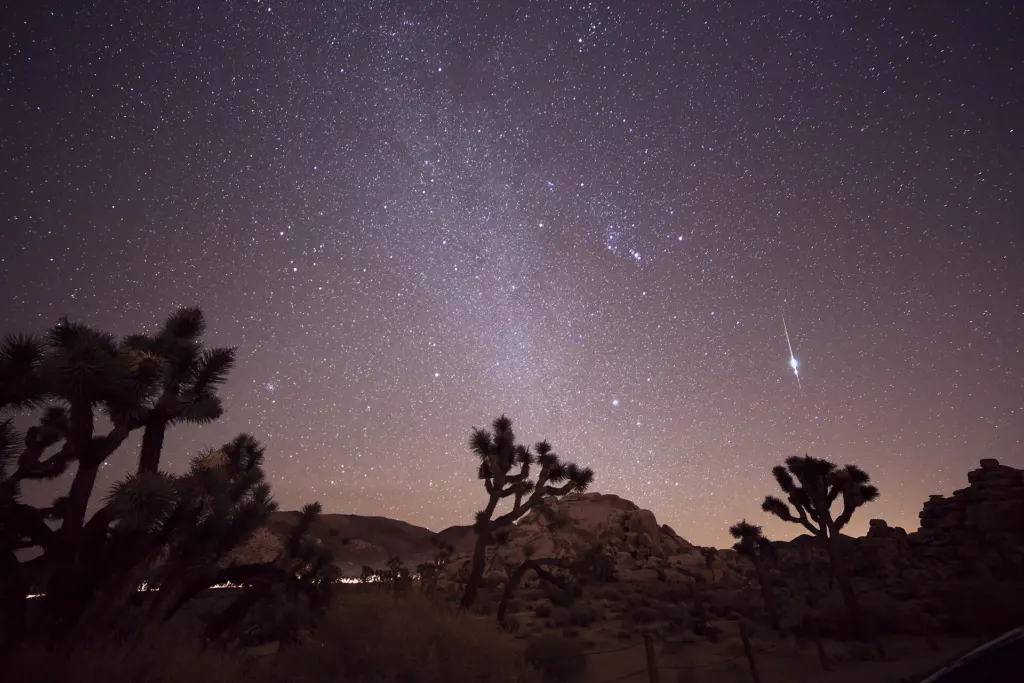
Two streams of comet debris are hitting Earth’s atmosphere at the same time this Halloween weekend, and the slow, heavy pieces they carry are why skywatchers call the Taurids the “Halloween fireballs.” Each stream adds about five meteors an hour under a dark sky, so with both active the combined count can reach roughly 10 an hour, with peaks still to come on November 5 and November 12.
The Southern and Northern Taurids both appear to fly out of the constellation Taurus, near the orange star Aldebaran and the small Pleiades cluster. That radiant climbs through the evening and stands highest around midnight, which makes the late hours of Halloween night the obvious window for readers in the US, Canada and the UK.
What the meteor counts show
The American Meteor Society lists the Southern Taurids as active from September 20 to November 20, 2026, with the fireball-rich part of the stream peaking on the night of November 4 to 5. The Northern Taurids run from October 20 to December 10 and peak on the night of November 11 to 12. The society notes that when the two branches overlap in late October and early November, fireball reports sometimes rise.
These meteors are not fast. They strike the upper air at about 28 kilometers per second, the slowest entry speed among the well-known annual showers. That sounds quick, but it lets a bright Taurid hang in view for a second or more, often breaking apart and sometimes leaving a smoky trail.
How the fireballs are made
The Southern branch traces back to Comet Encke, which completes an orbit every 3.3 years. The Northern branch is linked to the asteroid 2004 TG10, which shares a very similar orbit and may be a large chunk broken from the same parent. Astronomers think the whole complex is what is left of a much bigger comet that fell apart thousands of years ago.
Because the stream contains pebble-sized grains rather than fine dust, some Taurids flare far brighter than a typical shooting star. NASA’s Meteoroid Environment Office tracked one Halloween fireball over Tennessee in 2012; Bill Cooke, who led that office, said it was last seen at an altitude of 18.1 miles, “which is fairly low for a meteor.”
Your odds of a fireball, worked out
Here is the Badiyaa calculation, using the published rates. In a normal year about 1% of Taurid meteors become fireballs. One stream at five meteors an hour therefore gives 5 x 0.01 = 0.05 fireballs an hour, or one every 20 hours of watching. With both streams overlapping at about 10 an hour, that doubles to 0.1 an hour: one fireball for every 10 hours spent under a dark sky.
In a swarm year the fireball share can climb to 7%. At 10 meteors an hour, that would be 0.7 fireballs an hour, or about one every 86 minutes. The next swarm is predicted for 2032, so the odds this weekend sit at the ordinary end of that range.
Where and when to look this weekend
- Get away from streetlights and give your eyes 20 to 30 minutes to adjust.
- Face east to south-east in the evening, then look higher as Taurus climbs toward midnight.
- Do not stare at Taurus itself; meteors can appear anywhere and simply point back toward it.
- In the US and Canada, clocks fall back an hour on Sunday, November 1, so midnight arrives an hour “later” by the sky on Saturday night than on Sunday night.
Anyone who catches a big one can report it to the American Meteor Society, whose eyewitness reports help trace a fireball’s path. Our earlier guide to the Orionid meteors from Halley’s Comet covers the other shower still active this week.
Limits of the forecast
Peak dates for the Taurids vary between sources because neither branch has a sharp maximum; activity rambles across weeks rather than spiking on one night. Rates of five an hour assume a dark, moonless sky, and city glow or moonlight cuts that sharply. Many meteors you see this weekend will also belong to other showers or to random background debris, not the Taurids.
The better moonlight comes later. The Moon will be only 26% lit on the Southern Taurid peak night of November 4 to 5, and just 3% lit on the Northern peak night of November 11 to 12.
Further reading
Image: Channone Arif, CC BY 2.0 via Wikimedia Commons
This article was produced with AI assistance and reviewed by our Editorial Desk. How we work.