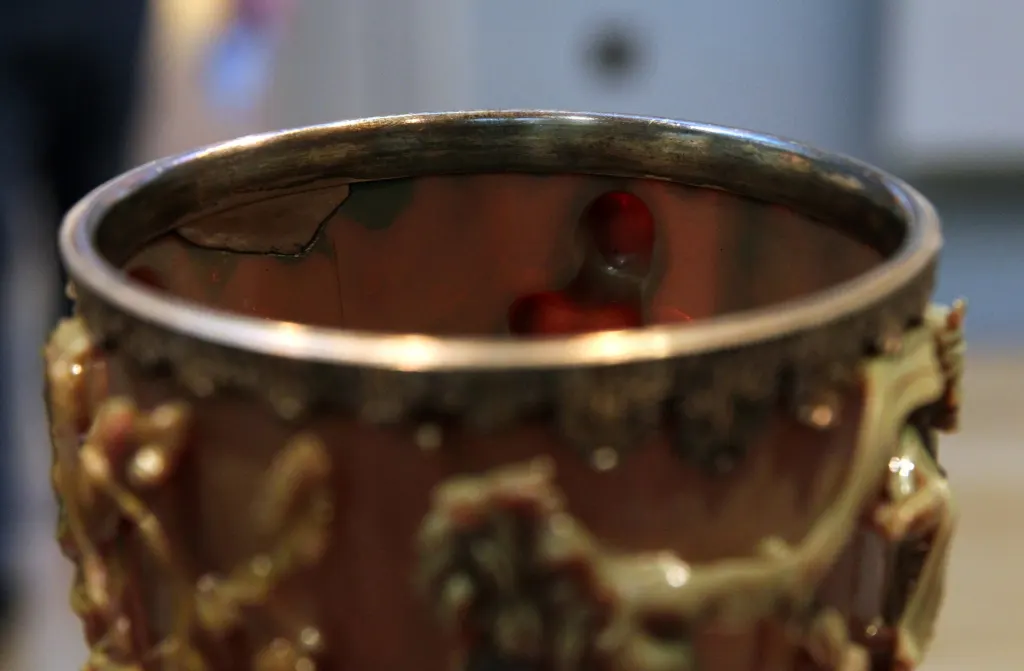
A team at the University of Sheffield in England says it has made new glass that turns jade green in reflected light and ruby red when light shines through it, matching the trick of the 1,600-year-old Lycurgus Cup in the British Museum. The color comes from gold and silver crystals so small that, by the original cup’s measurements, they are only about 70 nanometers across, far below what an ordinary microscope can show.
That size is the whole story. Particles that small sit close to the wavelengths of visible light, so they interact with light rather than simply blocking it, and the cup changes color depending on where the lamp stands.
How a Sheffield technician rebuilt a 4th-century recipe
The work was carried out by Dr. Lisa Hollands, a technician in the university’s School of Chemical, Materials and Biological Engineering, with Professor Russell Hand, according to the university’s exhibit listing. Hollands did the early research with Professor Caroline Jackson, a specialist in Roman glass, and the team based its recipe on the chemistry of a fragment of Roman dichroic glass, meaning glass that shows two colors.
The method, as Hollands described it in an interview published on Sunday, October 25, was to make a thick molten glass and let it cool from well above 1,832°F (1,000°C). As it cooled, gold and silver nanocrystals grew inside it. In transmitted light those particles absorb blue and green, so only reds and oranges pass; in reflected light they scatter, and the surface reads as an opaque green.
“People have tried it before with limited success,” Hollands said, calling the project “a labour of love.” Her verdict on the result: “To me, it’s magic.”
Less than a quarter of a gram of silver in a 700-gram cup
Earlier analysis of the original, summarized in the cup’s open reference record, puts its metal content at roughly 330 parts per million of silver and 40 parts per million of gold, added to an otherwise ordinary Roman glass. The cup weighs about 1.5 pounds (700 grams). If those parts per million are read by weight, the working is 700 × 0.000330 = 0.23 grams of silver and 700 × 0.000040 = 0.028 grams of gold, a pinch of metal spread through the whole vessel. The real figure is lower still, because the 700 grams includes the gilt metal rim and foot added around 1800.
Those quantities explain why historians doubt the Romans dosed the glass on purpose. The amounts are far too small to weigh with ancient tools, so the metals were probably added to a large melt and then diluted, or arrived as contamination from silver that already carried traces of gold.
Ian Freestone, emeritus professor of archaeological materials at University College London, who co-authored studies of the cup in 1990 and 2007, said the Sheffield glass gets much closer to the cup’s true shades than a version replicated in the 1960s. “This is more ambitious and more precise,” he said. The experiments also showed how touchy the chemistry is. “The colour was quite dependent on conditions in the furnace,” Freestone said, adding that with the Lycurgus glass the Romans “hit the jackpot.”
What one unpublished replication can and cannot show
The evidence so far is a single team’s furnace work, described through a university exhibit page and interviews. We could not find a peer-reviewed paper setting out the Sheffield recipe, particle sizes or color measurements, so outside chemists cannot yet check how closely the new glass matches the original.
Earlier attempts give a sense of the difficulty. Corning Glass Works produced a glass blank of similar composition that shows the same green-to-red shift. In 2020, chemists at Wageningen University in the Netherlands reported in the Beilstein Journal of Nanotechnology that they had 3D-printed a plastic cup containing silver and gold nanoparticles in a 90:10 ratio, with walls 600 micrometers (about 0.02 inch) thick. It showed the classic shift, but the authors wrote that its greens and reds were duller than the original’s.
That 2020 paper flagged a deeper problem. Published reflectance and transmission spectra of the Lycurgus Cup, the measurements that would let anyone match its colors precisely, are missing, and the few that exist are hand-drawn. Until such data are taken from the cup itself, every replica, Sheffield’s included, is matched largely by eye.
The Roman side has its own gaps. Only a few small fragments of dichroic Roman glass survive, and their two colors vary widely, which fits Freestone’s view that furnace position, not a fixed recipe, set the final shade.
Where to see the glass from November 6
Sheffield commissioned glass artist Elliot Walker to use the new glass in a sculpture that pairs the Lycurgus myth with the Farnese Atlas, swapping the globe for a cup. It goes on show at the Millennium Gallery in Sheffield during the university’s Festival of the Mind, November 6 to 15, open 11 a.m. to 5 p.m. Tuesday to Saturday and 11 a.m. to 4 p.m. on Sunday, before moving to permanent display at the Turner Museum of Glass.
The original stays in Room 41 of the British Museum in London, where it has been since the museum bought it from Victor, Lord Rothschild, in 1958 for £20,000.
Further reading
- Wikipedia: Lycurgus Cup
- Gold and silver dichroic nanocomposite in the quest for 3D printing the Lycurgus cup (Beilstein J. Nanotechnol., 2020)
- University of Sheffield: Ancient Secrets, Modern Light: The Lycurgus Project
Image: Vassil, CC0 via Wikimedia Commons
This article was produced with AI assistance and reviewed by our Editorial Desk. How we work.