Four volunteers who walked into a 1,700-square-foot 3D-printed habitat in Houston on October 19, 2025 were scheduled to walk out again on Saturday, October 31, after 378 days of pretending to live on Mars. NASA calls the study CHAPEA, the Crew Health and Performance Exploration Analog, and Mission 2 matched the first run to the day: 378 days, four people, one sealed hangar at the Johnson Space Center.
The crew were commander Ross Elder, a US Air Force test pilot; medical officer Ellen Ellis, a US Space Force colonel; science officer Matthew Montgomery, a hardware engineer; and flight engineer James Spicer, a satellite-communications specialist. NASA invited media to watch the exit ceremony on a screen outside the hangar that holds the habitat.
What 378 days inside looked like
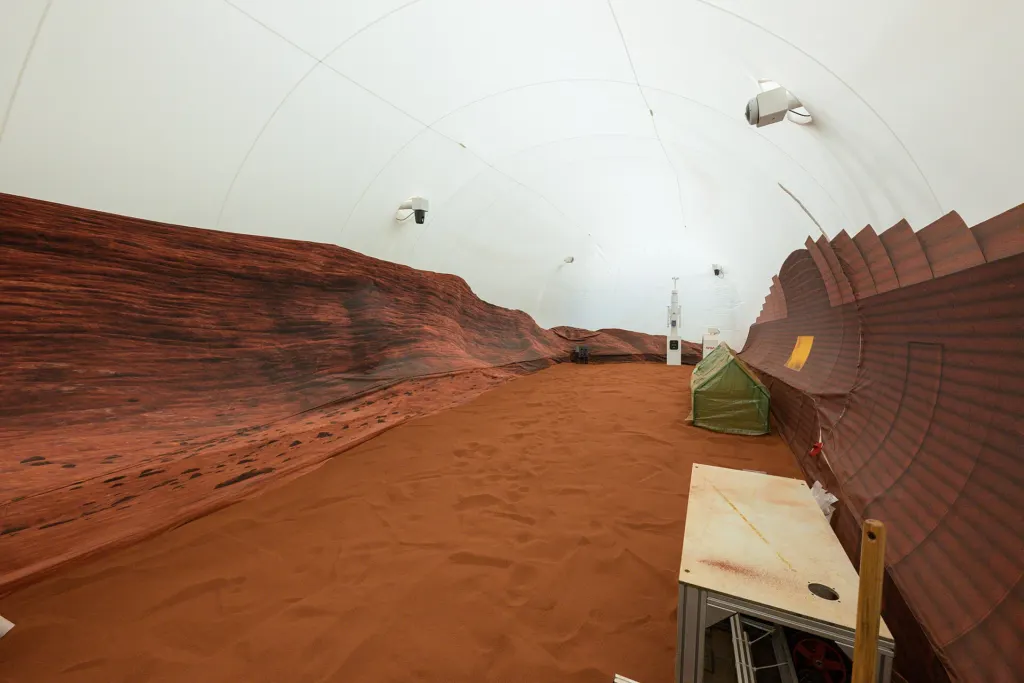
The habitat, named Mars Dune Alpha, was printed by the company Icon and holds crew quarters, an exercise area, a work room, a recreation space and a crop area. Crews leave through an airlock onto a red-soil “surface” backed by painted cliffs, where they carry out simulated spacewalks.
Before entering, Elder listed the stressors the study throws at a crew: resource limits, isolation and confinement, simulated equipment failures, communication delays and those spacewalks. One of the hardest tests came in a two-week loss of contact with “Earth,” which the crew described in a NASA podcast. Spicer, who spent his career designing the very relay networks the crew was cut off from, put the central problem plainly: “When astronauts go to Mars, you’re going to have a time delay that’s anywhere between 13 to 22 minutes.”
The numbers, worked out
Here is the Badiyaa arithmetic. At 378 days, each crew member logged 378 x 24 = 9,072 hours inside; across four people that is 36,288 crew-hours of data for NASA’s Human Research Program. A one-way delay of 22 minutes means a question sent to mission control earns its answer 44 minutes later at best, and even at 13 minutes the round trip is 26 minutes, which is why the crew often fixed a problem before the ground knew it existed.
Getting in took longer than staying in. Spicer applied in March 2024, trained in the Wyoming backcountry in January 2025, learned of his selection in April 2025 and started five weeks of training in mid-September. He counted about 19 months from application to ingress, roughly 580 days, against 378 days of mission.
Mission 1 versus Mission 2
The first CHAPEA crew, Kelly Haston, Ross Brockwell, Nathan Jones and Anca Selariu, entered on June 25, 2023 and left on July 6, 2024, also 378 days. Between that exit and the second crew’s entry, the habitat sat empty for 470 days while NASA sifted a new applicant pool. Both crews grew food in the habitat; the first run harvested peppers and tomatoes to top up shelf-stable rations, and NASA marked its exit with a livestreamed “welcome home” ceremony.
NASA says the data will let it weigh risks against countermeasures for long missions, from how much food to pack to what exercise gear and psychological support a Mars crew needs. A third and final CHAPEA mission is planned.
Limits of a Mars mission on Earth
Gravity in the hangar is Earth’s, radiation is absent, and the crew knew that a real door stood between them and Houston. The study measures behavior, health and performance under confinement and delay, not the physical toll of spaceflight. The results also rest on four people per mission, so NASA’s conclusions will draw on a total of 12 volunteers once the series ends.
For now, the second crew’s clock stopped at the same mark as the first: 378 days, ending October 31, 2026.
Further reading
Image: NASA/Bill Stafford, Public domain via Wikimedia Commons
This article was produced with AI assistance and reviewed by our Editorial Desk. How we work.