SpaceX’s Starship Flight 15 is in orbit about 275 km above Earth after deploying all 26 Starlink V3 satellites, and the ship is due back at Starbase, Texas, on Saturday, November 14, for the first attempt to catch a Starship upper stage with the launch tower’s arms.
The rocket lifted off from Orbital Launch Pad 2 at 22:47 UTC on Friday, November 13 (4:47 p.m. Central). The original plan called for a double catch, with both the Super Heavy booster and the ship returning to the tower. That will not happen this time: Booster 22 called off its catch about six and a half minutes into the flight and diverted to the Gulf of Mexico, its pre-planned backup site. Its flight termination system was then triggered after engine shutdown and the booster broke apart over the water. Ship 42, nicknamed “Don’t Panic,” carried on to orbit.
How the flight was planned
SpaceX’s own flight page lays out a mission of more than 22 hours and roughly 14 orbits. After reaching orbit, the ship opened its payload door and released the satellites over about 43 minutes. Three of them carry cameras to photograph the ship’s heat shield, giving controllers an outside view before they commit the vehicle to come home. The company says it “will only execute a return to launch site” if the systems needed for reentry, the final landing burn and the approach to the tower are healthy.
The return is fenced with checkpoints. The ship passed its early Hawaii return check about an hour and a half after launch. A mid-mission check over Chile and a final Hawaii check follow, then a deorbit burn roughly 21.6 hours in. If everything stays green, the catch is planned for about 22 hours and 33 minutes after liftoff, which works out to about 21:17 UTC (3:17 p.m. Central) on Saturday. If any check fails, the ship can drop into the Pacific near Hawaii or Chile, or into the Gulf.
Why a ship catch matters
SpaceX describes a successful double catch as “the first full recovery of an orbital launch system.” Even with the booster lost, a ship catch would be a first for any rocket upper stage. Reusing the top stage, not just the first stage, is the step that would let Starship fly again within hours or days instead of building a fresh vehicle each time, which is the basis of the launch rates Elon Musk has described for a future Starbase in Louisiana. Starship is also central to NASA’s lunar plans, including the $10 billion Moon Base cargo lander program where SpaceX is one of eight eligible firms.
Each Starlink V3 satellite adds about 1 terabit of capacity, according to SpaceX, and the 26 on this flight equal about 10 Falcon 9 launches of the older V2 Mini satellites.
Limits and open questions
This is a test flight, and SpaceX itself calls the schedule dynamic. The ship has never been caught before; tests in September only lifted Ship 42 with the chopsticks while it sat empty on the ground. The heat shield carries new tile retention hardware and a curved tile design after problems on earlier flights, and the camera satellites are one of several inputs the team will weigh. Musk put the odds of success on a first ship-catch attempt at “at least 50 or 60 percent” in September.
The returning ship will fly a path over parts of northern Mexico and southern Texas, and SpaceX has warned nearby residents they may hear sonic booms. The deorbit burn is planned for roughly 20:23 UTC on Saturday, about 54 minutes before the planned catch.
Further reading
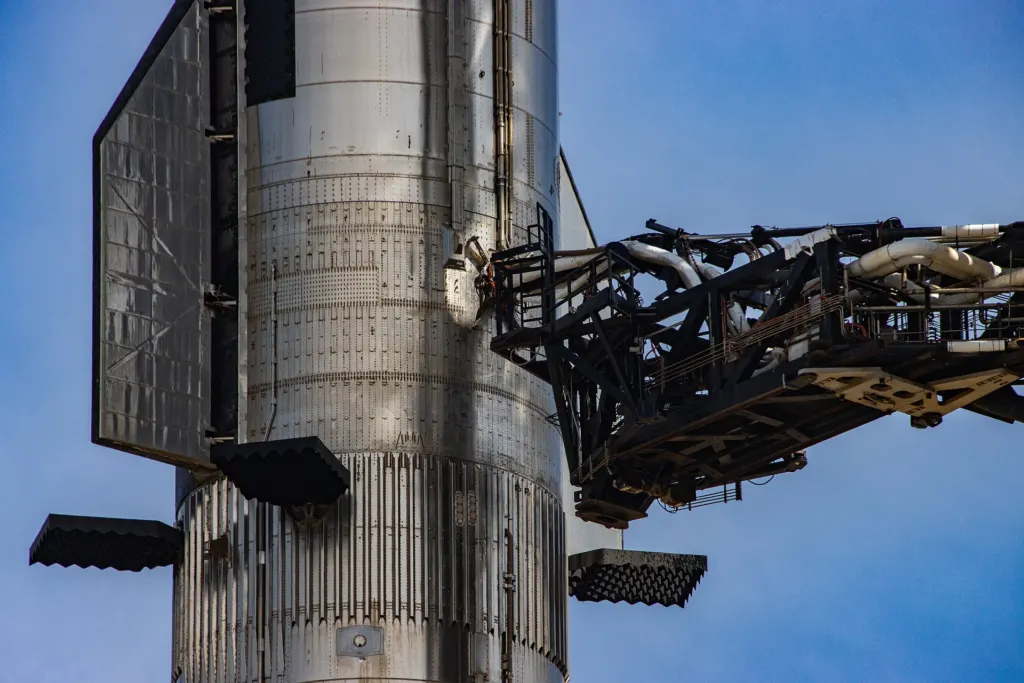
Image: Jenny Hautmann, CC BY-SA 4.0 via Wikimedia Commons
This article was produced with AI assistance and reviewed by our Editorial Desk. How we work.