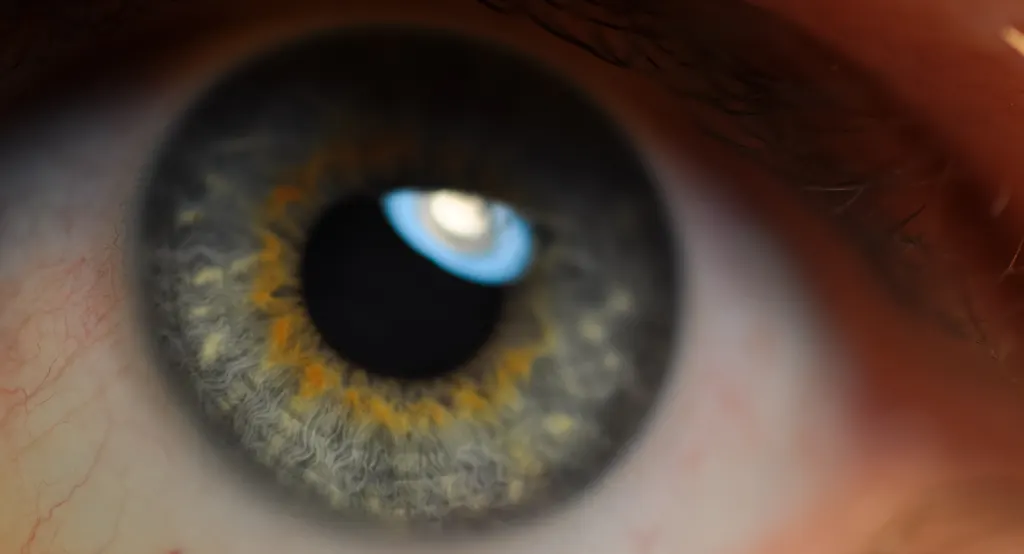
A curved, eyeball-shaped camera sensor built in Hong Kong packs 367,500 pixels onto a dome and sees in full color across a field of view wider than 160 degrees. The device, described in a paper in Nature Materials by a team at the Hong Kong University of Science and Technology (HKUST), is a machine-vision sensor for robots and compact cameras, not a medical implant.
Its pixels sit at a density of 1,905 per inch. That works out to a spacing of about 13 micrometers between pixel centers (25,400 micrometers in an inch divided by 1,905), roughly a sixth of the width of a human hair.
How a dome-shaped retina replaces a stack of lenses
Ordinary cameras use a flat sensor. Because a lens naturally focuses light onto a curved surface, flat sensors need several extra lens elements and software correction to fix blur and color fringing at the edges, known as optical aberrations. Those parts make cameras bulkier, use more power and usually narrow the field of view.
The human eye avoids the problem by putting its retina on a curve. The HKUST team copied that idea with what it calls a hemispherical tandem artificial retina: three light-sensing layers stacked on top of one another on a dome, tuned to blue, green and red. Together they cover light from 300 to 800 nanometers, which spans the visible band and spills slightly into ultraviolet and near-infrared.
Making it was the hard part. Standard chip-making uses lithography, which only works on flat wafers. According to the author contributions listed with the paper, the team developed a 3D laser-engraving method to pattern the pixels directly onto the curved surface. The paper was led by Zhenghao Long, now at Fudan University in Shanghai, with corresponding author Zhiyong Fan, chair professor of electronic and computer engineering and of chemical and biological engineering at HKUST.
A 3,675-fold jump from the team’s 2020 eye
Curved sensors have existed in labs for years, but their resolution was too low to be useful. Fan’s group reported a hemispherical eye in 2020 with about 100 pixels, according to HKUST’s chemical and biological engineering department. Going from 100 to 367,500 pixels is a 3,675-fold increase. The group says it aims to reach one million pixels by 2027, which would be about 2.7 times the new device.
The stacked design adds a second trick. Instead of only taking full pictures frame by frame, the sensor can flag motion directly on the chip, the way an event camera reports only the pixels that change brightness. In the team’s tests this cut the bandwidth needed by more than 99.95 percent compared with frame-based imaging. Put another way, the sensor sent less than one two-thousandth of the data a conventional camera would. It recognized motion with 98.6 percent accuracy.
What the Nature Materials paper does not show
The work is a lab prototype. At 367,500 pixels, the sensor holds about a third of a megapixel, far below the 12 megapixels or more in a typical phone camera, so the gain is in shape, width of view and efficiency rather than raw detail. The 98.6 percent figure comes from the team’s own motion-recognition setup, and outside groups have not yet tested the device.
It is also not designed to restore human sight. Retinal implants for people with vision loss are a separate field with their own clinical trials; this sensor is aimed at robots, drones and other machines that need wide, efficient vision in a small package.
The paper was received on 1 April 2025, accepted on 29 June 2026 and published on 17 August 2026, in the journal’s October 2026 issue. Wearable cameras are already reaching shops, as Badiyaa noted when Google’s Gemini glasses opened pre-orders at $395; more device research sits in the Badiyaa Science section. The next milestone HKUST has set itself is concrete: a one-million-pixel curved eye in 2027.
Further reading
- Nature Materials: An aberration-corrected bionic eye for full-colour vision and event-driven motion detection
- Wikipedia: Event camera
Image: Matt Ming, CC BY 2.0 via Wikimedia Commons
This article was produced with AI assistance and reviewed by our Editorial Desk. How we work.