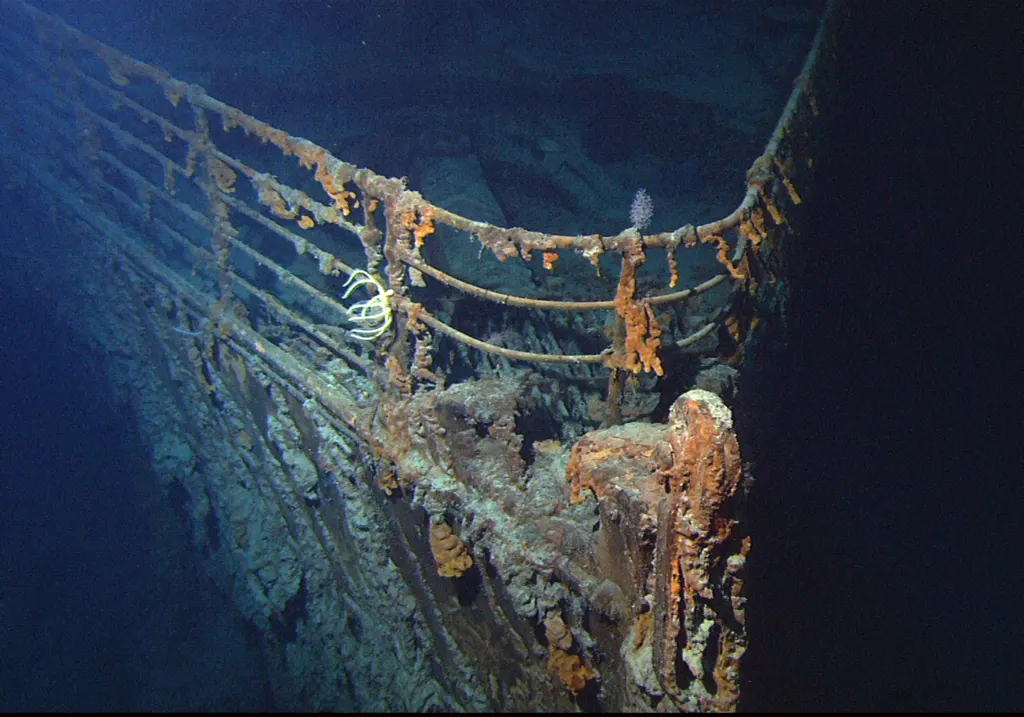
The wreck of the Titanic is slowly being dissolved by a bacterium named after it. Halomonas titanicae was pulled from rusticles, the dripping icicle-shaped growths of rust that hang off the hull, and formally described in 2010 by a team from the University of Seville in Spain and Dalhousie University in Halifax, Canada. One of its discoverers, Henrietta Mann, estimated that microbes like it could bring the ship down completely as soon as 2030.
The liner has lain about 12,500 feet (3,800 meters) down in the North Atlantic since April 1912, roughly 370 miles (600 kilometers) off Newfoundland. It rests in two main pieces about 2,000 feet (600 meters) apart, and the wreck site was found on 1 September 1985 by a French-American expedition.
How a 2010 study named strain BH1 from Titanic rust
The formal description appeared in the International Journal of Systematic and Evolutionary Microbiology, in a paper by Cristina Sánchez-Porro, Bhavleen Kaur, Henrietta Mann and Antonio Ventosa. The team grew a strain they labeled BH1 from rusticle samples collected at the wreck site and ran it through a battery of tests.
- Its 16S rRNA gene, a standard barcode for bacteria, was 98.6 percent similar to its closest known relative, Halomonas neptunia.
- DNA-DNA hybridization against four close relatives scored between 17 and 30 percent, well below the 70 percent line microbiologists usually use to call two strains the same species.
- It grew best at 86 to 99 degrees Fahrenheit (30 to 37 degrees Celsius) with 2 to 8 percent salt.
That last detail matters: the bacterium is halophilic, meaning salt-loving, and its sweet spot sits right around seawater’s average salinity of about 3.5 percent. The lab optimum is far warmer than the near-freezing water at the wreck, so the species grows much more slowly on the hull than it does in a dish.
Why low oxygen turns the bacterium against steel
H. titanicae does not chew metal the way the “eating” shorthand suggests. As the Wikipedia entry on Halomonas titanicae summarizes, where oxygen is plentiful it actually slows corrosion by using up dissolved oxygen. Where oxygen runs short, as it does in the deep sea, the bacterium switches to breathing iron, converting ferric iron, Fe(III), into ferrous iron, Fe(II). That reaction breaks down the protective rust film on the steel, exposes fresh metal and keeps the corrosion going.
A 2024 laboratory study of EH40 ship steel by researchers at the Chinese Academy of Sciences’ Institute of Oceanology in Qingdao found the same split personality: by consuming oxygen, the bacterium changed which part of a partly submerged steel coupon corroded fastest.
What the 2030 estimate does and does not mean
The collapse forecasts come from researchers’ estimates, not from a measured rate of steel loss across the whole ship, and they vary. Mann’s 2030 figure sits alongside a separate Dalhousie-Seville estimate that the wreck will not exist by 2037. Rusticles are also built by a whole community of microbes, so H. titanicae is one worker among many rather than the sole culprit. The original paper described the species; it did not measure how fast it removes iron at 12,500 feet.
“It has already lasted for 100 years, but eventually there will be nothing left but a rust stain on the bottom of the Atlantic,” Mann said.
The same habits have made the microbe interesting elsewhere. Its iron-reducing chemistry is being studied for bioremediation, including the controlled breakdown of old ships and oil rigs, and it survives crushing pressure partly by producing ectoine, a small molecule that balances water inside the cell.
The Titanic’s sister ship had a more eventful working life, as Badiyaa recounted in the story of how RMS Olympic passed and later sank Nantucket Lightship LV-117. More deep-sea and microbe stories sit in the Badiyaa Science section. For anyone hoping to see the Titanic’s bow, the window is narrowing: the type strain BH1 is now kept in public culture collections, which may outlast the steel it was found on.
Further reading
Image: NOAA/Institute for Exploration/University of Rhode Island, Public domain via Wikimedia Commons
This article was produced with AI assistance and reviewed by our Editorial Desk. How we work.