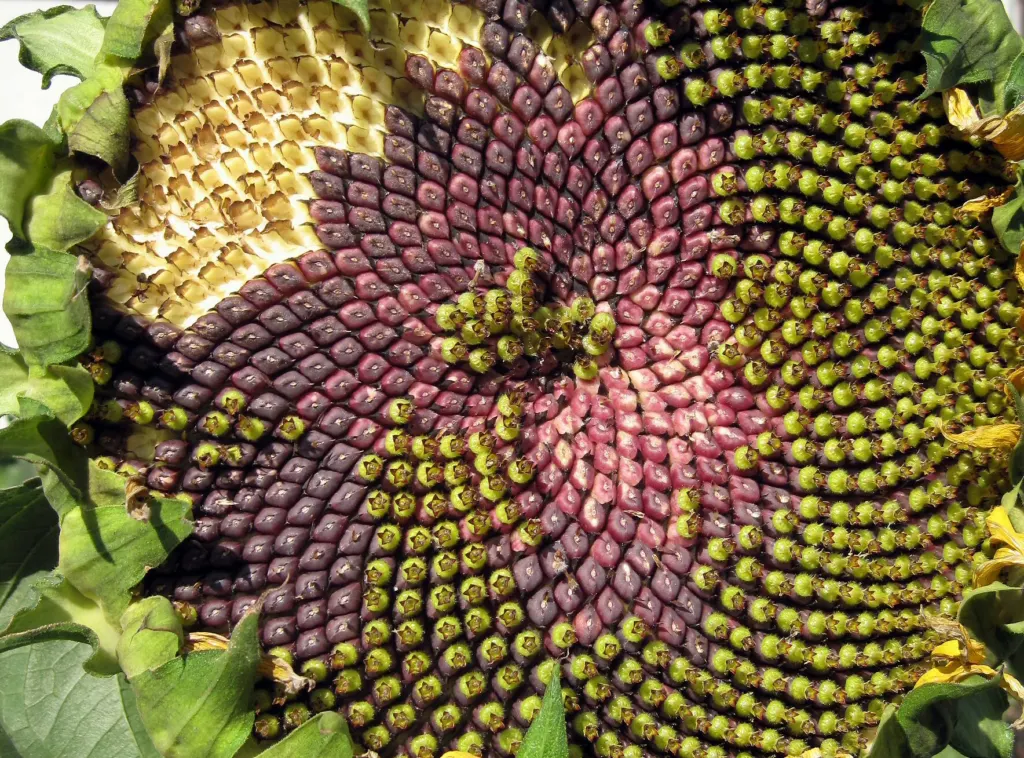
Count the spirals in a sunflower head and you will usually land on a Fibonacci number, but not always. In a citizen science study of 657 sunflowers, 632 of 768 reliable spiral counts fit Fibonacci patterns, leaving 136, or about 18 percent, that did not.
The project, led by Jonathan Swinton and Erinma Ochu, a University of Manchester researcher, with volunteers in a group named after Alan Turing, was published in Royal Society Open Science in May 2016. The authors called it the largest study of its kind and the first to systematically report seed heads with no Fibonacci structure at all.
The sequence behind the spirals
The Fibonacci sequence starts 1, 1, 2, 3, 5, 8, 13, 21, 34, 55, 89, with each number the sum of the two before it. Look at a sunflower face-on and two sets of spirals appear, one turning clockwise and one counterclockwise. Botanists call these parastichies. In a typical large head the two counts are neighbors in the sequence, such as 34 and 55.
The pattern is part of a wider habit in plants called phyllotaxis, the arrangement of leaves and other organs around a stem. The angle between one leaf and the next can be written as a fraction of a full turn, and the fractions keep returning to Fibonacci numbers:
- Beech and hazel twigs: 1/3 of a turn
- Oak and apricot: 2/5
- Sunflower, poplar and pear: 3/8
- Willow and almond: 5/13
In each case the top number and the bottom number are a Fibonacci number and the one two places after it, as the botanical record shows.
Why plants end up there
The modern explanation goes back to German botanist Wilhelm Hofmeister in 1868. A new leaf or seed bud, called a primordium, forms in the least crowded spot at the growing tip. Packing new buds into the gaps this way produces a steady turn of about 137.5 degrees, the golden angle, between successive buds. Because that angle never divides a circle evenly, no two buds line up on the same radial line, and the crossing spirals emerge on their own.
The hormone auxin plays a part: buds tend to start where it builds up, then draw it away from their neighbors, which steers where the next bud appears. Physicists have reproduced the same spirals with no plant at all; in 2009 one team built a “magnetic cactus” from magnets stacked on a stem that settled into botanical patterns.
The history is long. Leonardo da Vinci noted spiral leaf arrangements, Charles Bonnet described them in 1754, and in 1837 the brothers Auguste and Louis Bravais tied the ratios to the Fibonacci sequence.
What the misfits tell scientists
The 2016 team argued that the exceptions matter as much as the rule, because competing mathematical models make different predictions about how growth goes wrong. Working through the numbers:
Of 768 counts, 565 were plain Fibonacci numbers, which is 73.6 percent. Another 67 had a predefined Fibonacci-type structure, bringing the fit to 632, or 82.3 percent. The remaining 136 counts, 17.7 percent, fell outside both groups.
Among the near misses, counts one less than a Fibonacci number showed up significantly more often than counts one more. Some heads were so irregular that no spiral number could be assigned at all. The team also found more complex Fibonacci structures not previously reported in sunflowers.
Limits of the count
Volunteers grew and photographed the flowers, so the authors used only their most reliable subset for the headline figures. The study covers one species, Helianthus annuus, and says nothing on its own about pinecones or pineapples. Its data were released openly so others can recheck every head.
Patterns that look tidy from afar often turn messy up close, much like the coastline paradox that gives Canada several different lengths. Plant color has its own hidden logic too, as in why autumn leaves turn red and yellow. The next sunflower season in the Northern Hemisphere peaks in summer 2027, when anyone with a camera can count spirals for themselves.
Further reading
Image: Chiswick Chap, CC BY-SA 3.0 via Wikimedia Commons
This article was produced with AI assistance and reviewed by our Editorial Desk. How we work.