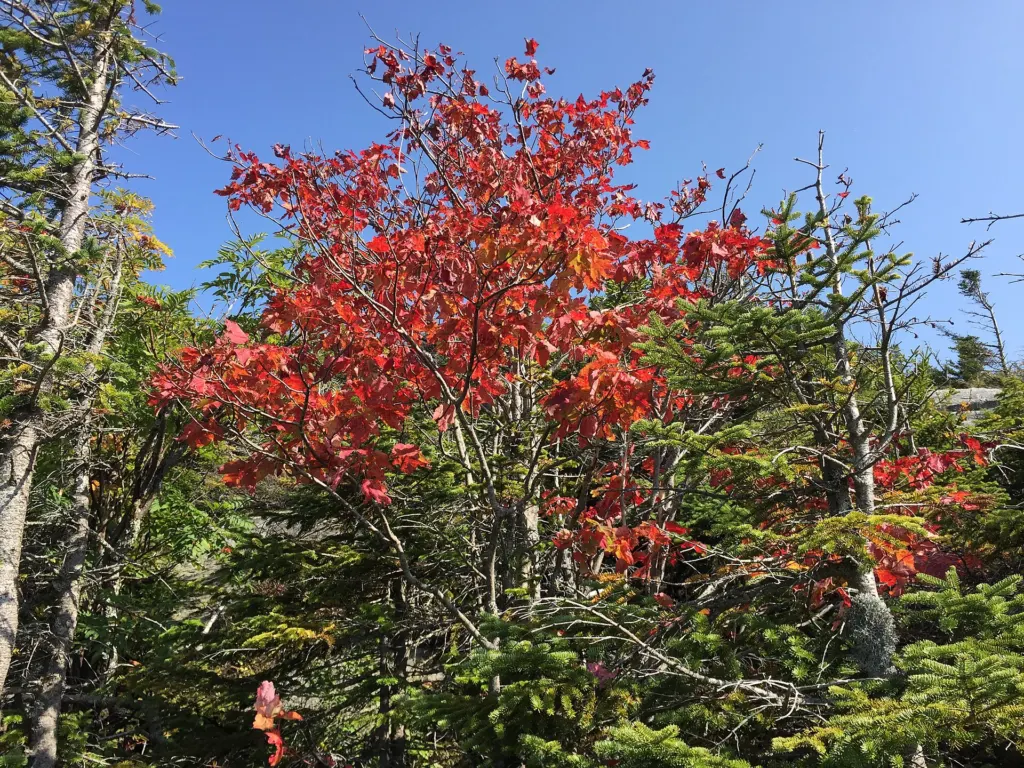
The yellow in an autumn maple was there all summer; the red is brand new. That is the short answer to why fall leaves turn color, and it explains why some trees blaze scarlet while others fade quietly to gold.
At Harvard University’s research forest in Massachusetts, about 70% of the trees and shrubs make red anthocyanin pigments as their leaves age, according to Harvard Forest’s guide to leaf color change. Across temperate forests as a whole, the figure is closer to 10% of tree species, which is one reason New England’s hills look so different from most of Europe’s.
Step one: the green drains away
All summer, leaves are packed with chlorophyll, the green pigment that captures sunlight to turn water and carbon dioxide into sugar. Trees constantly rebuild it as it wears out. When days shorten and nights cool in late summer, that rebuilding slows and then stops.
The tree is not simply letting the leaf die. It dismantles the chlorophyll in an orderly way so it can pull nitrogen and other nutrients back into the branches for next spring. Harvard Forest describes the process as very orderly under good conditions.
Step two: yellow and orange show through
Hiding beneath the green all along are carotenoids, the same family of pigments that colors carrots, corn and egg yolks. As chlorophyll disappears, these yellows and oranges are unmasked. The SUNY College of Environmental Science and Forestry notes that carotenes and xanthophylls sit alongside chlorophyll in the leaf for most of the year.
Hickories, aspens, birches, ash and yellow poplar are classic yellow trees. According to the Wikipedia article on autumn leaf color, carotenoids are the main pigment in the fall color of roughly 15% to 30% of tree species.
Step three: some trees make red on purpose
Red is different. Anthocyanins are not present through summer; trees actively build them in late summer and fall from sugars trapped in the leaf, a process that runs best in bright light. That is why the same pigment family also reddens cranberries, cherries and red apples.
Mix the pigments and you get the full palette:
- Yellow: carotenoids left behind after chlorophyll goes.
- Orange: anthocyanins blended with carotenoids, as in many sugar maples.
- Red and purple: lots of anthocyanin, as in red maples, sweetgums, dogwoods and sumacs.
- Brown: anthocyanin mixed with leftover chlorophyll, or tissue breaking down, as in many oaks.
Why bother making red at all?
Spending energy on a leaf that is about to fall seems wasteful, and scientists have offered several explanations. One idea is that red pigment works like sunscreen, shielding the leaf from light damage in cold weather so the tree can recover nitrogen more efficiently. Another, proposed by the biologist W. D. Hamilton in 2001, is that bright color warns insects such as aphids that the tree is well defended. Work on apple trees found that varieties with red autumn leaves carried fewer successful aphids. Neither idea has fully won out, and both may be partly true.
What makes a vivid year
Weather sets the intensity. Sunny, cool fall days with chilly nights that stay above freezing favor bright reds, while an early hard frost dulls them, the forestry college says. Warmer autumns are pushing the show later: one study of 150 years of herbarium specimens found a delay of more than a month in the onset of autumn since the 19th century.
The changing season has shaped other Badiyaa stories this fall, from crows commuting to giant winter roosts to woolly bear caterpillars that survive being frozen and the question of whether to mow or rake the leaves once they fall.
Once the color peaks, a corky layer of cells at the base of each leaf stem finishes sealing it off, and the next breeze drops it, leaving a small scar where a bud waits for spring.
Further reading
- Wikipedia: Autumn leaf color
- SUNY ESF: Why Leaves Change Color
- Harvard Forest: The Process of Leaf Color Change
Image: Famartin, CC BY-SA 4.0 via Wikimedia Commons
This article was produced with AI assistance and reviewed by our Editorial Desk. How we work.