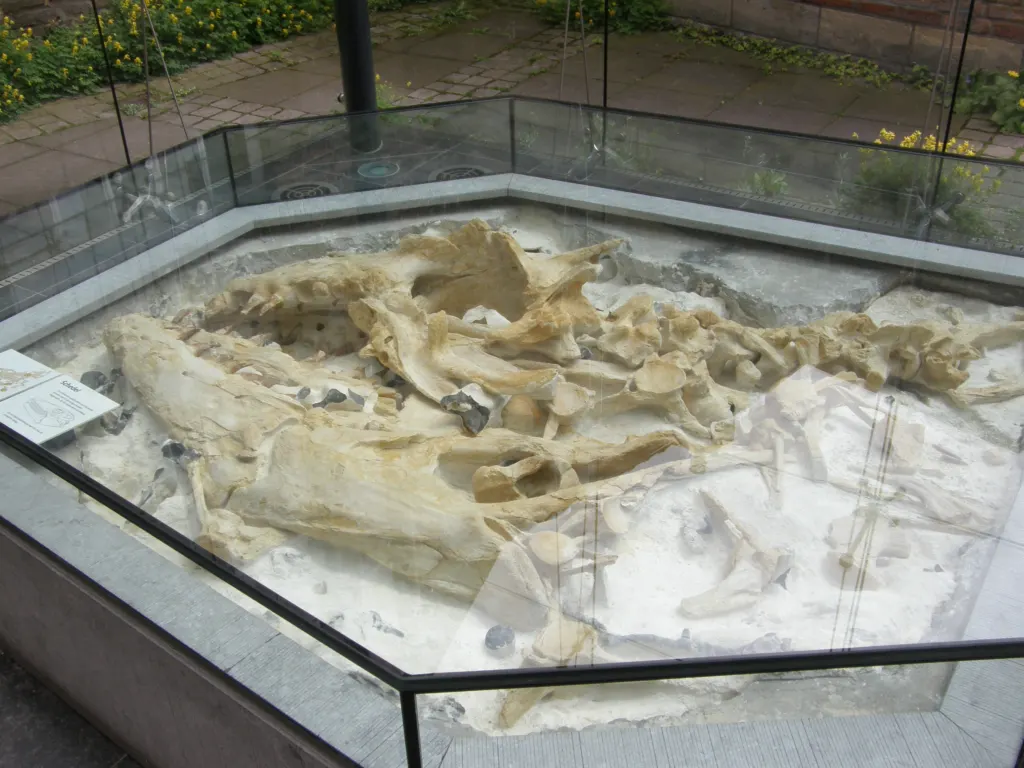
One skull, more than 1.4 meters (4.6 feet) long, is all science has of Prognathodon currii, and it is the largest skull known from any member of its mosasaur genus. Found in Israel and described in 2002 by paleontologists Christiansen and Bonde, the giant marine reptile is estimated to have reached about 11 meters (36 feet).
That would make it roughly as long as a city bus, cruising the seas over what is now the Middle East during the late Campanian, near the end of the age of dinosaurs.
A lizard, not a dinosaur
Mosasaurs were not dinosaurs. They were marine lizards, squamates related to living lizards and snakes, that took over the top predator role in Late Cretaceous oceans. Prognathodon belongs to the Mosasaurinae, the same subfamily as Mosasaurus itself. The genus name means “forejaw tooth,” from Latin and Greek roots, and Belgian paleontologist Louis Dollo first described it in 1889 from fossils dug up in Belgium.
The Israeli skull went by an informal name, “Oronosaurus,” before its formal description. Repeated analyses of mosasaur family trees have since placed it firmly inside Prognathodon. It differs from every other known mosasaur in one detail: the frontal bone on top of its skull is clearly wider than it is long.
What made Prognathodon different
The genus is known for jaws and teeth built for force. Its skull carries signs of very powerful jaw muscles, and fused processes on the quadrate, a bone in the jaw joint, may have helped it withstand the strain of biting down. One estimate for a related North American species put the bite force at the back of the jaw at roughly 7,600 to 11,000 newtons.
- Few teeth: fewer than most mosasaurs, typically about 13 or 14 in each lower jaw
- Extra teeth on the palate: large pterygoid teeth that likely gripped prey before swallowing
- Mixed tooth design: robust like a shell-crusher’s, but with fine serrations like a slicer’s
- A shark-like tail: a Jordanian specimen preserves a tail fin shaped like an upside-down shark tail
Direct diet evidence is rare, but one specimen from Alberta, Canada, held stomach contents: a 1.6-meter fish, a smaller fish, a sea turtle and possibly a squid-like cephalopod. Researchers read that mix as the menu of an opportunistic apex predator, comparable in feeding style to a modern killer whale, able to take almost anything in its sea.
How big is 1.4 meters, worked out
For scale, a skull of 1.4 meters is about the height of a typical 10-year-old. If the 11-meter body estimate holds, the skull made up about 13 percent of the animal’s length (1.4 divided by 11). The type species of the genus, P. solvayi from Belgium, reached only about 5 to 6 meters, so P. currii was roughly twice as long as the animal that gave the genus its name.
The limits of one skull
Every body-length figure for P. currii is an estimate scaled from that single skull. No skeleton has been found, so its proportions are borrowed from better-known relatives. The genus as a whole is also messy: about a dozen species have been assigned to it, and recent studies suggest several of them belong elsewhere, which means Prognathodon is probably not one natural group. Even so, P. currii sits inside the core of the genus in those analyses. A cast of its skull is displayed at the Geological Museum in Copenhagen.
Fossils from the same era turn up in surprising forms, such as the Alberta gemstone cut from ammonite shells about 70 to 75 million years old. More finds from Late Cretaceous seas are collected on our Science page. A new species, P. cipactli, was named in 2026, adding another entry to the genus list.
Further reading
Image: Olof Moleman, CC0 via Wikimedia Commons
This article was produced with AI assistance and reviewed by our Editorial Desk. How we work.