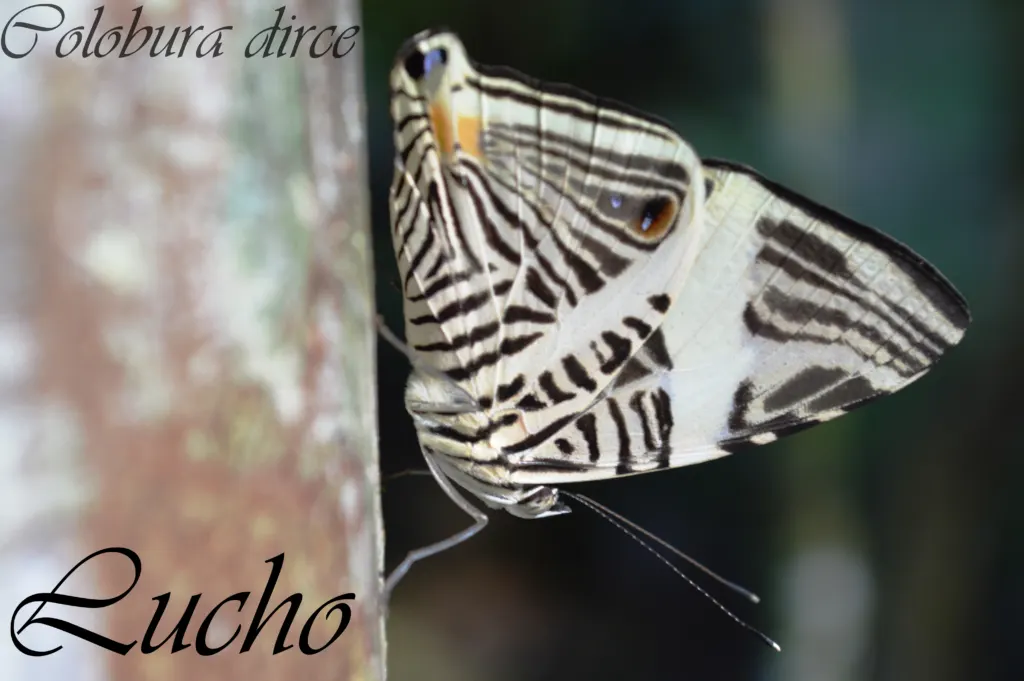
One of the most familiar butterflies in the American tropics, the zebra-striped Colobura, is really three species that look almost the same, and the newest one gave itself away only because its caterpillars are missing a few cream-colored marks. Biologists at the Florida Museum of Natural History have named it Colobura cryptica.
The discovery closes a case that stayed open for well over two centuries. “These butterflies look almost exactly the same and are found in the exact same place at the same time,” said Anisha Sapkota, the doctoral student who led the work, which appears in the journal Zootaxa.
A butterfly everyone thought they knew
Colobura butterflies range from Mexico and the Caribbean through Central America to the Andes, the Amazon and Brazil’s Atlantic Rainforest. Their caterpillars feed on Cecropia trees, a fixture of tropical forests. “If you go to the neotropics, Colobura is one of the first butterflies you see,” Sapkota said.
That very familiarity hid the problem. Here is how the case unfolded, according to the museum’s account:
- 1758: Carl Linnaeus formally describes the butterfly, and for generations naturalists treat it as one species, Colobura dirce.
- 1852: Dutch entomologist Jan Sepp argues that different cream markings on the caterpillars mean two species. His peers ignore him for about 150 years.
- 2001: Keith Willmott, now a curator at the museum’s McGuire Center for Lepidoptera and Biodiversity, and colleagues revive Sepp’s idea and name Colobura annulata.
- Roughly 25 years later: Andrés Orellana photographs Colobura caterpillars stripping a Cecropia sapling in Venezuela. None has any cream markings at all.
Count it up and the butterfly spent 243 years, from 1758 to 2001, filed as a single species, and it took another quarter century to find the third. “We assumed that was the problem solved,” Willmott said of the 2001 work.
DNA and invisible color
Sapkota checked DNA barcodes collected during a long-running survey of Costa Rican moths and butterflies led by co-authors Daniel Janzen and Winnie Hallwachs. Older museum specimens went to Nick Grishin at UT Southwestern Medical Center in Texas, who sequenced their genomes. The genetic results split Colobura cleanly into three lineages.
The adults barely differ to human eyes. The best visible clue is a gray band under the forewing that is either uniform or slightly wider and either touches a yellow band below it or stops short. But after hours at the microscope Sapkota noticed a faint violet shimmer and tested the wings with a spectrometer. “Even though the butterflies didn’t look violet to me, it reflected UV light,” she said. Each species reflects ultraviolet at a different average wavelength: about 376 nanometers for C. dirce, 370 for C. annulata and 344 for C. cryptica.
Badiyaa recently covered another Florida Museum insect project, a seven-year lab study that widened luna moth tails. For more nature stories, visit our Science section.
What is still unknown
The three species overlap across much of their range, and the nuclear DNA shows no sign of interbreeding. How they tell each other apart is a puzzle. They lack the scent glands some butterflies use for courtship, so Sapkota is testing whether ultraviolet color guides mate choice; so far the results are inconclusive. The team also suspects the species may sort themselves by height, with C. dirce in the undergrowth and the other two higher in the canopy, but field studies disagree.
Of the three, C. cryptica has the smallest range, from southern Mexico to the Andean foothills. Sapkota’s answer to the open questions is simple: “Someone has to go the field to find it out themselves.”
Further reading
Image: Lucho.agudelo, CC BY-SA 3.0 via Wikimedia Commons
This article was produced with AI assistance and reviewed by our Editorial Desk. How we work.