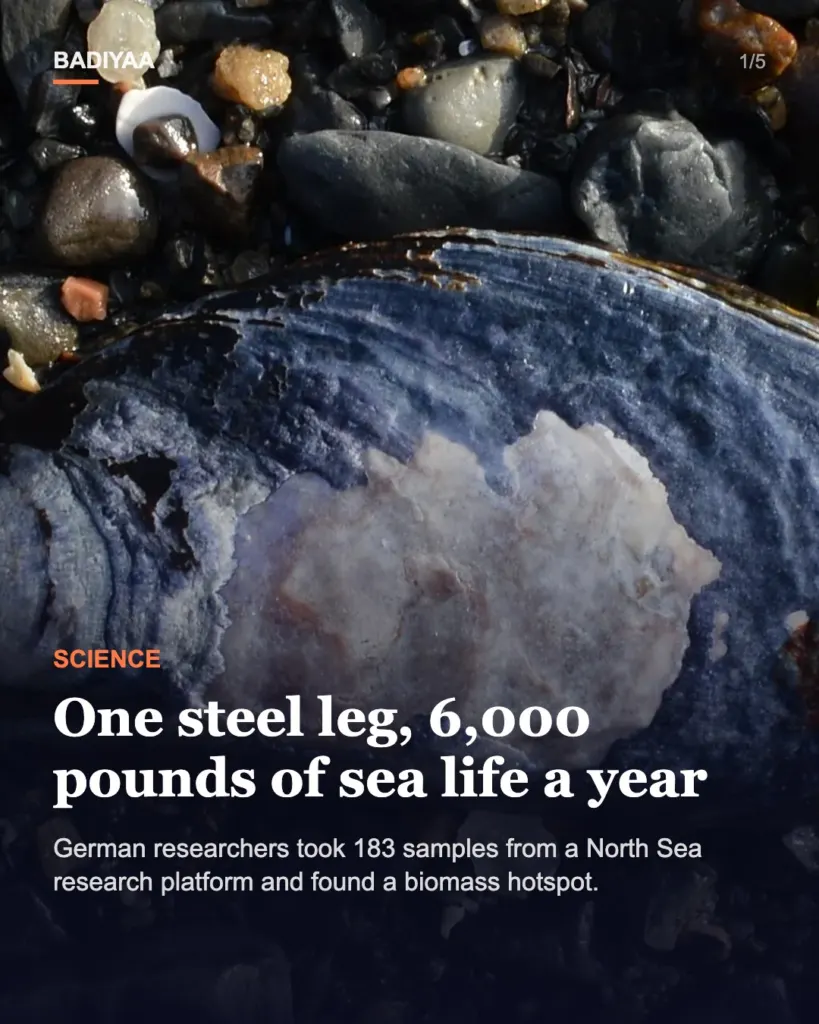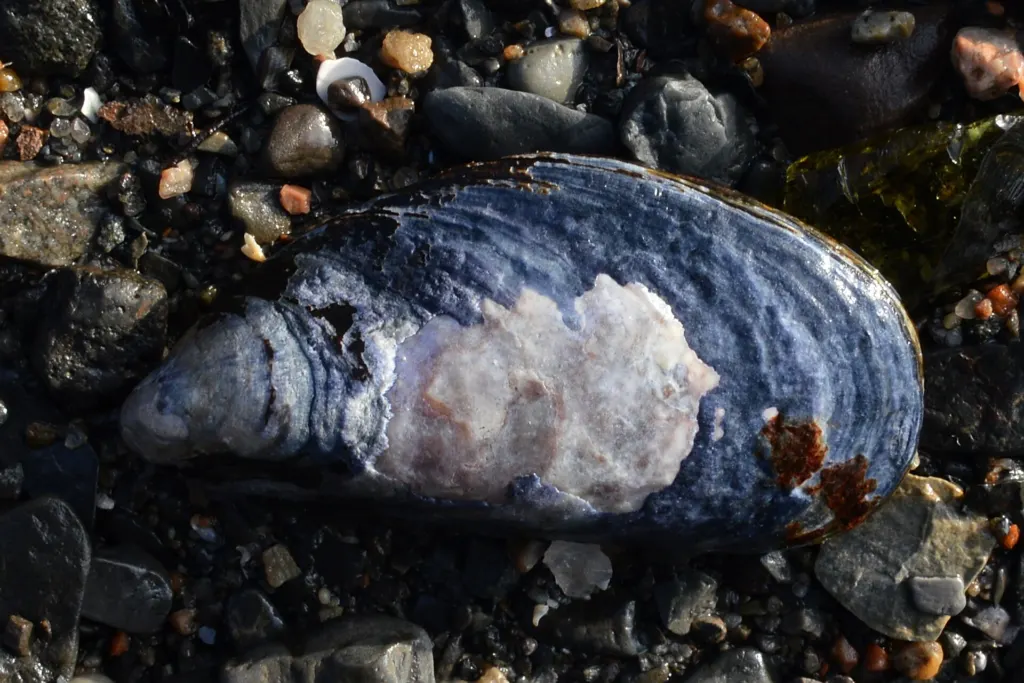
One steel offshore platform in the German Bight, the shallow southeastern corner of the North Sea off Germany, carried an average of about 9,500 pounds (4,300 kilograms) of attached animals and probably shed at least 5,950 pounds (2,700 kilograms) of that load every year, according to researchers from the Alfred Wegener Institute and the University of Koblenz-Landau. Blue mussels dominated the shallow parts of the structure, which is why the finding is circulating online again as “nearly 6,000 pounds of mussel biomass.” The study’s own figure covers all the attached biomass, with mussels the leading shallow-water component.
The work is not new. Roland Krone, Lars Gutow, Tanja Joschko and Alexander Schröder published it in April 2013 in the journal Marine Environmental Research, under the title “Epifauna dynamics at an offshore foundation: Implications of future wind power farming in the North Sea.” Its question has only grown more pressing as offshore wind farms spread across the region.
How the team weighed 183 samples from one platform
The researchers worked at FINO 1, a research platform in the German Bight whose underwater structure is comparable to a wind turbine foundation. They took 183 separate samples at depths of about 3, 16, 33 and 66 to 92 feet (1, 5, 10 and 20 to 28 meters) and compared both the mass and the makeup of the biofouling, meaning the animals that colonize submerged surfaces, across depth and time. The institute’s repository lists scientific diving and the research vessel Heincke among the platforms used.
Three groups dominated: the blue mussel Mytilus edulis; anthozoans, the group that includes sea anemones; and Jassa, small shrimp-like crustaceans called amphipods. Mussels ruled the 3- and 16-foot zones, anthozoans the deepest zone, and the 33-foot band was a mix of the two. Why that matters: the seabed around the platform is mostly sand and mud, so a steel tower adds hard-bottom habitat that the area otherwise lacks.
Why 35 times more biomass makes a foundation a hotspot
The structure’s submerged surface measured 1,280 square meters (about 13,780 square feet). Its footprint on the seabed was 1,024 square meters (about 11,020 square feet). Spread the average 4,300-kilogram load over that footprint and you get about 4.2 kilograms per square meter, or roughly 0.86 pounds per square foot. The surrounding soft seabed in Germany’s exclusive economic zone holds about 0.12 kilograms per square meter (0.025 pounds per square foot). Divide one by the other and the result is the paper’s headline ratio: about 35 times more bottom-living animal mass on the same patch of seafloor.
The export figure is the striking one. If at least 2,700 of the 4,300 kilograms leave each year, the platform sheds the equivalent of about 63 percent of its standing load annually. Much of that falls as mussels and shells. The team estimated that 3.45 million individual mussel shells of different sizes were produced during the study period.
Why that matters: falling shells form what the authors call secondary hard substrate, new rough ground on the seabed that other animals can settle on. More mussels also filter more seawater. The authors gave the predicted shift a name, the “Mytilusation” of the German Bight.
An earlier count found 30,000 mussels per square meter
A 2008 paper in Marine Biology Research, by Joschko, Gutow, Schröder and Bela Buck, tracked mussels colonizing an offshore research platform in the German Bight from summer 2003 to summer 2005. Settlement in 2003 was poor, mainly because construction finished out of step with the arrival of mussel larvae. By summer 2005, densities reached up to 30,000 mussels per square meter (about 2,800 per square foot) and close to 40 kilograms per square meter (around 8 pounds per square foot), and the upper foundation was fully covered. The lower parts stayed sparse. Mussels grew fast offshore because conditions suited them and fewer natural constraints held them back.
What one platform and 183 samples cannot show
This is one structure, and a research platform rather than a working turbine, so the totals are a case study, not a census of every foundation. The yearly export number is an inference from how biomass changed over time; the authors wrote “we assume” when they gave it. The data are also more than a decade old. In his 2012 University of Bremen doctoral thesis, Krone wrote that the effect of extra production and concentrated biomass on the North Sea’s energy flow “remains unknown,” and that whether the reef effects count as positive, negative or neither depends on interpretation.
The thesis did scale the numbers up. It said 5,000 wind power foundations were planned in the German Bight over the following 30 years, which would raise total biomass in the bight by about 0.8 percent. Mussels on all of them would equal roughly half the mussels then living in the German Wadden Sea, the tidal flats along the coast, and the extra filtering could make water clearer. Shallow steel could also help the Pacific oyster, an introduced species, spread. No European lobsters were seen at the foundations already standing.
The thesis put the build-out in concrete terms: 12 foundations finished and 197 under way at the time, and an expected 2.0 million brown crabs living on future foundations, on top of 2.3 million already estimated at the bight’s 1,300 shipwrecks.
Further reading
- Tethys: Epifauna Dynamics at an Offshore Foundation (abstract)
- DOI: Krone et al. 2013, Marine Environmental Research
Image: Ryan Hodnett, CC BY-SA 4.0 via Wikimedia Commons
This article was produced with AI assistance and reviewed by our Editorial Desk. How we work.
Spot an error? Help verify this story
The story in 5 slides