The “Mysterious Hanging Boulder” at Polar Caves Park in Rumney, New Hampshire, an 80-ton slab of granite that had jutted over a visitor walkway for all 104 years the attraction has been open, fell on Sunday, October 18, the last day of the park’s 2026 season. Nobody was underneath it, and the park said no one was hurt.
The fall has been circulating again online this week, eight days after it happened. The more useful question it raises is how a rock that size stays put for a century and then lets go on an ordinary autumn Sunday.
A trail sign that said 75 percent hung over your head
The park’s own sign spelled out the risk in plain numbers. “This boulder is cracked all the way through and rests on 3 contact points in the back,” it read. “It weighs 80 tons, 75 percent of which is hanging over your head.”
Take the sign at its word and the working is simple: 80 tons × 0.75 = 60 tons of granite held in the air, with only 20 tons sitting over its three points of support. That is roughly the weight of 40 midsize cars (at about 1.5 tons each) cantilevered over a boardwalk.
Video of the aftermath shared by a hiker showed the walkway railing smashed and the trail blocked by the boulder, now resting on its side. The trail sign’s arrow still points at the overhang that is no longer there.
How a glacier parked the boulder and ice pried it loose
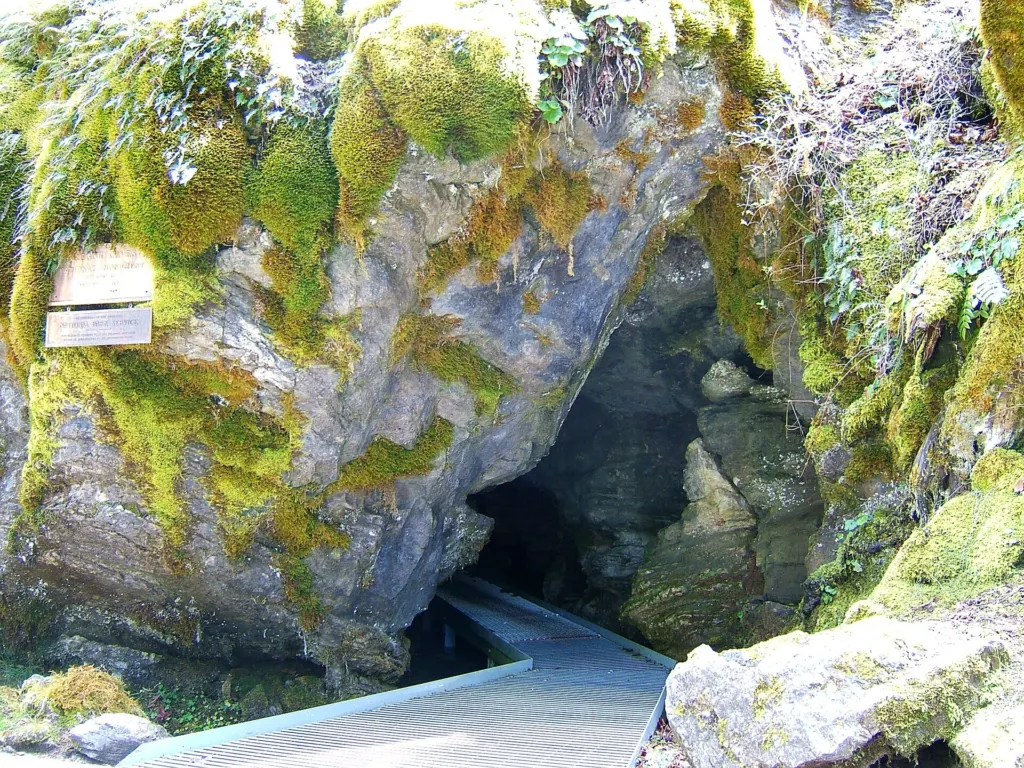
Polar Caves is a cluster of talus caves, meaning open spaces left between huge fallen blocks rather than tunnels carved into solid rock. The park’s nine granite caves are linked by boardwalks along a route of about 2 miles (3.2 kilometers), and the deepest cave stays cold enough for snow to linger into summer, which is where the name comes from.
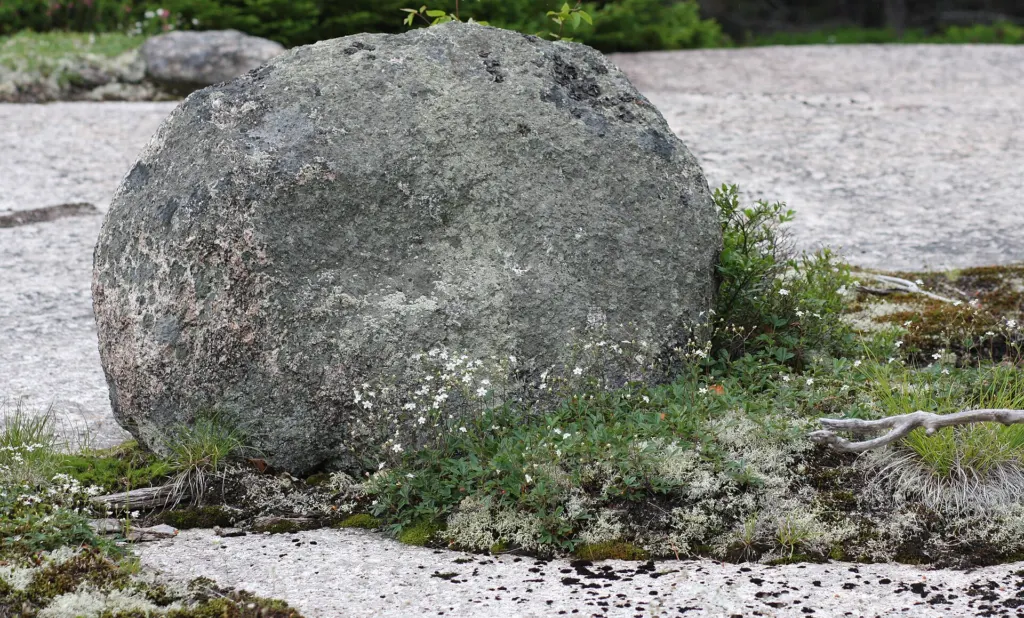
“The Polar Caves are actually called that because the caves are spaces between enormous granite boulders that were at one point put there by glaciers,” Joe Licciardi, a University of New Hampshire glacial geologist, said in an interview published on October 20. The hanging boulder was left in its perch by that ice thousands of years ago.
Two slow processes probably finished the job. Jan Earle, a geologist whose career includes work with the US Geological Survey, described the boulder as essentially a balanced rock. “If more of its weight was hanging over the edge than sitting on its base, then it was just a matter of time until gravity and erosion of its base took over, and it tipped over,” she said. Wind and rain wearing away the support beneath it, plus the weight of water, dust or rock landing on top, could have tipped the balance.
The second process is frost wedging. Licciardi noted that water expands by roughly 9 percent as it freezes. When meltwater seeps into a crack and freezes overnight, that expansion pushes the crack a little wider, and the next thaw lets more water in. “That’s more than enough to cause the rock to further fracture and crumble,” he said.
The National Park Service describes the same mechanism at Bryce Canyon in Utah, where more than 200 freeze-thaw cycles a year pry rock apart bit by bit, much as a pothole grows in a road. A 2006 rockfall there dumped an estimated 400 to 500 tons of rock on the Navajo Loop Trail while hikers were on it; no one was injured in that case either.
What is not known about the October 18 fall
No one has published a measured cause. The geologists’ explanations are informed general readings of how balanced boulders fail, not the findings of a site inspection, and the park declined to comment further on what triggered the fall. There is no public record of how much the cracks had widened in recent years, whether the boulder had been monitored, or what the weather was on the day.
New Hampshire has seen this before on a far bigger stage. The Old Man of the Mountain, five granite ledges forming a 40-foot (12-meter) profile 1,200 feet (370 meters) above Profile Lake, collapsed between midnight and 2 a.m. on May 3, 2003. Freeze-thaw had opened fissures in its “forehead” for decades; the state chained the crack in the 1920s and in 1957 approved $25,000 for a repair that used 20 short tons of cement, steel rods and turnbuckles. The patchwork bought time, not permanence.
Reopening set for the 2027 season
Polar Caves, which first opened to visitors in 1922, will assess the site during its offseason before deciding what to do with the walkway and the fallen block. “The safety of our guests and employees continues to be our highest priority,” the park said. Its normal season runs from mid-May to mid-October, and it has told visitors: “We look forward to welcoming everyone back for the 2027 season.”
Further reading
- Wikipedia: Polar Caves Park
- Wikipedia: Old Man of the Mountain
- National Park Service: Navajo Loop Trail Rock Fall (Bryce Canyon)
Image: Dcrjsr, CC BY-SA 3.0 via Wikimedia Commons
This article was produced with AI assistance and reviewed by our Editorial Desk. How we work.