Two separate teams now claim to have shown that the Navier–Stokes equations, the 19th-century formulas used to model air over wings and blood in arteries, can break down in finite time. Neither claim has been accepted by mathematicians yet. The newest arrived on November 20, when Levent Alpöge and Tristan Buckmaster posted a blow-up result that needs no outside force pushing the fluid at all.
What "blow-up" means
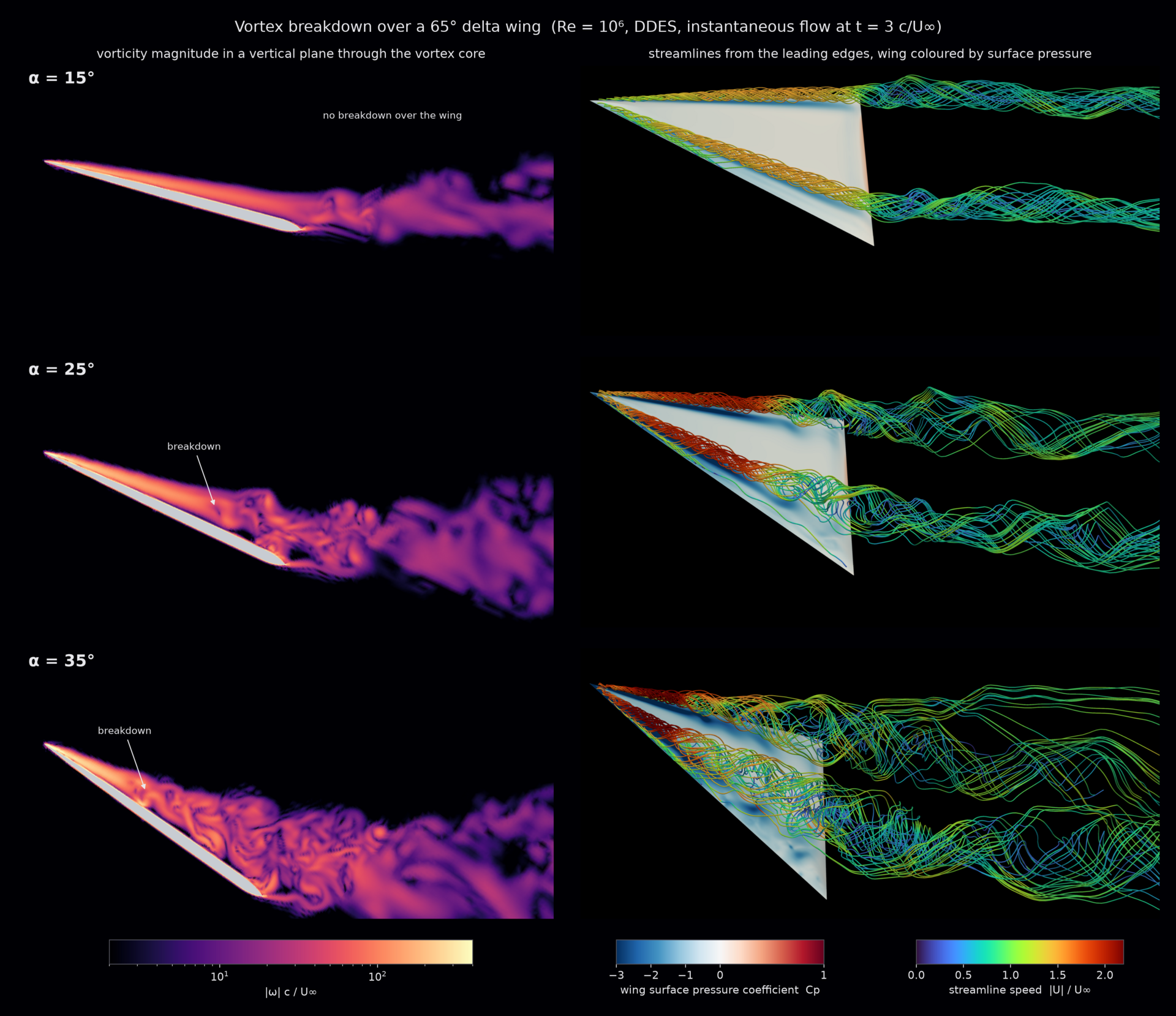
The equations describe a fluid as a smooth, continuous substance. A blow-up, or singularity, is a moment when the predicted speed somewhere in that fluid grows without limit, even though the motion started out smooth and the total energy stays finite. Real water cannot move infinitely fast, so a blow-up would show the equations themselves failing.
The Clay Mathematics Institute's Navier–Stokes page notes that the equations were written down in the 1800s yet remain poorly understood. Clay made the problem one of its seven Millennium Prize Problems in 2000. As Wikipedia's article on the problem explains, there are four official versions: two ask for proof that smooth solutions always exist with no force applied, and two ask for an example of breakdown, where a smooth external force is allowed. Solving any one counts.
Claim one: OpenAI, September 8
In OpenAI's announcement of its Navier–Stokes result, the company says an internal model produced a proof, plus a Lean computer formalization, that an initially still fluid with a smooth force applied can form a singularity. It describes the solution as a vortex that spirals inward and stretches out "like spaghetti." On the order of 10,000 AI agents worked on the problem for about 88 hours, sending 2.7 million messages along the way. The company wrote: "We do not intend to claim the Millennium Prize for this result."
Doubts followed quickly. Wikipedia's summary records a September 17 preprint by Peter Constantin, Mihaela Ignatova and Vlad Vicol arguing that the method cannot be extended to forces of the smoothest, "real analytic" kind, which includes zero force. It also records an October 6 arXiv paper reporting that the Lean code did not faithfully match the written proof.
Claim two: no force at all
The November 20 claim targets the harder, more physical case: a fluid that blows up purely through its own motion. Wikipedia lists it, while noting that its correctness has not been confirmed. The pair had already published related blow-up results for simpler fluid models, and those results were extended on October 5 in Fan Zheng's arXiv preprint on the porous media equation, which removed the outside force from a construction by Alpöge, Buckmaster and Coiculescu.
Buckmaster, a professor at New York University, shared the 2019 Clay Research Award with Vlad Vicol and Philip Isett for work on Navier–Stokes, according to his NYU faculty page. Alpöge is a number theorist now at Anthropic.
The numbers behind the race
Jean Leray proved in 1934 that weak solutions exist, so the smoothness question has been open for 92 years. OpenAI's agents used roughly 130 billion output tokens on Navier–Stokes in 88 hours. Divided out, that is close to 1.5 billion tokens an hour, around the clock, for more than three and a half days.
Limits
A preprint is not a proof until experts check it, and a Lean file proves only what its definitions actually say. Clay has made no announcement on either claim. Badiyaa covered a similar situation in our explainer on the Riemann hypothesis and an unverified proof claim, and machine-checked math more broadly in DeepMind's verified audit of Signal's encryption. More on the field is on Badiyaa's Science page.
The next concrete marker is whether specialists in fluid equations publish line-by-line checks of the November 20 paper.
Sources
- Navier–Stokes existence and smoothness, Wikipedia, 2026
- On the Navier–Stokes Millennium Prize Problem, OpenAI, 2026
- Navier-Stokes Equation (Millennium Prize Problems), Clay Mathematics Institute, 2026
- Fan Zheng, preprint on unforced blow-up of the porous media (IPM) equation, arXiv, 2026
- Tristan Buckmaster faculty page, New York University, Courant Institute, 2026
Image: Vilhelm.s, CC0 via Wikimedia Commons
This article was produced with AI assistance and reviewed by our Editorial Desk. How we work.