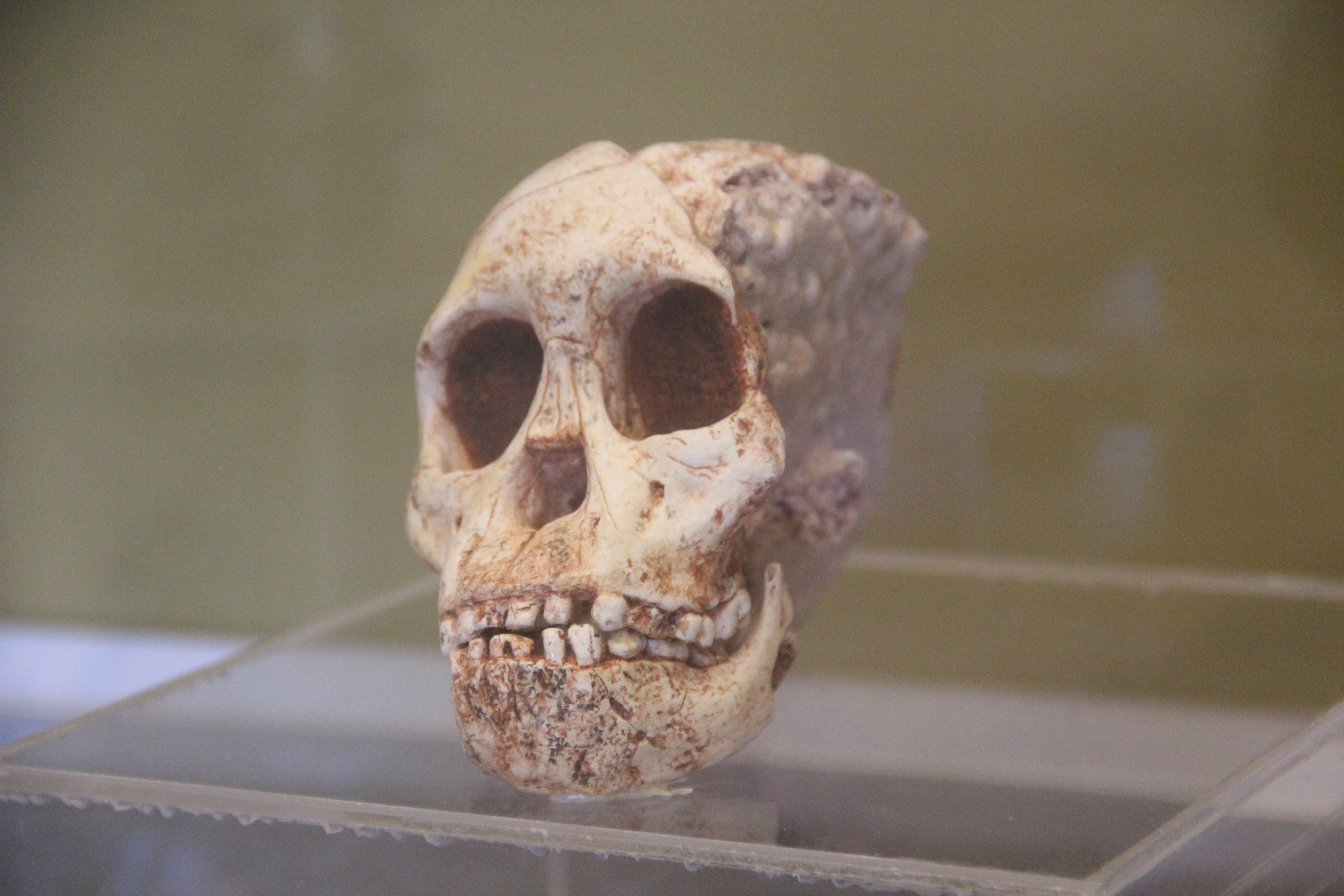
The Taung Child, the small skull that first convinced science that humans arose in Africa, is about 3 million years old, a new study finds: between 2.96 and 3.03 million years. That is a few hundred thousand years older than the figure most textbooks still give.
The study, “The Taung child and the biogeographic and palaeoclimatic drivers of southern African hominin diversity,” published November 5, 2026, in npj Palaeoecosystems, a Nature Portfolio journal, was led by Gabriele Macho of the AMGC research group at Vrije Universiteit Brussel (VUB) in Belgium, with seven co-authors.
The new age matters because the old one was shaky. Wikipedia’s article on the Taung Child lists the fossil at 2.8 million years and notes a tooth-ratio method that placed it near 2.58 million. Pinning it closer to 3 million years puts the child alongside, rather than after, some of the other South African fossils it is compared with.
A 1924 skull that defines a whole species
Quarry workers at Taung, in what is now South Africa’s North West province, turned up the skull in 1924. Anatomist Raymond Dart named it Australopithecus africanus, “southern ape from Africa,” in the journal Nature in February 1925, only 40 days after he first saw it.
The child was about three or four years old when it died, judging by how its tooth enamel was laid down. Its brain, at 400 to 500 cubic centimeters, was about the size of an adult chimpanzee’s, yet the position of the opening for the spinal cord suggested it walked upright.
Taung is also the type specimen, the single fossil that officially defines A. africanus. Here is the twist the new paper presses: no firm criteria were ever set for assigning later finds to the species, so Taung remains the only fossil that belongs to it without question, according to Vrije Universiteit Brussel’s release on the study.
How the team tested the family tree with teeth and brains
Besides re-dating the site, the researchers compared how Taung’s teeth and brain developed during growth with adult fossils long lumped into the same species. They also examined variation at the dentino-enamel junction of the first molar, the boundary between a tooth’s inner dentine and its outer enamel.
Several of those adults did not follow Taung’s growth path, and differences in brain development suggest more than one kind of hominin lived in the Sterkfontein area, at the same time or one after another. The paper concludes that A. africanus is a poorly defined taxon.
“The human family tree wasn’t a neat, straight trunk—it was a chaotic, tangled bush driven by climate shifts,” Macho said in the university’s statement.
Fossil pollen points the same way. It shows Taung lived in a far wetter, more forested setting than today’s South Africa, with tree species now found hundreds of kilometers to the northeast.
What one skull can and cannot settle
The argument rests on one juvenile skull compared against a scattered set of adult fossils, so it reframes the debate more than it ends it. The authors propose that drift and hybridization, meaning interbreeding between populations, probably drove the diversity of southern African hominins; that is a hypothesis, not a measured result.
The dating fits a broader shake-up. Wikipedia’s entry on Australopithecus africanus notes that a 2022 study re-dated the fossil-rich Sterkfontein Member 4 deposit to 3.4 million years, older than once thought.
For a sense of the wider family, Badiyaa recently looked back at how Lucy, the 3.2-million-year-old skeleton from Ethiopia, was found in 1974. More fossil stories sit in Badiyaa’s Science section.
The original Taung skull is held at the University of the Witwatersrand in Johannesburg, now with a date of roughly 3 million years attached to it.
Sources
- Macho et al., Taung child paper (npj Palaeoecosystems), Vrije Universiteit Brussel et al., 2026
- Taung child study release (via EurekAlert), Vrije Universiteit Brussel, 2026
- Taung Child, Wikipedia, 2026
- Australopithecus africanus, Wikipedia, 2026
Image: GuillaumeG, CC BY-SA 4.0 via Wikimedia Commons
This article was produced with AI assistance and reviewed by our Editorial Desk. How we work.