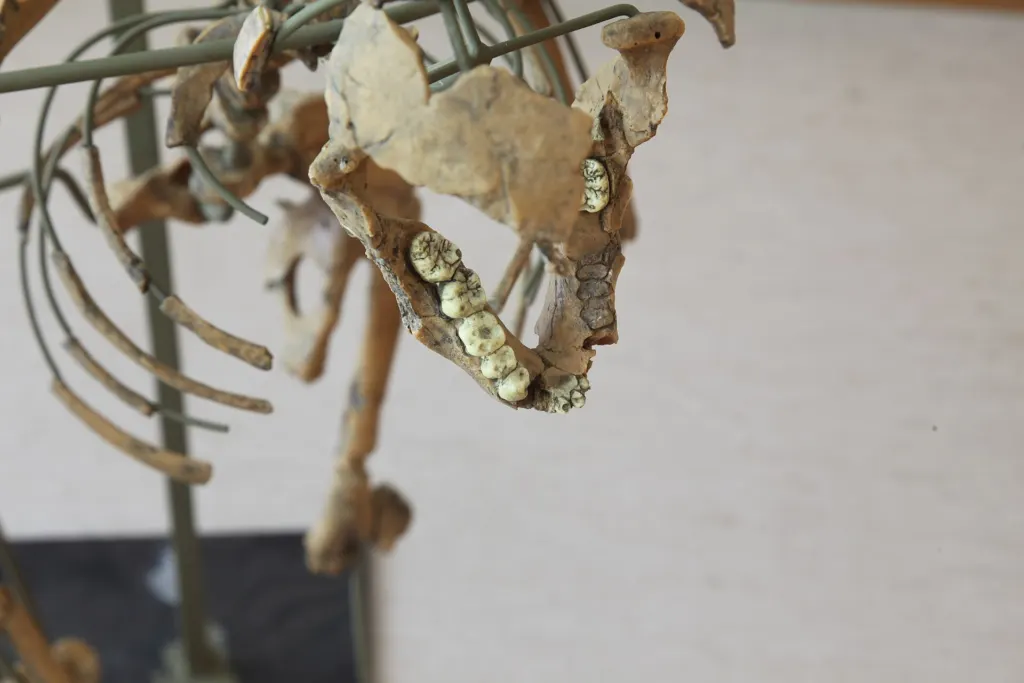
On the morning of November 24, 1974, paleoanthropologist Donald Johanson skipped his paperwork, went fossil hunting with graduate student Tom Gray at a site called Locality 162 in Ethiopia, and spotted a fragment of arm bone on the slope of a gully that others had already checked at least twice. Within three weeks the team had collected several hundred pieces of a single skeleton, about 40% of one individual. That night’s camp soundtrack, the Beatles’ “Lucy in the Sky with Diamonds,” gave her a name.
The discovery turns 52 next Tuesday; Lucy herself is about 3.2 million years old. According to the history of the find, she was catalogued as AL 288-1 and is also known in Ethiopia as Dinkinesh, Amharic for “you are marvelous.”
Where she was found
The site is Hadar, in the Afar Region of northeastern Ethiopia, beside the Awash River in the Afar Triangle, a lowland within the Rift Valley system. The Hadar fossil beds have produced hominin fossils dated from about 3.42 to 2.90 million years ago, including the “First Family” site found a year after Lucy, with 216 specimens from roughly 17 individuals.
Lucy’s age came later. Volcanic ash layers just below and above the bones were dated in the early 1990s with the argon-argon method, giving ages of 3.22 and 3.18 million years.
Why one skeleton mattered so much
Lucy combined two features many scientists had not expected to see together. Her braincase was small, like a chimpanzee’s, but her pelvis, knee and leg bones showed she walked upright. That supported the view that walking on two legs came before big brains in human evolution.
The Smithsonian’s Human Origins Program describes Lucy’s species, Australopithecus afarensis, as one of the longest-lived and best-known early human species, with remains from more than 300 individuals. It lived in eastern Africa between about 3.85 and 2.95 million years ago. Females averaged about 3 feet 5 inches (105 cm) and 64 pounds (29 kg), and brains were usually under 500 cubic centimeters, about a third the size of ours. The species was formally named in 1978.
Fifty-two years in perspective
The time scale is hard to picture, so try this. If the 3.2 million years since Lucy lived were squeezed into a single 24-hour day, the 52 years since Johanson spotted her arm bone would take up about 1.4 seconds (52 divided by 3.2 million, times 86,400 seconds). Her species, which lasted more than 900,000 years, would fill nearly seven hours of that day.
Badiyaa has covered newer twists in the human story, from Homo naledi fossils that may all be female to the pattern of Neanderthal DNA across Europe.
What killed Lucy is still debated
Nobody knows for certain. A 2016 team led by John Kappelman of the University of Texas at Austin scanned the bones with CT and argued in a paper in Nature titled “Perimortem fractures in Lucy suggest mortality from fall out of tall tree” that her breaks fit a fall from a height. Johanson and fellow paleoanthropologist Tim White disagreed with that reading.
The limits
Lucy is no longer seen as the earliest member of the human family, and researchers now think her species lived in grassy woodlands rather than open savanna. She is also a partial skeleton, so some features, such as her spine, are still being reassessed. The original fossils are kept in a vault at the National Museum of Ethiopia in Addis Ababa, where visitors see a replica. The 52nd anniversary of her discovery falls on November 24, 2026.
Sources
- Lucy (hominid), Wikipedia, 2026
- Hadar, Ethiopia, Wikipedia, 2026
- Australopithecus afarensis, Smithsonian Institution Human Origins Program
- Perimortem fractures in Lucy (Kappelman et al.), Nature, 2016
Image: Rama, CC BY-SA 3.0 FR via Wikimedia Commons
This article was produced with AI assistance and reviewed by our Editorial Desk. How we work.