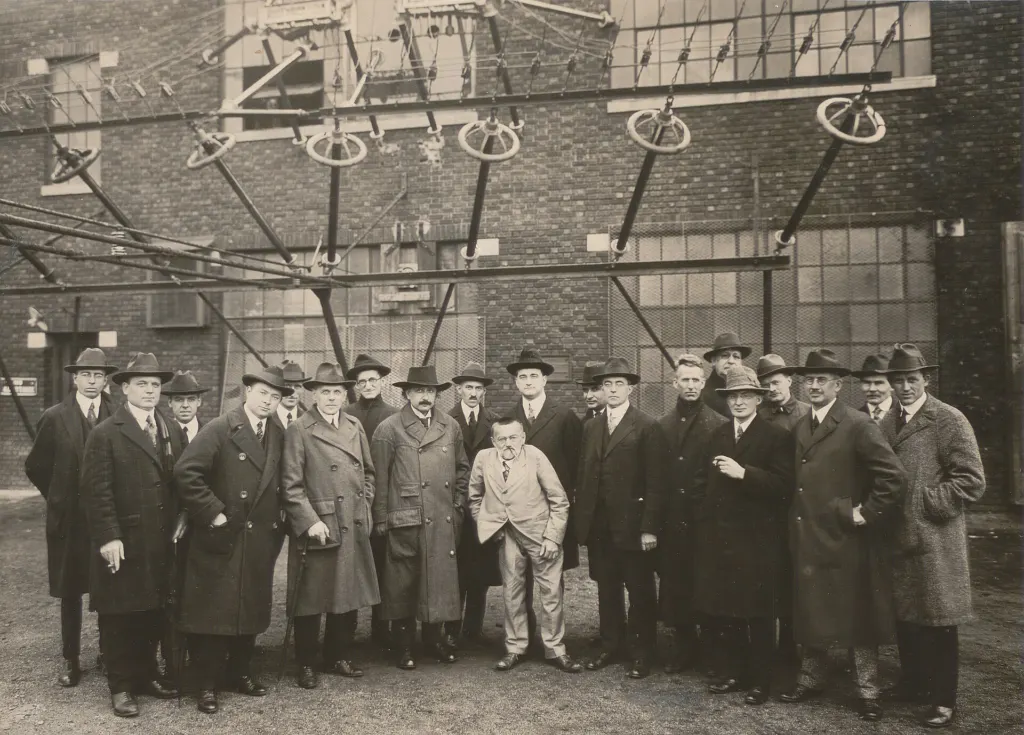
On November 25, 1915, Albert Einstein stood before the Prussian Academy of Sciences in Berlin and presented the equations that still define how gravity works. The paper, “Die Feldgleichungen der Gravitation” (The Field Equations of Gravitation), ran just four pages, 844 to 847 in the academy’s proceedings, according to the original German text preserved on Wikisource. It was printed and issued on December 2.
Einstein knew what he had. Near the end he wrote: “Damit ist endlich die allgemeine Relativitätstheorie als logisches Gebäude abgeschlossen.” In English: with this, the general theory of relativity is finally complete as a logical structure.
A fix made in a hurry
The November 25 equations were not Einstein’s first try that autumn. As the history of general relativity records, the version he published in October 1915 already explained an odd drift in Mercury’s orbit, which thrilled him, but it clashed with the conservation of energy and momentum unless the universe had the same density everywhere. Air, rock and empty space would all have had to weigh the same.
The new paper solved that by changing how the energy of matter enters the equations. Einstein noted that his vacuum equations, the ones behind his Mercury result, were untouched by the change. The core idea stayed the same: mass and energy curve spacetime, and that curvature is what we feel as gravity.
The 43-arcsecond problem
Mercury was the first proof. Astronomers had known since Urbain Le Verrier’s work in 1859 that the point where Mercury swings closest to our star creeps around faster than Newton’s physics allows. Today’s figures, listed in the record of tests of general relativity, put the relativistic share at 42.98 arcseconds per century, out of a total observed drift of about 574 arcseconds.
That sounds tiny, and it is. A full circle holds 1,296,000 arcseconds (360 degrees x 3,600). Dividing that by 42.98 shows the relativity effect alone would need about 30,150 centuries, roughly 3 million years, to turn Mercury’s orbit all the way around once. Einstein got the number right from his equations with no adjustable fudge.
Badiyaa recently told the story of how Le Verrier found Neptune with math in 1846; the same astronomer’s Mercury puzzle stayed open until Einstein closed it.
What the equations predicted next
The 1915 theory also fixed Einstein’s own earlier estimate of how much solar gravity bends starlight, doubling it to 1.75 arcseconds. Expeditions during the total solar eclipse of May 29, 1919, to Sobral in Brazil and Príncipe off West Africa backed the prediction and made him world famous.
Other predictions took far longer. Gravitational waves, ripples in spacetime itself, were first detected on September 14, 2015, by the twin LIGO detectors in Louisiana and Washington state. Caltech’s LIGO announcement said the signal came from two black holes, of about 29 and 36 solar masses, merging 1.3 billion years ago. “It would have been wonderful to watch Einstein’s face had we been able to tell him,” MIT physicist Rainer Weiss said in that release.
The same equations now sit underneath black hole images, cosmology and even satellite navigation; Badiyaa has covered newer tests such as a gravity model suggesting dark energy switched sign 9.5 billion years ago.
The limits
General relativity is not the last word. It does not fit with quantum mechanics, and physicists still lack an agreed theory of quantum gravity. The mathematician David Hilbert also derived the equations almost simultaneously in late 1915, and historians continue to study the timing of the two men’s work. November 25 marks 111 years since Einstein’s Berlin talk.
Sources
- Die Feldgleichungen der Gravitation (Albert Einstein), Prussian Academy of Sciences proceedings via Wikisource, 1915
- History of general relativity, Wikipedia, 2026
- Tests of general relativity, Wikipedia, 2026
- Gravitational waves detected 100 years after Einstein’s prediction, LIGO Laboratory, Caltech, 2016
Image: Radio Corporation of America (RCA), Public domain via Wikimedia Commons
This article was produced with AI assistance and reviewed by our Editorial Desk. How we work.