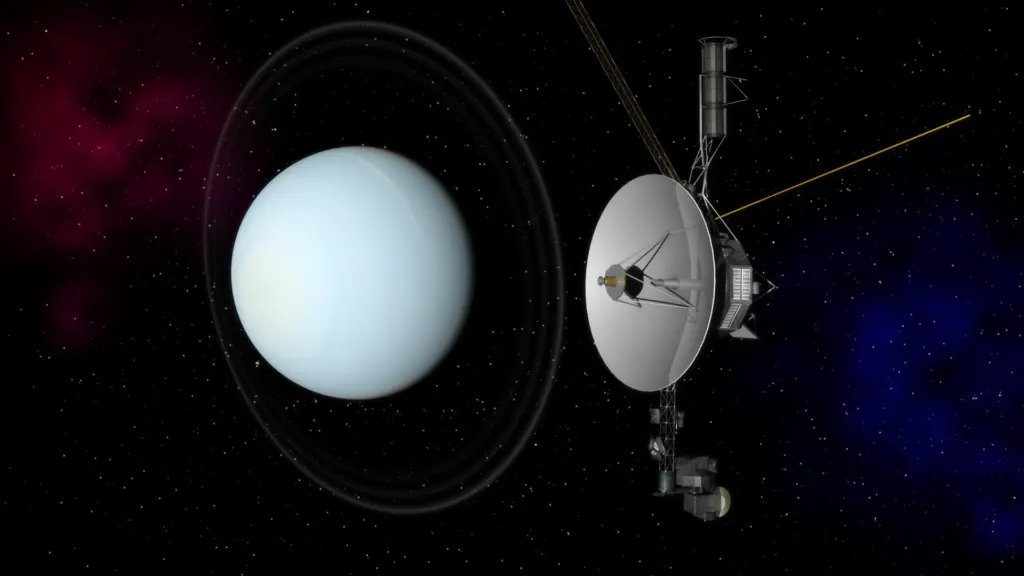
Europe’s Hera spacecraft is circling the asteroid that NASA hit on purpose, but it is not flying in circles. It drifts around the Didymos pair at a typical speed of just 12 centimeters per second, which ESA compares to a fast-crawling insect, and it turns its path by 90 degrees every few days so that it traces what the agency calls “rectangular orbits” in an ESA mission update.
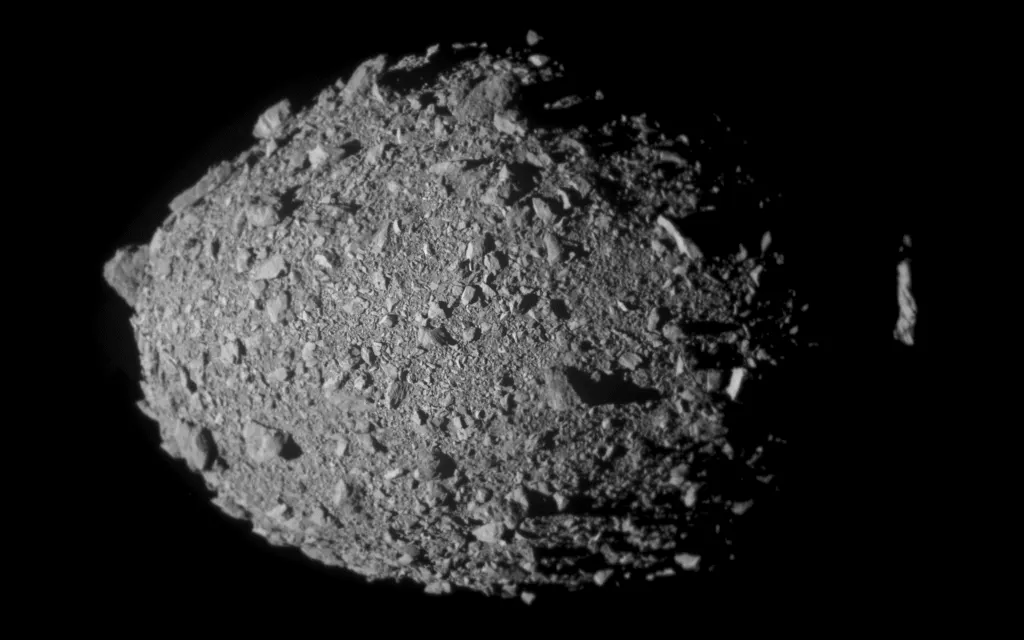
The odd shape is a direct answer to a gravity problem. The larger asteroid, Didymos, is about 780 meters wide and pulls roughly 40,000 times more weakly than Earth. Its moonlet, Dimorphos, is about 151 meters across and its gravity is around 200,000 times weaker than ours, according to ESA.
Why a normal orbit does not work
Around a planet, a spacecraft falls into a smooth ellipse because gravity keeps bending its path. Around a rock this small there is almost nothing to do the bending, so a circular orbit would be painfully slow and easy to lose. Instead, Hera coasts in nearly straight lines around the shared center of gravity of the two bodies, staying about 25 to 30 kilometers away.
On a repeating cycle of three days and then four days, controllers fire its thrusters as it moves away from the asteroids and swing its course through a right angle. Four turns close the box. ESA says the pattern is inherently safe: if a single burn fails, the probe simply drifts away from the asteroids instead of toward them, and each maneuver uses only a tiny amount of propellant.
The idea is borrowed. ESA’s comet chaser Rosetta flew two successive triangular paths around comet 67P in 2014, built from straight segments joined by thruster burns, before it settled into a true orbit.
What 12 centimeters per second means
The number is easier to grasp with some arithmetic. Twelve centimeters per second is 0.43 kilometers per hour, or about 0.27 miles per hour. At that pace Hera covers roughly 10.4 kilometers in a full day (0.12 meters x 86,400 seconds), less than the distance many people commute. A brisk human walk, around 5 kilometers per hour, is more than 11 times faster.
That slowness is the point. The probe must hover near two bodies whose combined pull could not hold it in a fast orbit, while its cameras build up maps of both surfaces.
What Hera has seen so far
The German Aerospace Center, which leads the science for Hera’s Asteroid Framing Camera, released the first close images of Didymos in a DLR announcement. They show large boulders, craters, groove-like structures and a surprisingly sharp ridge around the asteroid’s equator, taken from 60 and 56 kilometers. DLR says Didymos spins once every 2.2 hours, fast enough to be close to breaking apart, which may push loose material toward its equator.
All of this sits downstream of one experiment. On September 26, 2022, NASA’s DART mission struck Dimorphos to test whether a kinetic impact could shift an asteroid’s motion. ESA says the collision shortened the moonlet’s orbit by about 33 minutes. Badiyaa covered Hera’s arrival at the asteroid NASA hit in 2022 and the simulations suggesting DART reshaped Dimorphos instead of leaving a crater.
The limits
The current phase is about the big picture: shape, mass and gravity, not close-ups of the impact site. Hera talks to Earth for only about eight hours a day, across about 196.5 million kilometers, through ESA’s 35-meter deep space antennas in Argentina, Spain and Australia. Next month it is due to move closer and switch to bowtie-shaped arcs starting from around 20 kilometers. DLR says detailed images of Didymos and Dimorphos will be released on November 25, 2026.
Sources
- Hera spacecraft in ‘rectangular orbit’ around target asteroids, European Space Agency, 2026
- Hera spots its target (first Didymos images), German Aerospace Center (DLR), 2026
- Double Asteroid Redirection Test (DART), NASA Science, 2022
- Rosetta (spacecraft), Wikipedia, 2026
Image: NASA/Johns Hopkins APL, Public domain via Wikimedia Commons
This article was produced with AI assistance and reviewed by our Editorial Desk. How we work.