The magnetic fields of Uranus and Neptune may not look anything like they did when Voyager 2 measured them in the 1980s. New computer models from the University of Texas at Austin suggest the tilt of each planet’s field can swing by tens of degrees within a few decades, while Earth’s drifts by roughly one degree in 50 years.
The study, led by research associate Chi Yan of the university’s Jackson School of Geosciences, appeared in the journal Communications Physics, with collaborators at UCLA, Imperial College London and Northumbria University, according to the Jackson School’s announcement.
Two planets with crooked magnets
Earth behaves roughly like a bar magnet. Its magnetic axis leans just 11 degrees from the axis it spins on, which is why a compass points more or less north. The ice giants break that pattern badly. Uranus’s magnetic dipole is tilted 59 degrees from its spin axis, and Neptune’s is tilted 47 degrees.
Uranus is stranger still. Voyager 2 data show the center of the Uranian field sits shifted toward the planet’s south pole by up to a third of the planet’s radius. Surface field strength ranges from about 0.1 gauss in the southern hemisphere to 1.1 gauss in the north, an elevenfold difference across one world.
What the model changed
Planets make magnetic fields through a dynamo: electrically conducting fluid churns inside them and generates current. In Earth, that fluid is molten iron in the outer core. Uranus and Neptune, each about four times wider than Earth, are thought to hold mostly hydrogen, helium, water, ammonia, methane and rock.
Yan’s team assumed that the deep interior becomes a better electrical conductor the farther down you go, then ran simulations across a range of interior layouts. The crooked, many-lobed fields that Voyager 2 recorded emerged from those runs.
“Deep inside Uranus and Neptune, pressures and temperatures become extremely high,” Yan said. “Under these conditions, which can cause water molecules to break apart into ions, the material may become increasingly electrically conductive with depth.”
The same models show the fields do not sit still. “In some stretches the tilt swings by tens of degrees within decades. In others it shifts only slightly over the same span,” she said.
Why it matters
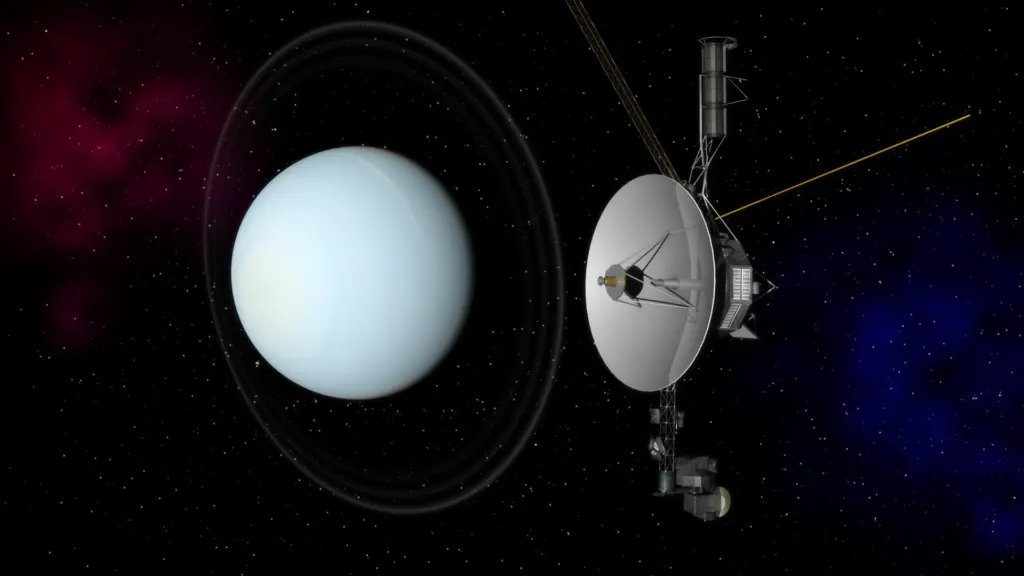
Voyager 2 is still the only spacecraft to visit either planet. It flew past Uranus on January 24, 1986, which means the one detailed map of that field is now 40 years old. If the model is right, the field Voyager mapped may have reshaped itself several times since. Badiyaa covered the other half of Uranus’s oddity earlier this month in a piece on why Uranus spins tipped on its side, and Voyager’s twin is now nearing one light-day from Earth.
Astronomers have another way to check. The James Webb Space Telescope has been imaging aurorae on both ice giants, glowing where charged particles streaming from our star strike the upper atmosphere, and those patterns depend on where the magnetic poles sit. “We are busy working on what’s contained within these observations,” said Tom Stallard of Northumbria University, who led the Webb campaign.
Limits
The work is a set of simulations, not a new measurement. The real chemistry deep inside Uranus and Neptune is unknown, and the models rest on an assumption about conductivity rising with depth. Each planet has been measured up close exactly once, so there is no second snapshot to test the predicted drift against. The researchers say only new missions to the ice giants can settle it, and none is currently scheduled to fly.
Further reading
Image: Kevin M. Gill, CC BY 2.0 via Wikimedia Commons
This article was produced with AI assistance and reviewed by our Editorial Desk. How we work.