A dead star more than 5,000 light-years from Earth flashes radio pulses every eight minutes, and for the first time astronomers have caught one of these slow cosmic beacons circling a star much like our own Sun. The system, catalogued as GPM J071507−114153, pairs a white dwarf with a G-type star, the same spectral class as our own star.
Every earlier white dwarf linked to this kind of signal had a smaller, cooler red dwarf as its partner. The new pairing was described in the journal Nature Astronomy by a Perth-based team from Curtin University’s branch of ICRAR, the International Centre for Radio Astronomy Research, according to the university’s announcement on 12 November.
A new member of a strange family
The object belongs to a class called long-period transients. Ordinary pulsars, the spinning remains of exploded stars, tick many times a second. Long-period transients switch on and off over minutes or even hours, a pace that standard theory struggles to explain. Roughly a dozen are known, and the first was found by the same Curtin group in 2021.
In several earlier systems, nobody could tell which of two stars sent the signal. Here the answer looks clearer. The radio pulses arrive regular enough that the team could watch the white dwarf move along its orbit, which places the source close to the white dwarf or on it.
“This is the first time the pulses are clear enough to see the white dwarf moving in its orbit around its companion, so we know that the pulsations are coming from a region close to the white dwarf, or possibly even from the white dwarf itself,” said lead author Sam McSweeney, who made the find while at ICRAR and now works as a commissioning scientist for the Square Kilometre Array Observatory.
How three telescopes pinned it down
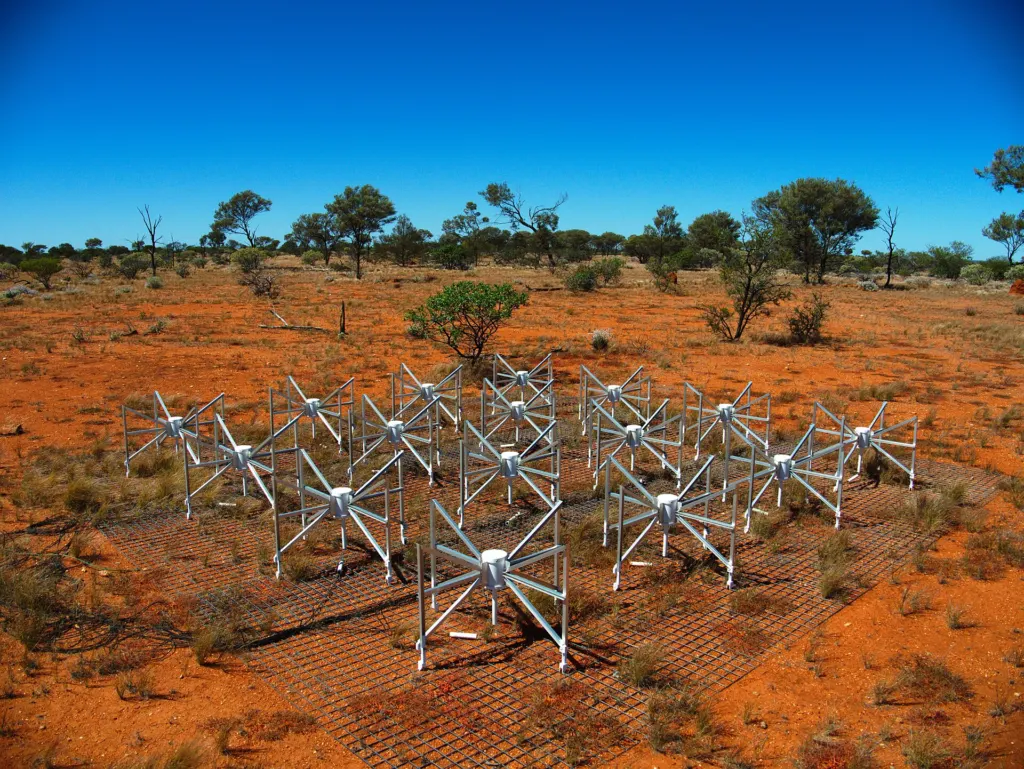
The hunt took three instruments on three continents. The Murchison Widefield Array (MWA) in Western Australia first flagged the source during a survey of the whole Milky Way visible from Australia. South Africa’s MeerKAT radio telescope then fixed its exact position, and optical observations from the W.M. Keck Observatory on Maunakea in Hawaii matched it to its Sun-like partner. To confirm the orbital motion, the team ran over 100 hours of radio recordings through the Pawsey Supercomputing Research Centre in Perth.
The white dwarf’s beam also works as a probe. As it sweeps through its partner’s surroundings, it picks up flares on the companion star, the same kind of activity that drives aurorae on Earth. Co-author Natasha Hurley-Walker said the team also watched the white dwarf pass behind a strongly magnetized region, most likely a stellar prominence, a huge loop of plasma rising from the star’s surface. “It’s amazing that by using radio wavelengths we can detect the storms on a star over 5000 light-years away,” she said.
Why it matters
Long-period transients have split astronomers between two suspects: highly magnetized neutron stars and white dwarfs. Curtin’s earlier find GPM J1839−10, which repeats roughly every 22 minutes, is still classed as a possible ultra-long-period magnetar. A clean white dwarf case with a known partner gives theorists a firm anchor.
Put the numbers side by side and the oddity is plain. An eight-minute period means the dead star turns about 180 times a day, while a pulsar turning once a second, a common pace, completes 86,400 rotations in the same span (60 seconds times 60 minutes times 24 hours). Badiyaa has covered other white dwarf oddities, including a white dwarf that may be the first green star, and how a network of 67 pulsars hints that giant black holes merge.
Limits
The finding pins the signal near the white dwarf but does not say how a slow-spinning dead star produces such strong pulses, and the team’s release offers no mechanism. One system is also a single data point in a family of about a dozen. McSweeney expects many more once the full Square Kilometre Array telescopes, SKA-Low in Australia and SKA-Mid in South Africa, come online. “If we are already making such discoveries with precursor telescopes, just imagine how many more star systems we will be able to find,” he said.
Further reading
Image: Natasha Hurley-Walker, CC BY-SA 3.0 via Wikimedia Commons
This article was produced with AI assistance and reviewed by our Editorial Desk. How we work.