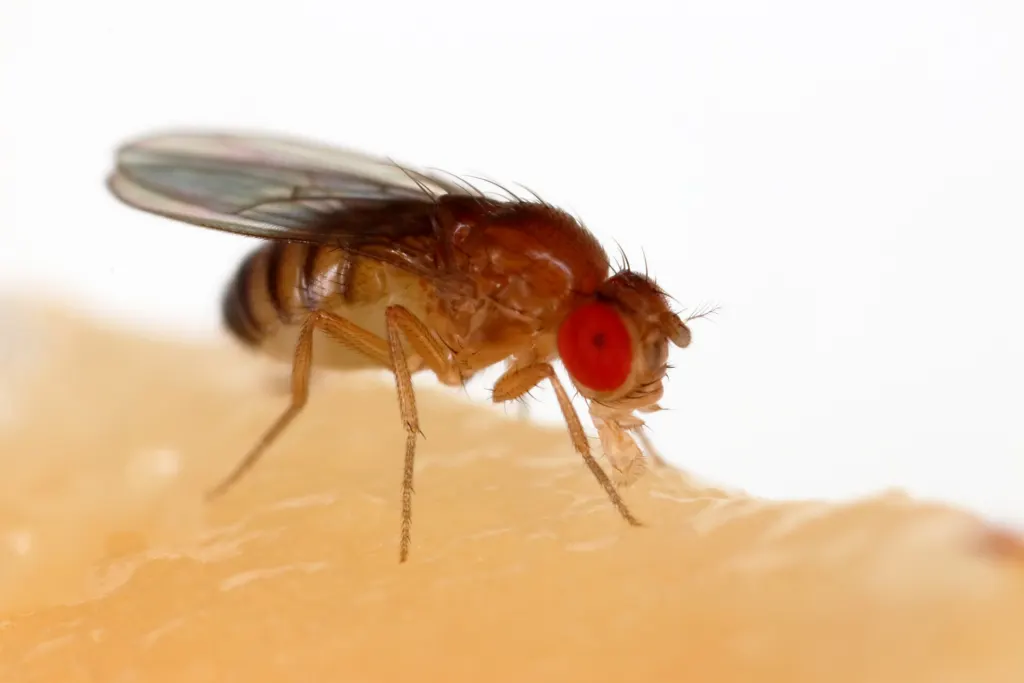
Short fragments of Nemuri, a protein that makes fruit flies sleep, stopped the growth of drug-resistant bacteria in laboratory dishes at concentrations of roughly 2 to 32 micromolar. Instead of punching holes in the bacteria, the fragments slipped inside and clumped up the cell’s protein-making machinery.
The work, led by Hirofumi Toda of the University of Tsukuba’s International Institute for Integrative Sleep Medicine and Nobuo Noda of Hokkaido University, was published on October 29 in Nature Communications under the title “Antimicrobial peptides derived from Nemuri induce ribosomal condensation to inhibit translation.” It is a cell-culture study; no animal or human was treated.
A sleep protein with a second job
The same group had earlier identified Nemuri (the name comes from the Japanese word for sleep) as a fly protein with a double role: it pushes the fly toward sleep and kills bacteria when the animal is under stress such as infection. What nobody knew was how it did the killing.
The team found that flies cut Nemuri at two points near its tail end, releasing short pieces rich in the amino acids arginine and glycine. They named three of them C62, C42 and C20, made synthetic versions, and tested them. All three blocked the growth of a standard lab bacterium at 5 to 7 micromolar.
Across a wider panel of microbes, including Staphylococcus aureus, Streptococcus pyogenes, several mycobacteria and the yeast Candida albicans, most were inhibited. The list of resistant strains is long: NDM-1-producing E. coli, multidrug-resistant Pseudomonas aeruginosa, KPC-2-producing Klebsiella pneumoniae, methicillin-resistant and vancomycin-intermediate Staphylococcus aureus, and vancomycin-resistant Enterococcus faecalis. C62 was generally the most potent of the three.
How the peptides jam the ribosomes
Most antibiotics that hit the ribosome act like a key in a lock, plugging one precise pocket. A mutation that changes the pocket can defeat them. The Nemuri peptides work more like sand in a gearbox. They bind loosely and at many points to RNA and ribosome surfaces, pulling ribosome-rich regions into dense clumps, or condensates. Trapped ribosomes move less, and protein production across the whole cell drops.
The researchers saw no substantial membrane damage at working doses, which separates these peptides from the many antimicrobial peptides that kill by bursting bacteria open. Swapping all 16 arginines in C42 for alanine left the peptide inactive, pointing to arginine as essential.
The fragments also showed low toxicity toward cultured fly and mammalian cells, a necessary first filter for any future drug candidate.
Limits
Everything here happened in dishes and test tubes. The University of Tsukuba describes the result as basic research and says the next steps are tests of effectiveness and safety in animal models of infection, along with stability, how the body handles the peptides, immune reactions and the risk that bacteria evolve resistance. None of that has been done, and this is not a treatment.
The value for now is a new target. The paper argues that the physical organization of a bacterium’s ribosomes, rather than a single binding site, is a weak spot that drug designers could aim at.
Growing bacteria in the lab still relies on agar, the jelly that Fanny Hesse suggested from her kitchen in 1881, and sleep research keeps turning up surprises across the animal world, from fruit flies to the frigatebirds that sleep 42 minutes a day on long ocean flights.
Further reading
Image: Sanjay Acharya, CC BY-SA 4.0 via Wikimedia Commons
This article was produced with AI assistance and reviewed by our Editorial Desk. How we work.